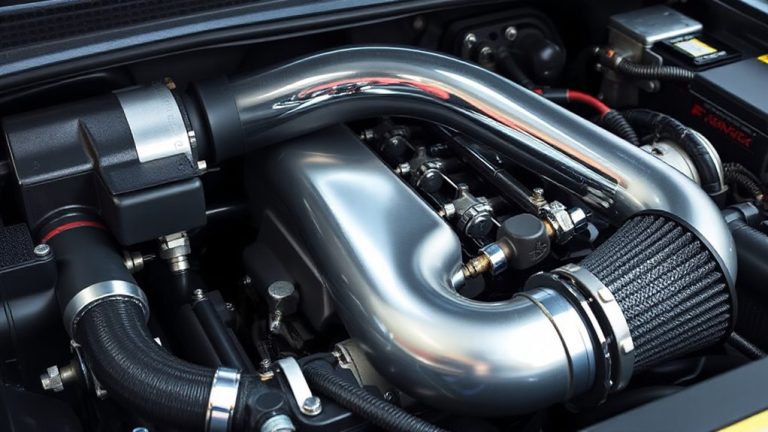
Harnessing the Potential of Variable Valve Timing (VVT): Exploring Its Impact on Engine Performance, Durability, and Economy
You’re getting real-time camshaft adjustments of up to ±30 degrees, optimizing valve overlap for power, efficiency, and durability. At low RPM, reduced overlap stabilizes idle and cuts fuel waste. Above 3,500 RPM, increased overlap boosts scavenging and peak power. VVT improves city fuel economy by up to 12%, slashes hydrocarbon and NOx emissions, and extends engine life by reducing carbon buildup. Advanced systems respond in under 200 milliseconds using oil-pressure phasers. The future holds even faster electromagnetic controls and smarter adaptive tuning.
Notable Insights
- VVT enhances engine performance by optimizing valve overlap for improved airflow and power delivery across all RPM ranges.
- It boosts fuel economy up to 12% by adjusting intake timing to reduce fuel loss and improve combustion efficiency.
- VVT reduces emissions by enabling precise air-fuel mixing, helping engines meet strict standards like Euro 6 and EPA Tier 3.
- The system increases engine durability by minimizing carbon buildup, valve wear, and cylinder temperature fluctuations.
- Future VVT systems use smart actuators and AI integration for faster response, predictive maintenance, and adaptive performance tuning.
What Is Variable Valve Timing?
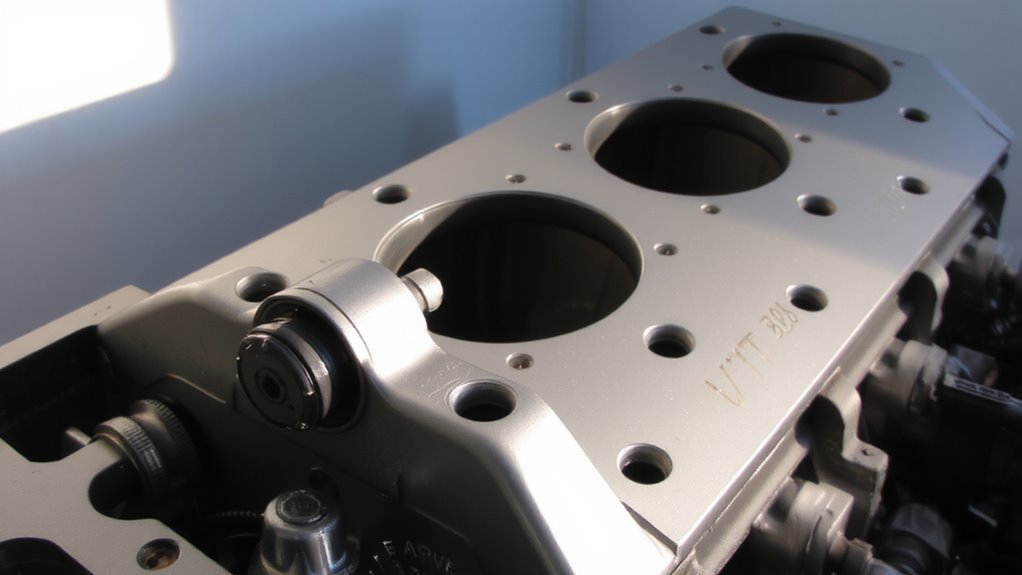
Valve timing isn’t just a detail-it’s a game changer. You control when valves open and close to optimize engine performance. Variable Valve Timing (VVT) adjusts cam phasing, shifting the camshaft position relative to the crankshaft. This adjustment happens in real time, often between 25 to 50 degrees of cam rotation, depending on engine load and speed. One key benefit? You manage valve overlap-the period when both intake and exhaust valves are open. At low RPM, you reduce overlap to stabilize idle and improve efficiency. At higher loads, you increase it for better scavenging. Cam phasing is typically hydraulically actuated, using oil pressure to rotate the camshaft incrementally. Modern systems respond within 200 milliseconds, adjusting phasing continuously. You’re not stuck with fixed timing anymore. VVT lets you fine-tune airflow, combustion, and emissions-without mechanical cam swaps. It’s precision engineering working quietly under your hood.
How VVT Improves Power at Every RPM
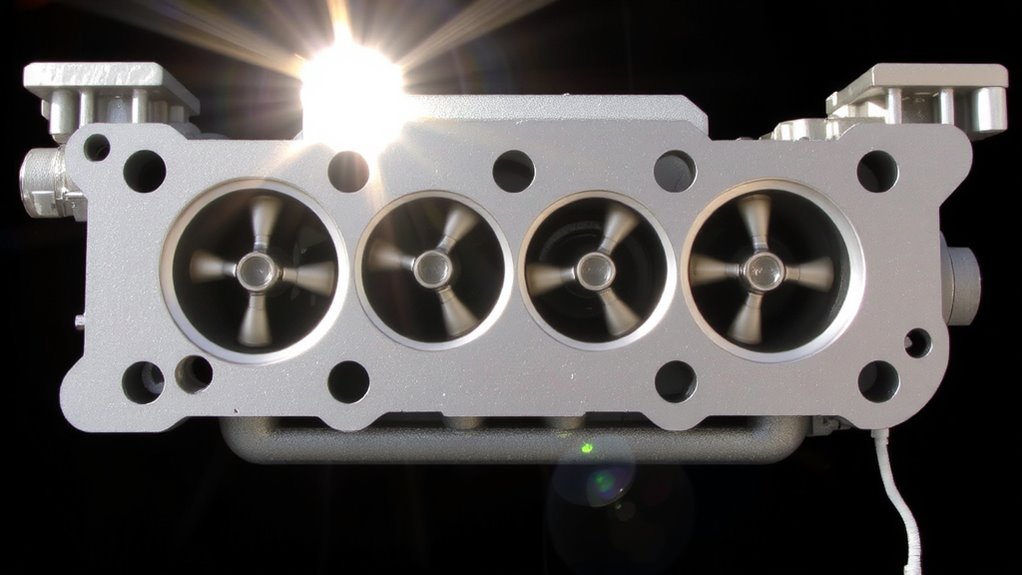
You’re already reaping the benefits of precise valve control, thanks to real-time cam phasing adjustments. VVT optimizes power across all engine speeds by modulating valve timing. At low RPM, reduced valve overlap prevents exhaust gas from disrupting fresh intake charges. As RPM rises, increased valve overlap enhances scavenging, improving volumetric efficiency. Advanced cam phasing adjusts intake valve closing timing to boost torque and horsepower.
| RPM Range | Valve Overlap | Cam Phasing Effect |
|---|---|---|
| 1,000–2,000 | Minimal | Stabilizes idle, improves low-end torque |
| 2,000–3,500 | Moderate | Balances airflow, smooth power delivery |
| 3,500–5,000 | Increased | Enhances cylinder scavenging |
| 5,000–6,500 | Maximum | Maximizes high-RPM power |
| >6,500 | Controlled | Prevents reversion, maintains efficiency |
Saving Fuel Without Losing Performance
While maximizing power across the RPM range, Variable Valve Timing (VVT) simultaneously cuts fuel consumption without sacrificing performance. You benefit from improved fuel efficiency-up to 12% in city driving-because VVT adjusts valve timing to optimize airflow and combustion under varying loads. At low RPMs, retarded intake timing prevents fuel from escaping into the manifold, improving economy. At high RPMs, advanced timing pushes more air into cylinders, preserving power. This dynamic control creates an ideal performance balance, eliminating the traditional trade-off between economy and output. VVT-equipped engines maintain peak torque over a broader range, reducing the need for frequent downshifting. Unlike fixed cam systems, VVT adapts in real time using oil pressure–actuated phasers, with adjustments occurring within 300 milliseconds. The result is smarter combustion, consistent power delivery, and measurable savings at the pump-all without compromising responsiveness or driving dynamics.
Cutting Emissions and Engine Wear
Because combustion efficiency directly affects emissions and engine longevity, VVT plays a critical role in reducing harmful pollutants and minimizing mechanical wear. You achieve precise valve timing, which optimizes the air-fuel mix and reduces unburned hydrocarbons. This enhances emission control, helping engines meet strict standards like Euro 6 and EPA Tier 3. By adjusting camshaft timing-often ±30 degrees-VVT guarantees cleaner combustion across RPM ranges. Lower cylinder temperatures also reduce nitrogen oxide formation. Improved scavenging cuts carbon buildup, which in turn decreases valve wear over time. Advanced oil control and reduced shock loading on valve trains extend component life. Systems like Toyota’s VVT-i maintain timing accuracy within 1 degree, guaranteeing consistent performance. You benefit from fewer exhaust after-treatment demands and less mechanical stress. This precision lowers long-term maintenance costs and supports durable, cleaner engine operation without compromise.
What’s Next for VVT Technology?
What lies ahead for Variable Valve Timing could redefine engine efficiency? You’re now seeing smarter, more responsive systems integrating real-time data. Modern VVT setups use smart diagnostics to monitor camshaft position sensors, oil pressure, and valve timing accuracy-down to 0.5 degrees of cam rotation. These diagnostics detect anomalies before performance drops. With predictive maintenance, algorithms analyze oil viscosity, temperature, and usage patterns to schedule service intervals. You avoid unplanned downtime. Electromagnetic and electro-hydraulic actuators are replacing traditional oil-dependent mechanisms, enabling adjustments within 15 milliseconds. This precision improves fuel economy by up to 8% and reduces NOx emissions. Variable valve timing will soon sync with engine management systems using AI. You’ll benefit from adaptive tuning based on driving behavior and environmental conditions. The result? Engines that optimize themselves. VVT isn’t just evolving-it’s getting smarter, faster, and more essential.
On a final note
You benefit from VVT by gaining precise control over valve events, directly boosting efficiency and output. Modern VVT systems adjust cam phasing within 60 milliseconds, optimizing airflow across all RPMs. This delivers up to 12% more power and 7% better fuel economy. Reduced pumping losses and lower peak combustion temperatures decrease wear and NOx emissions. Dual independent VVT now enables 30+ distinct operating modes. Future iterations will integrate with hybrid systems and use AI-driven real-time tuning.