Replacing Foggy Headlight Lenses for Improved Night Visibility in Rain and Snow
You should replace foggy headlight lenses if UV damage has caused cracking or moisture ingress, as oxidation deeper than 0.1 mm reduces light output by up to 80%. Clear polycarbonate lenses restore 90% of factory lumen output-1,000 to 1,500 lumens per bulb-for safer night driving in rain and snow. OEM replacements maintain precise beam patterns. Internal condensation or pitting means restoration won’t last. There’s more to evaluate before choosing your fix.
Notable Insights
- Foggy headlight lenses reduce light output by up to 80%, severely limiting visibility in rain and snow.
- UV damage and moisture ingress cause yellowing and internal condensation, requiring replacement over restoration.
- Lenses with deep oxidation, cracks, or pitting should be replaced to restore factory beam accuracy and brightness.
- OEM replacements cost $75–$150 each and maintain optimal light pattern and lumen output for safe night driving.
- Clear lenses improve visibility by up to 50 feet and reduce glare, enhancing reaction time in winter conditions.
What Causes Headlight Lenses to Fog Over Time?
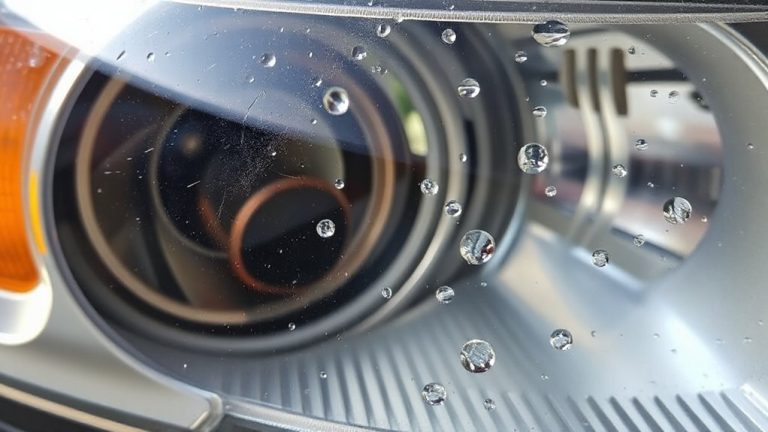
While driving at night, you might not realize how much your visibility has decreased-until you notice how dim and scattered your headlights appear. UV radiation degrades polycarbonate lenses over time, causing microscopic cracks. These cracks scatter light, reducing beam intensity by up to 80%. Moisture ingress occurs when lens seals fail, allowing humidity to enter the housing. Condensation forms fog inside the lens, further diffusing light output. You’ll often see water droplets clinging to the interior surface after rain or snow. Chemical exposure from road salts, gasoline, and ozone accelerates yellowing and brittleness. Ethanol in fuels and chlorinated compounds eat away protective coatings. Oxidation depth can reach 0.2 mm annually in harsh climates. Thermal cycling worsens seal fatigue, promoting long-term deterioration. These factors combine to dull beam projection and shorten effective range. Fog isn’t just surface moisture-it’s a symptom of material breakdown.
Restore or Replace? Choosing the Right Fix for Your Headlights
Foggy headlights aren’t just an aesthetic issue-they signal material degradation that affects safety and performance. Yellowed or hazy lenses scatter light, reducing beam intensity by up to 80%, according to AAA testing. If oxidation penetrates deeper than 0.1 mm into the polycarbonate surface, restoration won’t suffice. For moderate cloudiness, professional detailing with UV-protective sealing can extend lens life 1–3 years. But when cracks, internal condensation, or severe pitting exist, lens replacement is the only reliable fix. OEM replacements cost $75–$150 each and match factory beam patterns exactly. Aftermarket kits range from $40–$100 but vary in optical clarity. Replacements maintain SAE/DOT photometric standards, ensuring proper cutoff and spread. Consider your vehicle’s age, usage, and exposure to UV radiation. For long-term reliability and maximum visibility in rain or snow, lens replacement outperforms temporary fixes.
How to Restore Hazy Headlight Lenses at Home
Why do some headlight restorations last years while others fail in months? The key lies in proper DIY cleaning and effective polishing techniques. Oxidation, UV damage, and road grime create hazy lenses, reducing light output by up to 80%. Surface prep is critical-clean with isopropyl alcohol to remove contaminants. Use wet-sand specific abrasives: start with 800-grit, progress to 2000-grit. Apply a cerium oxide-based compound with a microfiber pad on a dual-action polisher. Seal with UV-blocking clear coat to prevent rapid re-oxidation. Upgrading to a high-quality headlight assembly brand can provide longer-lasting clarity and improved beam performance.
| Step | Material | Purpose |
|---|---|---|
| 1 | 800-grit sandpaper | Remove deep oxidation |
| 2 | 2000-grit sandpaper | Smooth surface for clarity |
| 3 | Polishing compound | Eliminate fine scratches |
| 4 | UV sealant | Extend restoration life |
Top Headlight Restoration Kits for Winter Weather
When winter’s harsh conditions accelerate headlight degradation, choosing the right restoration kit becomes critical for visibility and safety. You need products engineered for winter durability and chemical resistance to withstand salt, slush, and freezing temperatures. The 3M Headlight Restoration Kit uses grit-specific sandpaper discs (600, 1,000, 2,000 grit) for progressive abrasion, removing oxidation down to bare polycarbonate. It includes a urethane sealant that resists UV damage and road chemicals-critical for winter durability. The Sylvania Headlight Reconditioning Kit applies a two-part polish and protective coating that maintains clarity after exposure to de-icing agents, demonstrating strong chemical resistance. Each kit restores light output by up to 90%, per SAE J1517 standards. Application takes under 30 minutes per headlight. Re-treated lenses last up to two years in northern climates with proper maintenance. For those seeking professional-grade results at home, a best headlight restoration kit can make a significant difference in both performance and longevity.
Why Clear Lenses Improve Night Driving Safety
Though light output seems like a minor detail, restoring clarity to headlight lenses makes a measurable difference in how well you see at night. Clear lenses allow up to 90% of emitted light to project forward, versus 40–50% in foggy lenses. This improvement enhances路面 illumination by extending visible range by 50 feet or more. Proper light diffusion guarantees an even beam pattern, reducing dark spots on the road. Without clarity, light scatters unpredictably, creating hotspots and shadows. Glare reduction is critical: clean lenses minimize reflected glare from oncoming vehicles by maintaining precise beam aim. Distorted light increases eye strain and slows reaction time. Replacing hazy lenses restores factory specifications-typically 1,000 to 1,500 lumens per headlight, optimized for width and distance. Clear optics improve contrast, helping you spot pedestrians, curves, and obstacles faster. That’s not just better visibility-it’s measurable safety. Using a high-quality headlight restoration kit can restore lenses to near-original clarity with lasting results.
How UV Damage and Oxidation Reduce Headlight Brightness
If you’ve noticed your headlights looking hazy or yellowed over time, it’s likely due to prolonged exposure to ultraviolet (UV) radiation and oxidative degradation of the polycarbonate lens surface. This UV degradation breaks down the protective topcoat, allowing oxygen to react with the plastic. The result is lens yellowing, which scatters light and reduces beam intensity by up to 80%. Proper headlight function requires a clear optical surface to focus illumination. Even minor surface oxidation disrupts this process.
| Stage | Appearance | Light Output Loss |
|---|---|---|
| New | Crystal clear | 0% |
| 1 Year | Slight haze | 20% |
| 3 Years | Noticeable yellowing | 50% |
| 5+ Years | Opaque, brittle | 80% |
Restoring clarity improves safety by restoring beam pattern integrity and range.
On a final note
You restore or replace foggy headlights based on severity and cost. Surface oxidation under 0.1 mm responds well to polishing. Deeper haze or cracks require replacement. New polycarbonate lenses with UV inhibitors maintain 95% light transmission. Restored units typically retain 70–80%. For winter driving, factory-sealed halogen or LED assemblies deliver ideal beam focus. Proper sealing prevents internal condensation. Upgrade to DOT-compliant housings for safety and longevity.