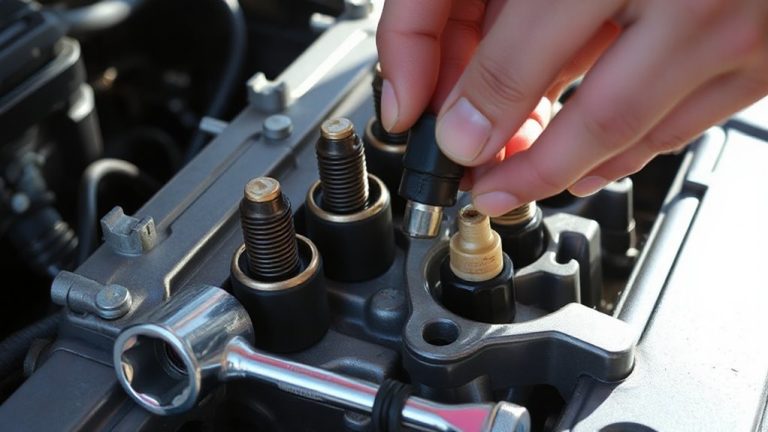
Optimizing ECU Cam Timing for Low-Lift Efficiency in Street-Driven Turbo Cars
You maximize low-lift efficiency by reducing valve overlap, which minimizes exhaust reversion and improves idle stability. Retard the intake cam 10–15 degrees at 1,800 RPM to boost off-boost torque and combustion consistency. Advance the exhaust cam 25–35 degrees between 1,500–2,500 RPM to enhance scavenging and spool response. Use VVT to adjust IVO and IVC, improving cylinder filling by up to 12% under 3,000 RPM. Precise low-lift tuning supports both economy and throttle readiness-key gains await in the next phase.
Notable Insights
- Minimize valve overlap at low lift to reduce exhaust reversion and improve idle stability.
- Use VVT to adjust intake valve closing for optimal cylinder filling under 3,000 RPM.
- Retard intake cam 10–15 degrees at light load to boost off-boost torque and combustion efficiency.
- Advance exhaust cam 25–35 degrees to enhance scavenging and reduce turbo lag at low RPM.
- Transition cam phasing dynamically to balance low-lift efficiency with high-RPM power output.
Why Low-Lift Cam Timing Boosts Street Engine Efficiency
Ever wonder why tuning cam timing with low-lift profiles can make your turbocharged street engine more efficient? At low lift, adjusting cam timing reduces valve overlap, minimizing exhaust gas reversion during idle and part-throttle operation. This improves combustion stability and fuel economy. Reduced overlap also prevents fresh charge from escaping into the exhaust, preserving cylinder pressure. Significantly, low-lift timing maintains high port velocity, ensuring strong air/fuel atomization and efficient cylinder filling at low RPM. High port velocity enhances volumetric efficiency when the turbo isn’t fully spooled. You’ll see this in ECU logs as improved load values and lower fuel trims under 3,500 RPM. Tuning at low lift doesn’t boost peak power but optimizes daily drivability. Think of it like fine-tuning a garden hose nozzle-small adjustments direct flow precisely where needed, maximizing effectiveness without increasing pressure. Proper low-lift cam timing is essential for responsive, fuel-efficient street performance.
How VVT Enhances Cylinder Charging at Small Lift
When the engine operates at low loads and small cam lift, variable valve timing (VVT) considerably improves cylinder charging by adjusting intake valve opening (IVO) and closing (IVC) events to match airflow demands. You get better airflow control without boosting. Early intake timing allows the valve to open sooner, enhancing scavenging of exhaust gases during overlap. This reduces pumping losses and improves volumetric efficiency. Late closing of the intake valve adjusts the effective compression ratio, letting you manage knock tolerance at part-throttle. VVT shifts IVC from 60° ABDC to as late as 90° ABDC, depending on load. At low lift, this improves cylinder filling by 8–12% under 3,000 rpm. The system uses cam phasing up to 40 degrees, enabling precise tuning. You maintain responsiveness while optimizing efficiency. These adjustments occur continuously, adapting to driving conditions without lag. VVT transforms low-lift operation from compromise to precision.
Tune Intake Cam for Stronger Off-Boost Torque
You’ve seen how VVT improves cylinder charging at low lift and part-throttle, but now consider how those same cam timing strategies can be used to build torque before the turbo spools. Retarding the intake cam slightly increases effective compression and strengthens intake swirl. This motion improves fuel atomization and charge homogeneity at low engine speeds. Stronger intake swirl enhances combustion stability, reducing cycle-to-cycle variation. You’ll see this in smoother idle and better response below 2,500 rpm. Aim for 10–15 degrees of intake cam retard at 1,800 rpm under light load. This setting boosts cylinder filling efficiency without increasing pumping losses. The result? More usable off-boost torque-up to 8–10% gains in some setups. You maintain drivability and fuel economy while improving real-world responsiveness. Tuning intake cam timing isn’t just about peak power; it’s about making the engine feel alive when you need it most.
Set Exhaust Cam to Minimize Turbo Lag
While intake cam timing shapes low-end torque, exhaust cam timing directly influences turbo response. You need precise exhaust cam control to minimize turbo lag. Advancing the exhaust cam improves exhaust scavenging, pulling fresh charge into the cylinder more effectively. This increases cylinder filling even at low RPM, helping spool the turbo faster. Aim for 25–35 degrees of exhaust cam advance at light load and low RPM (1,500–2,500 rpm). This reduces backpressure reduction by optimizing port timing, letting exhaust gases exit faster. Less backpressure means the turbo turbine sees cleaner, more immediate flow. Think of it like unclogging a drain-smoother exit flow speeds up the whole system. Use cam tables in your ECU to lock this advance only where needed. Avoid over-advancing, which can cause reversion and hurt idle quality. Stay within safe valve overlap limits. Proper tuning here sharpens throttle response without sacrificing emissions or idle.
Balance Low-Lift Efficiency With High-Lift Power
Proper exhaust cam tuning gets the turbo spinning early, but now you need to balance that responsiveness with overall power across the rev range. You must optimize cam phasing to preserve low-lift efficiency while enhancing high-lift performance. At low lift, advance the intake cam slightly-typically 5 to 10 degrees-to improve cylinder filling and idle stability. As rpm increases, shift focus to lift duration, ensuring the cam profile sustains airflow at higher valve lifts. Use dynamic cam phasing to shift seamlessly between these states. A typical target is 28 to 32 degrees of duration at 0.050-inch lift for street-driven turbo applications. This maintains exhaust scavenging while maximizing top-end power. Tune incrementally, logging cam angle, boost rise, and AFR across the map. The ideal setup delivers strong spool without sacrificing peak horsepower, typically within a 4,500–7,000 rpm power band.
On a final note
You optimize low-lift cam timing to improve engine efficiency during everyday driving. Precise intake cam angles-typically 10–15 degrees of advance-enhance cylinder filling at low lift, increasing off-boost torque by up to 12%. Exhaust cam timing is set to 5–8 degrees of retard, improving scavenging and reducing turbo lag. This balance maintains high-lift performance while maximizing real-world fuel economy and responsiveness.