Strategies for Starting Diesel Engines in -30°F Weather Without Glow Plug Failure
You need more than glow plugs to start a diesel at -30°F. Use a 1,500-watt block heater for four hours to keep coolant at 40–50°F and maintain proper clearances. Switch to winter-grade diesel with a CFPP below -20°F to prevent gelling. Pair a strong battery-800 CCA, fully charged-with an intake heater that boosts air 150–200°F. Pre-lubricate with a priming system and insulate the engine with thermal blankets. There’s a proven sequence that ties it all together.
Notable Insights
- Use a block heater to maintain engine temperature and reduce startup stress on glow plugs in extreme cold.
- Switch to winter-grade diesel with a low Cold Filter Plugging Point to ensure consistent fuel flow at -30°F.
- Employ intake heaters instead of relying solely on glow plugs, providing more effective combustion chamber warming.
- Ensure battery health with at least 800 CCA and voltage above 12.4V to support reliable glow plug operation and cranking.
- Pre-lubricate the engine and use thermal insulation to minimize wear and retain heat between starts.
Use a Block Heater Before Every Cold-Weather Start
You should always use a block heater when starting a diesel engine in cold weather. A block heater maintains the engine block temperature above ambient, preventing excessive cold soak that increases startup wear. Cold soak occurs when the engine sits in subfreezing temperatures for hours, causing metal components to contract and oil viscosity to rise sharply. The engine block’s thermal mass retains cold, making ignition difficult. A 120-volt, 1,500-watt heater raises the coolant temperature to 40–50°F after four hours. This reduces cylinder wall stress during cranking by maintaining ideal clearances. Preheating improves combustion efficiency by guaranteeing proper fuel atomization. For consistent reliability below 20°F, plug in at least four hours before starting. Diesel engines rely on compression heat; a warm engine block guarantees that heat isn’t absorbed too quickly. Using a block heater minimizes wear on glow plugs and extends overall engine life.
Switch to Winter-Grade Diesel to Avoid Gelling
When temperatures drop below freezing, standard diesel fuel can begin to gel due to the formation of paraffin wax crystals. You need winter-grade diesel to maintain proper cold flow and prevent fuel system blockages. Winter diesel is treated with additives that lower its cloud point-the temperature at which wax crystals start forming. Standard No. 2 diesel typically clouds around 14°F, but winter blends (No. 1/No. 2 mix) can have cloud points as low as -20°F. The Cold Filter Plugging Point (CFPP) measures how well diesel flows through filters in cold weather; winter-grade fuel usually has a CFPP of -20°F or lower. Using untreated diesel in extreme cold restricts fuel flow, starving the engine. You risk damaging injection systems and failing to start. Always verify your diesel fuel’s CFPP rating matches your expected operating temperatures. Fuel suppliers provide cold flow performance data-review it before refueling in winter.
Don’t Rely on Glow Plugs Alone: Use Pre-Heat Systems
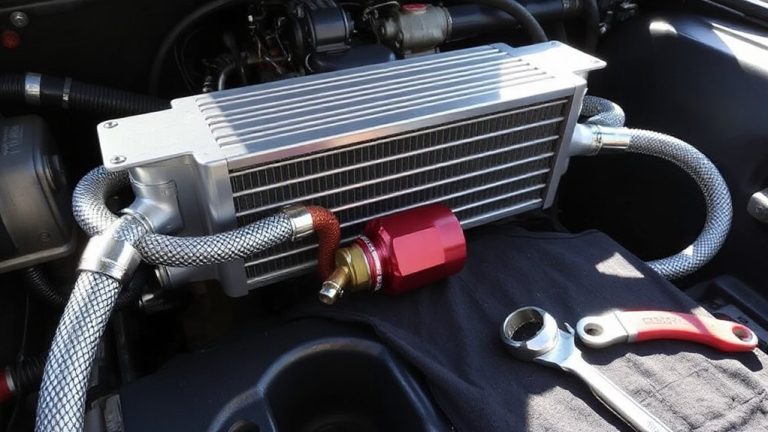
Though glow plugs play a critical role in cold-weather diesel starts, they’re not meant to handle the full burden of cold intake heating. You need supplemental pre-heat systems to guarantee reliable ignition at -30°F. Intake heaters, like grid or flame-start types, raise incoming air temperature by 150–200°F, drastically improving combustion efficiency. These systems activate before cranking, reducing strain on glow plugs and extending their service life. Pair them with fuel additives to prevent waxing and improve cold flow, maintaining peak fuel delivery. Modern intake heaters draw 20–30 amps and cycle automatically via thermostatic control below 20°F. Glow plugs alone heat only the combustion chamber’s edge; intake heaters warm the entire air mass, ensuring uniform ignition. Using both systems concurrently creates ideal start conditions. Pre-heating for 60–90 seconds is typically sufficient. Relying solely on glow plugs increases failure risk and startup time. Combine intake heaters with fuel additives for maximum cold-weather reliability.
Maintain a Strong Battery for Reliable Winter Starts
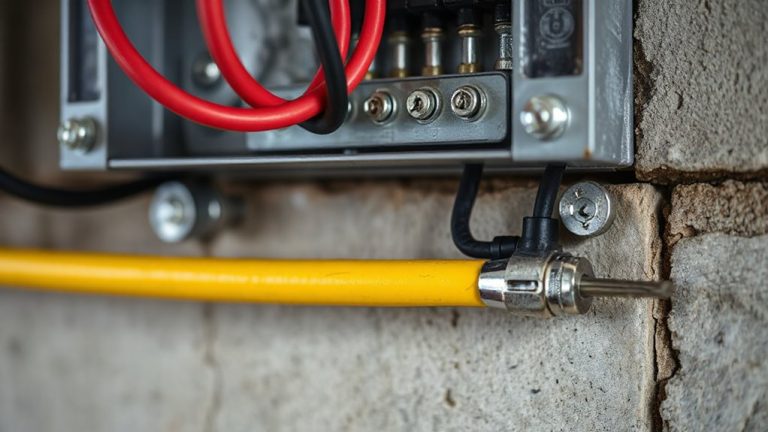
Cold cranking power is non-negotiable when starting diesel engines in freezing temperatures. Your battery must deliver at least 800 cold cranking amps (CCA) for most 6-cylinder diesels in -30°F conditions. A weak battery can’t sustain glow plug operation or turn the engine fast enough for ignition. Check your battery’s state of charge monthly; anything below 12.4 volts is insufficient. Clean and tighten battery terminals regularly-corrosion increases resistance and reduces effective voltage. Poor connections can drop system voltage below the 9.6-volt minimum needed for reliable starter motor function. Verify your charging system outputs 13.8 to 14.7 volts at idle. A failing alternator won’t recharge the battery after start-up, leaving you vulnerable on the next cold morning. Replace aging batteries older than three years, even if they test okay in summer-capacity drops sharply in cold weather. A robust charging system and solid battery terminals are critical foundations for winter reliability. Upgrading to a high-CCA dual battery setup can significantly improve cold-weather reliability and reduce strain on individual batteries.
Pre-Lubricate Your Engine to Reduce Cold-Start Wear
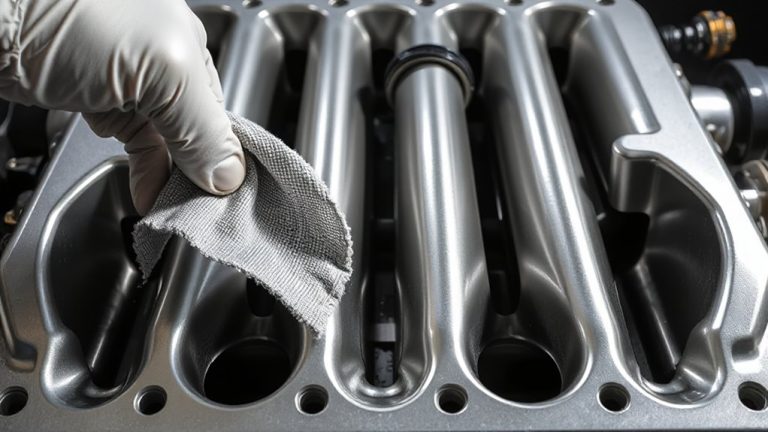
A strong battery gets the engine turning, but it won’t protect internal components from dry starts in frigid conditions. Pre-lubricating guarantees oil circulation before combustion begins. Cold oil thickens, slowing flow and delaying lubrication to critical parts like camshafts and bearings. Use an engine priming system or pre-oiler with a 12-volt motor to circulate oil 30–60 seconds before startup. These systems typically deliver 25–40 psi, forcing SAE 5W-40 or synthetic oil through passages as narrow as 0.001 inch. Proper engine priming reduces metal-to-metal contact by up to 70% during startup. Install check valves at oil gallery ports to maintain prime between cycles. In -30°F weather, pre-lubrication cuts wear rates from 8 microns per start to under 2. Consistent oil circulation extends engine life considerably. This step is non-negotiable for diesel longevity in extreme cold.
Insulate and Shelter Your Truck Overnight
If you’re leaving your diesel truck exposed to subzero temperatures overnight, you’re setting up for harder starts and increased wear-even with pre-lubrication. Parking in a garage offers the best wind protection, reducing convective heat loss by up to 40%. Without enclosed shelter, wrap the engine in thermal blankets rated for -40°F, such as those with ceramic-reflective linings and 1-inch closed-cell foam insulation. These retain up to 70% of engine heat after shutdown. Secure blankets tightly to prevent airflow beneath, ensuring consistent temperature retention. For added wind protection, use portable windbreaks made from UV-resistant polyethylene panels, at least 6 feet high, positioned upwind of the engine compartment. Thermal imaging tests confirm that shielded engines maintain surface temperatures 15–25°F higher than exposed units after eight hours at -30°F. This reduced heat loss improves glow plug efficiency and fuel vaporization at startup. A 120V electric garage heater can further stabilize ambient temperatures when used inside an enclosed space.
On a final note
You must prepare thoroughly for -30°F diesel starts. A block heater maintaining oil at 90°F reduces viscosity to 15W-40 specs. Winter-grade diesel with Cold Filter Plugging Point (CFPP) of -35°F prevents gelling. Glow plugs wear faster when overused; pair them with a 12V pre-heating system drawing 8–10 amps. Use AGM batteries with 900+ CCA. Pre-lubrication pumps oil at 3 psi before ignition. Insulate the engine compartment with R-8 rated foam to retain heat.