How to Remove Iron Contamination From Paint Without Clay Bar Use
You can safely remove iron contamination from your car’s paint without a clay bar by using an acidic iron remover. Spray it directly onto cool, dry panels out of sunlight. The active chelating agents, like sulfonic acid derivatives, dissolve ferrous particles on contact. Watch for a purple or red color change-this confirms iron extraction. Rinse thoroughly within 5 minutes using low-pressure water. For best results, follow with a neutral pH wash and paint protection. Learn how to choose the right product and prevent recontamination effectively.
Notable Insights
- Use an iron remover spray containing sulfonic or phosphoric acid derivatives to dissolve ferrous contaminants chemically.
- Apply the product on cool, damp paint in the shade to prevent rapid drying and ensure effective reaction time.
- Watch for a color change to purple or red, indicating the remover is extracting iron particles from the surface.
- Rinse the treated area thoroughly with low-pressure water to remove dissolved contaminants and prevent residue.
- Follow with a pH-neutral wash and protective coating to safeguard against future iron contamination and fallout buildup.
What Is Iron Contamination on Car Paint?
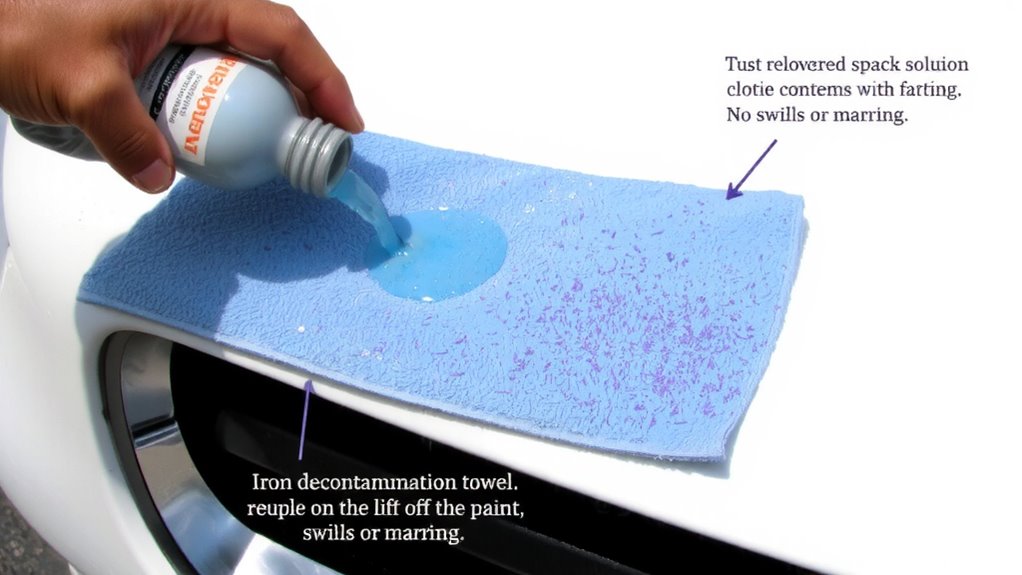
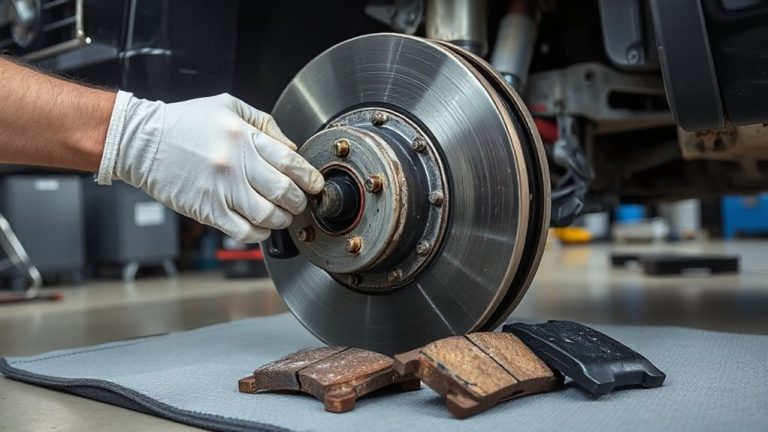
Why does your car’s paint sometimes feel rough even after washing? The culprit is often iron contamination. Microscopic magnetic particles, like brake dust and industrial fallout, bond to your car’s surface. These particles are ferrous dust-iron-based debris attracted to metal components and paint. They embed during braking, road wear, or near industrial zones. Ferrous dust reacts with moisture and oxygen, creating iron oxide, which eats into clear coats over time. Though invisible at first, these contaminants create a gritty texture. Testing with a microfiber cloth reveals dark specks. A magnet will attract them, confirming their ferrous nature. Contamination levels vary by region, traffic, and exposure. Urban drivers see heavier buildup. Unlike dirt, ferrous dust resists soap and water. It requires chemical or physical removal. Ignoring it risks long-term adhesion and oxidation. Using a dedicated iron remover can dissolve these contaminants safely without requiring a clay bar.
Why Iron Contamination Damages Your Paint
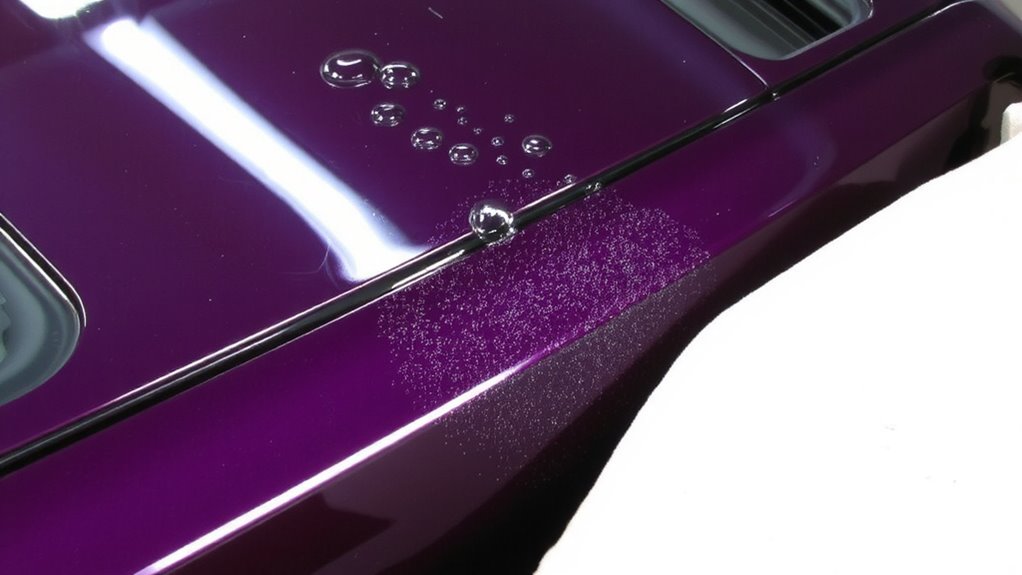
Even a thin layer of iron contamination can compromise your paint’s integrity over time. Iron particles from brake dust, industrial fallout, or rail dust embed into your clear coat. When exposed to moisture and oxygen, they undergo rust oxidation, expanding up to seven times their original size. This expansion creates internal stress on the surrounding clear coat, leading to paint etching. The etching appears as tiny, web-like fissures or halo spots around embedded particles. Once initiated, this damage is irreversible without correction. Rust oxidation also attracts hygroscopic moisture, accelerating breakdown beneath the surface. UV exposure worsens the degradation, weakening resin bonds in the clear coat. Over months, the microscopic damage spreads, creating entry points for contaminants and promoting further oxidation. Left untreated, iron contamination compromises your paint’s gloss, depth, and protective function-diminishing both appearance and resale value.
How Iron Removers Work Without Clay
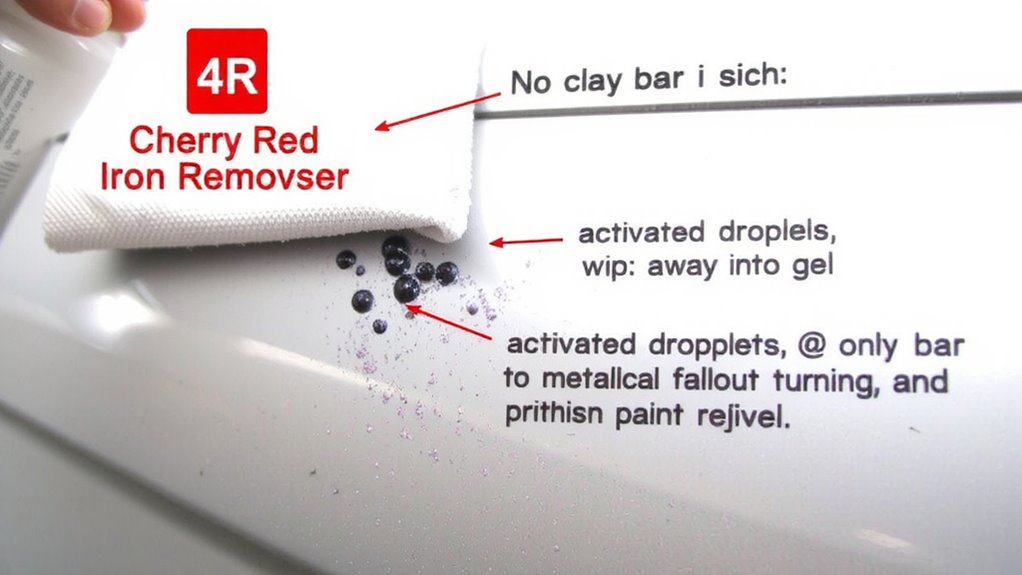
While traditional decontamination methods rely on physical abrasion, iron removers offer a chemical solution that targets embedded ferrous particles without requiring clay. You apply the product to cool, dry paintwork, where it begins immediate surface penetration. Active ingredients, typically sulfonic or phosphoric acid derivatives, initiate a chemical reaction with oxidized iron, transforming it into a water-soluble compound. This reaction changes the iron’s molecular structure, breaking its bond with the paint. The remover’s pH, usually between 2.5 and 4.0, guarantees effective decontamination without harming clear coat. Chelating agents bind to dissolved metals, preventing redeposition. You’ll see the liquid turn purple or red-evidence of iron extraction. Unlike clay, which only removes surface-level debris, iron removers penetrate deeper layers of contamination. This method removes up to 98% of ferrous particles, depending on dwell time and contamination level. No rubbing or marring occurs.
Applying Iron Remover Safely: A Step-by-Step Guide
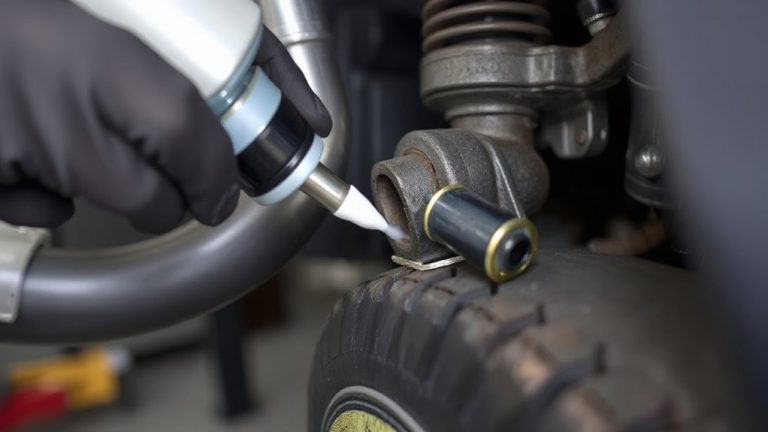
Start by making certain the vehicle’s paint is cool to the touch and out of direct sunlight, as high surface temperatures can cause the iron remover to evaporate prematurely and leave residues. Apply the remover with a fine mist sprayer, saturating one panel at a time. You’ll see a purple or red reaction-this color change is due to iron chemistry, where the active chelating agents bind to ferrous particles. Let the product dwell for 2–5 minutes, but never exceed 7 minutes to avoid surface etching. Always follow exact manufacturer dwell times. Wear nitrile gloves and eye protection-key safety precautions when handling chemical agents. Rinse thoroughly with low-pressure water, using a 15–20 degree nozzle tip to prevent splash-back. Repeat if needed, but avoid over-application. Proper application makes certain contaminant removal without harming clear coat layers.
Best Iron Fallout Removers (No Clay Needed)
What if you could eliminate iron contamination without the hassle of claying? You can-using modern iron remover types designed for direct application. These formulas, often pH-neutral and water-soluble, contain active chelating agents like thioglycolic acid that bind to ferrous particles. When applied, they turn purple upon reacting with iron, offering visual confirmation. Spray evenly on cool, clean paint and let dwell for 2–5 minutes. Over-saturation risks runoff, so follow recommended dilution ratios. Most liquid removers require no agitation. Application frequency depends on driving conditions but typically ranges from every 4–8 weeks. Frequent exposure to brakes or railways calls for monthly use. Choose non-acidic variants to avoid paint damage. Leading brands like CarPro IronX, Gtechniq IR03, and Poorboy’s World Iron Remover deliver consistent results. These solutions dissolve embedded particles without physical contact, making them ideal for sensitive finishes.
After Iron Removal: Next Steps for Shine
Once you’ve removed iron contamination, it’s time to restore and protect your paint’s finish. Begin with paint correction to address swirls, scratches, and oxidation. Use a dual-action polisher with a foam cutting pad and progressive compound (e.g., 2,000–3,000 RPM) to safely level defects without harming clear coat. Maintain consistent pressure and overlap passes for uniform results. After correction, wipe the surface with an isopropyl alcohol solution (50/50 with distilled water) to remove residue. Follow with a high-quality wax application. Opt for synthetic carnauba wax offering 6–12 months of protection and a 9H hardness rating. Apply in thin layers using a microfiber applicator, allowing 5–10 minutes of dwell time before buffing. This creates a durable, hydrophobic barrier that enhances gloss and shields against environmental fallout and UV damage. For heavy-duty performance vehicles like the F150, choosing the right engine can significantly impact towing efficiency and overall durability, making the best F150 engine for towing a critical consideration for maintaining vehicle longevity under stress.
How to Prevent Iron Contamination Long-Term
Your car’s finish faces constant exposure to airborne iron particles from brake dust, industrial fallout, and road debris, making long-term prevention essential for maintaining paint integrity. Regular washing every 1–2 weeks removes surface contaminants before they bond to the paint. Use a pH-neutral car shampoo and two-bucket method to minimize swirl marks. After washing, apply a wax coating with iron particle inhibitors-opt for synthetic polymer-based sealants with a minimum thickness of 0.5 microns for durable protection. These coatings create a sacrificial barrier that repels metallic particles. Reapply every 3–6 months, depending on environmental exposure. Parking indoors or under cover reduces particle accumulation by up to 70%. Avoid prolonged exposure to rail dust near train tracks or heavy traffic zones. A best car ceramic coatings product can offer superior, long-lasting defense against iron contamination due to its enhanced durability and resistance properties. With consistent maintenance, your paint resists contamination longer, preserving gloss and clarity. Prevention is more effective than correction.
On a final note
You’ve effectively removed iron contamination without a clay bar. Acid-free iron removers neutralize ferrous particles on contact, changing color to indicate reaction. They dissolve embedded metal without harming clear coat. Always apply to cool, clean paint in the shade. Follow with a pH-balanced wash to remove residue. For best results, seal protection with a ceramic coating or wax. This process preserves finish integrity and maintains optical clarity of the paint surface over time.