Employing Active Dampers With Coilover Bodies for Real-Time Road Contour Adaptation
You upgrade your coilovers with active dampers to adapt instantly to road contours. Sensors detect wheel speed, body motion, and steering input up to 1,000 times per second. The ECU processes data in under 2 ms, adjusting damping force through hydraulic valves in less than 10 ms. Magnetorheological fluid enables precise compression and rebound control across 20+ levels. Forged aluminum housings cut unsprung mass by 30%. Systems respond faster than 15 ms, maintaining tire contact and reducing body roll-performance you’ll want to explore further.
Notable Insights
- Active dampers in coilover bodies adapt in real time using sensors that detect road changes within milliseconds.
- Real-time adaptation relies on accelerometers and position sensors feeding data at 1,000 Hz to the ECU.
- Electronically controlled hydraulic valves adjust damping force in under 10 ms for precise road contour response.
- Magnetorheological fluid enables instant stiffness changes, maintaining tire contact on uneven surfaces.
- Proper calibration ensures optimal damping balance, with track setups favoring stiffer front pitch control.
How Active Dampers Make Coilovers Smarter
While traditional coilovers rely on fixed damping settings, active dampers transform them into adaptive suspension systems that respond in real time to road conditions. You get real time feedback from sensors monitoring wheel speed, body acceleration, and steering input. This data feeds into a central control unit that processes changes 1,000 times per second. The system adjusts damping force within milliseconds, delivering a precise dynamic response to varying surfaces. Unlike passive coilovers with static valving, these dampers use electronically controlled valves to modulate oil flow. Response times are under 15 milliseconds, with damping force adjustable across 20+ levels depending on the model. The result? A smoother ride and sharper handling without mechanical trade-offs. You maintain ideal tire contact and vehicle stability whether cornering aggressively or driving over potholes. Active dampers make your coilovers smart-continuously adapting with minimal lag.
What’s Inside an Active Damper System
Since you’re looking to understand how active dampers achieve real-time control, it helps to start with the core components inside the system. Electronic sensors constantly monitor suspension movement, speed, and road forces. These inputs feed into an ECU that adjusts hydraulic valves within milliseconds. The valves regulate oil flow between chambers, altering damping force to match conditions. Every part works in sync to maintain ideal ride and control.
| Component | Function | Response Time |
|---|---|---|
| Accelerometers | Measure wheel acceleration | <5 ms |
| Position Sensors | Track damper shaft displacement | <3 ms |
| ECU | Processes data, sends valve commands | <2 ms |
| Hydraulic Valves | Adjust fluid resistance in real time | <10 ms |
| Solenoids | Actuate valve openings precisely | <1 ms |
Why Adaptive Damping Excels on Road and Track
When you hit a pothole at highway speed, the system reacts before your body even senses the bump. Adaptive damping continuously adjusts force in real time, ensuring ideal road handling. Each damper responds within 5 milliseconds, modifying compression and rebound using magnetorheological fluid. This allows the vehicle to stay composed over undulating pavement, minimizing body roll and tire lift. On smooth tarmac or during high-speed cornering, the system prioritizes track precision. Firm damping settings reduce suspension travel by up to 30%, increasing lateral grip and turn-in response. Sensors monitor wheel position, speed, and load 1,000 times per second, feeding data to the ECU for instant adjustments. Unlike fixed dampers, adaptive systems maintain tire contact patch integrity across diverse surfaces. You gain confidence whether commuting or pushing limits on track. The result is a balanced compromise-daily comfort with race-ready control-all managed seamlessly without driver input.
Choosing the Right Active Coilover System
How do you pick the best active coilover system for your build? You prioritize real-time adaptability without sacrificing ride comfort or handling precision. Look for systems with magnetorheological or semi-active dampers-these adjust damping forces in milliseconds. Response times under 10 ms allow instant reaction to road changes. Most high-end units offer 15 to 25 damping levels, letting you fine-tune performance. Check frequency response; units exceeding 80 Hz track rapid wheel motion accurately. Guarantee compatibility with your vehicle’s suspension geometry and weight distribution. Systems with integrated ride-height sensors and CAN bus controls enable seamless ECU communication. Opt for forged aluminum bodies to reduce unsprung mass by up to 30%. Reliable systems operate effectively across -40°C to 120°C. Don’t overlook software-custom tuning via mobile apps or laptops gives you precise control over damping profiles. Choose a system that balances daily drivability with track-day performance.
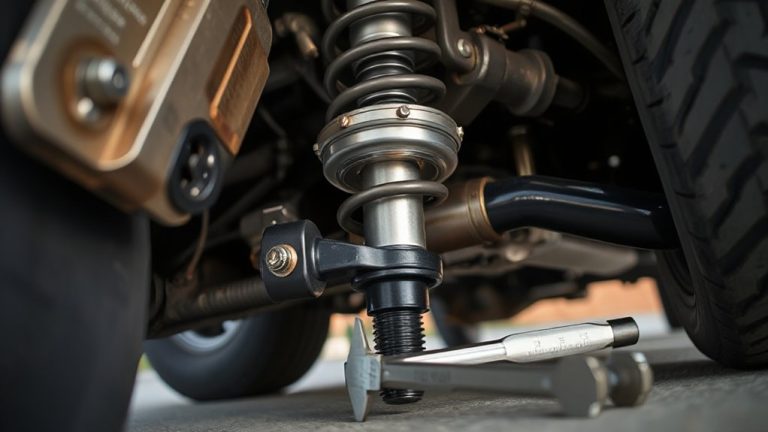
Installing and Tuning Your Active Coilovers
What if you could dial in suspension performance as precisely as adjusting engine timing? Installing active coilovers demands attention to alignment specs-mounting height must be within ±1mm tolerance to prevent preload errors. You’ll face installation challenges like routing hydraulic lines or integrating control modules with the ECU. Miswiring sensors can lead to damper response delays exceeding 200ms, degrading real-time adaptation. Once mounted, tuning complexity emerges. Start with base settings: rebound damping at 60% of total stroke, compression at 40%. Use onboard accelerometers and wheel displacement data to adjust gain settings. Most systems offer 15–20 damping levels per second, reacting in under 5ms. Calibrate pitch and roll control separately-track mode typically requires a 12% stiffer front bias. Fine-tune using real-world feedback: aim for body movement under 2 inches over 3-inch bumps at 30 mph.
On a final note
You now control suspension behavior with precision. Active dampers integrate electronically adjustable valves, responding in milliseconds to road inputs. Systems like those from Tenneco or ZF adjust damping forces from 0.5 to over 3,000 N, adapting stiffness across varied terrain. Sensors feed body motion, wheel acceleration, and steering angle data at 100 Hz. This enables ideal tire contact, reducing pitch by up to 40% during braking. Your active coilovers deliver track responsiveness and daily comfort-automatically calibrated.