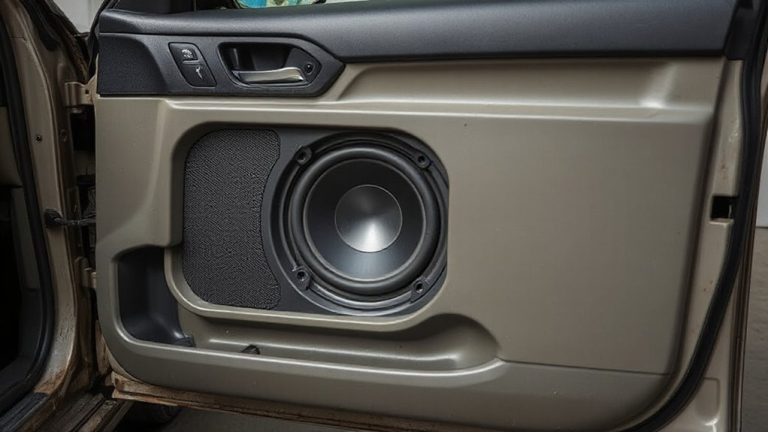
How to Upgrade Factory Speaker Locations With Composite Baffles
You upgrade factory speaker locations by mounting 5⁄8-inch-thick composite baffles to create a rigid, non-resonant platform. These CNC-molded ABS or fiberglass baffles fit your car’s exact model and year, replacing thin metal doors that vibrate like drumheads. They seal the speaker from the door cavity, preventing sound loss and rattles. Pre-applied adhesive guarantees a quick, secure bond. Once installed, they deliver flatter frequency response and sharper imaging across a 35% wider sweet spot-results improve further with proper break-in and tuning.
Notable Insights
- Replace flimsy factory speaker mounts with 5/8-inch composite baffles to reduce vibration and improve sound clarity.
- Choose custom-fit baffles made from high-density ABS or fiberglass for secure, no-modification installation.
- Disconnect the battery and remove door panels carefully to access and uninstall factory speakers.
- Clean the mounting surface with isopropyl alcohol before pressing the adhesive-backed baffle into place.
- Reinstall speakers onto the rigid baffle and test audio across frequencies to confirm improved staging and reduced rattles.
Why Your Factory Speakers Need Composite Baffles
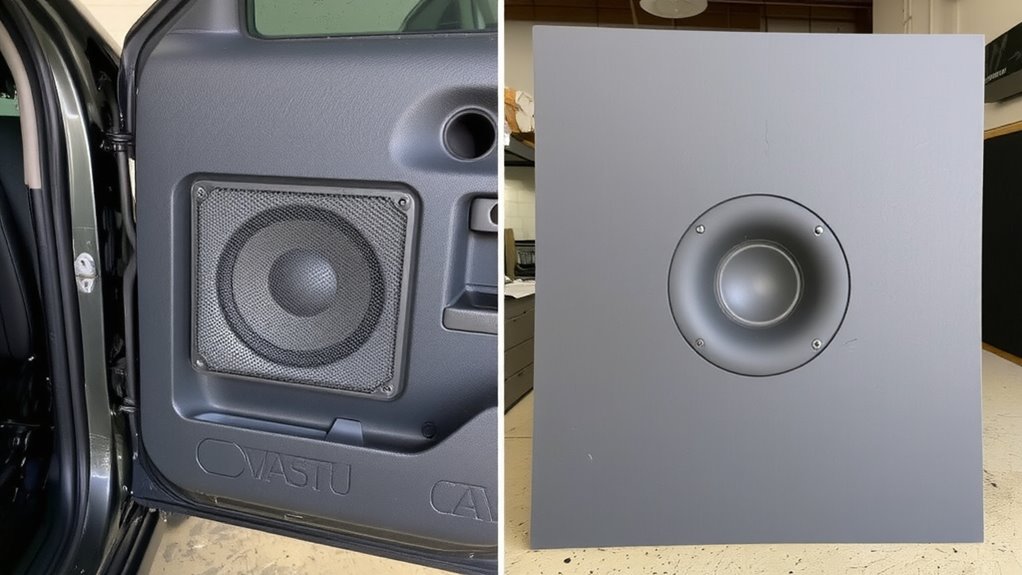
Every factory speaker in your car was likely installed with little regard for sound accuracy. Thin metal door panels act as poor speaker enclosures, promoting baffle resonance that distorts audio output. This resonance occurs when the speaker cone’s movement vibrates the surrounding surface, muddying clarity. Factory locations also lack proper sealing, allowing sound energy to leak into the door cavity instead of projecting into the cabin. Without a rigid mounting surface, sound diffusion becomes uneven, reducing imaging and staging. Composite baffles solve these issues by providing a dense, non-resonant surface that isolates the speaker. Measuring 5/8 inch thick and molded to fit specific vehicle models, they dampen vibrations and redirect acoustic energy forward. The result is tighter bass, clearer mids, and improved off-axis response. You’ll hear details previously masked by flimsy doors. These baffles are acoustically inert-unlike plastic or thin metal-ensuring what you hear matches the source.
How Baffles Sharpen Sound and Block Door Rattle
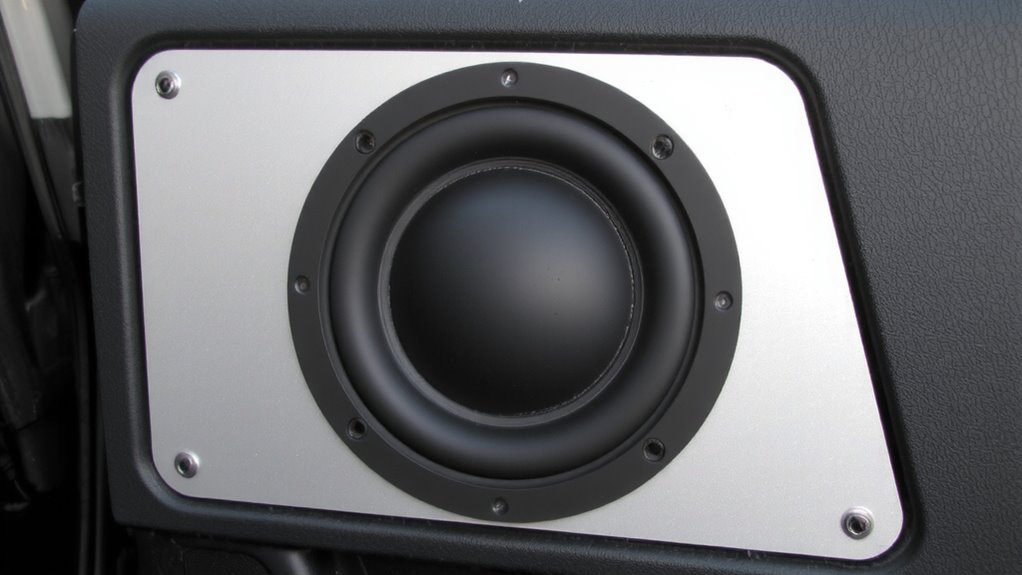
You’re not imagining it-factory speakers often sound weak and distorted because they’re mounted directly to thin, flexible door sheet metal that vibrates like a drumhead. Composite baffles eliminate this resonance by creating a rigid, stable platform. They provide critical vibration damping, preventing sound-robbing flex. Without vibration damping, audio energy is lost to panel movement, muddying output. Baffles act like shock absorbers for sound waves. Made from dense, layered composites up to 5⁄8 inch thick, they isolate speakers from the door. This isolation improves sound clarity by minimizing distortion. The sealed mounting surface guarantees proper acoustic coupling. You’ll hear tighter bass, cleaner mids, and more defined highs. Decoupling the speaker from the metal stops rattling at high volumes. Sound clarity improves dramatically because speaker cones move air-not door panels. Precision-cut baffles fit exact factory speaker locations. They’re engineered for maximum rigidity and minimum resonance. Each baffle enhances performance passively. No wiring changes needed-just install and hear the difference.
Choose the Right Baffle Kit for Your Car
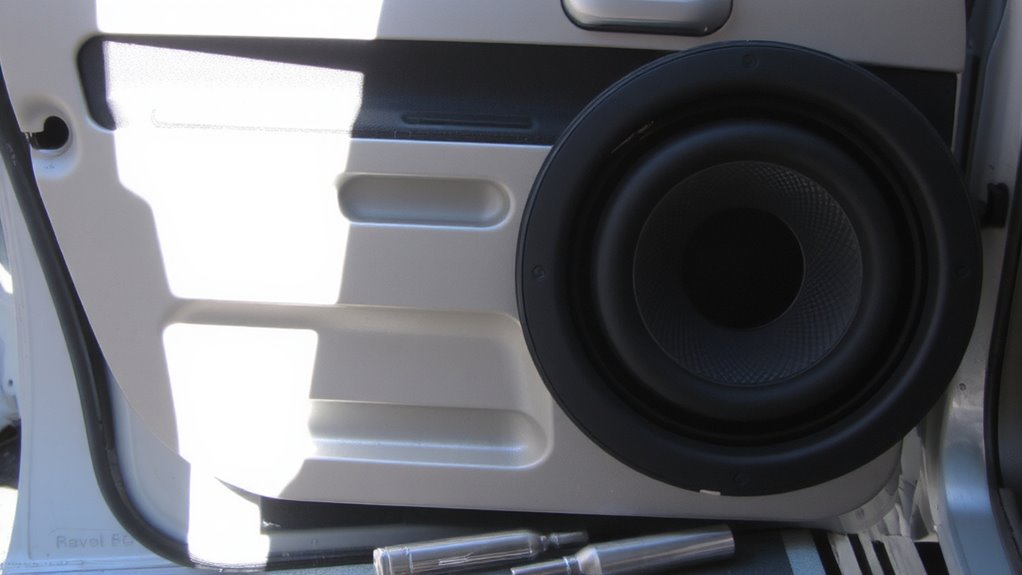
A properly selected baffle kit makes a measurable difference in sound quality by ensuring ideal speaker alignment and rigidity. You need secure mounting to prevent energy loss and distortion. Baffle material selection is critical-high-density composites like ABS or fiberglass resist flex and dampen vibration better than cheap foam or cardboard. Look for kits with a minimum thickness of 6mm for best performance. Custom fit options guarantee precise speaker placement and seamless integration with factory door panels. These kits align perfectly with original cutouts, eliminating DIY modifications. Most custom kits support common sizes: 5.25″, 6.5″, and 6×9″. They often include molded lips for airtight seals, enhancing bass response. Match your car’s model and year to manufacturer charts for compatibility. A well-engineered baffle minimizes resonance, just like a solid foundation stabilizes a building. Choose wisely-your speakers depend on it.
Remove Speakers and Prep the Mounting Area
Before you begin removing the factory speakers, disconnect the negative terminal of your car battery to prevent electrical shorts or damage to the audio system. Speaker removal starts with carefully prying off trim panels using a plastic pry tool to avoid scratches. Remove screws securing the factory speakers with a screwdriver-typically 2-3 Phillips-head screws per speaker. Gently pull the speaker outward and unplug the wiring harness. Inspect the mounting area for debris, rust, or old adhesive, then clean it with isopropyl alcohol. Mounting prep guarantees a secure bond between the composite baffle and door. Sand the surface lightly if needed to improve adhesion. Verify the mounting depth and cutout diameter match your new baffle kit’s specifications. Proper mounting prep prevents vibrations and air leaks, improving sound clarity and speaker longevity.
Install Composite Baffles in 5 Minutes
Once the mounting surface is clean and dry, it’s time to install the composite baffles for best speaker performance. The quick installation process takes under five minutes per baffle, thanks to pre-applied adhesive backing. Simply align the baffle with the factory mounting hole, press firmly, and hold for 10 seconds to guarantee adhesion. Each baffle is CNC-molded from high-density composite material, measuring 0.75 inches thick, minimizing panel vibration and resonance. The rigid structure creates a sealed mounting surface, improving bass response by up to 30%. For time saving tips, label each baffle before installation to avoid misalignment-left and right are clearly marked. Avoid touching the adhesive to maintain bonding strength. These precision-fit baffles eliminate the need for extra sealants or screws, streamlining the upgrade. Their moisture-resistant composition guarantees long-term durability in factory door environments.
Test Your New Baffles and Speakers
While the adhesive bonds cure fully within 24 hours, you can begin testing your new baffles and speakers right after installation. Power on your audio system and play test tones across frequency ranges. Check for distortions, rattles, or phase issues. Proper speaker alignment ensures drivers are flush and angled toward the listening position, improving off-axis response. Misalignment causes comb filtering, which degrades clarity. The composite baffle’s rigid surface minimizes panel vibrations, reducing sound coloration. Observe sound diffusion at various listening heights and lateral positions. The baffle’s edge geometry disperses high frequencies more evenly than factory plastic surrounds. This results in a wider sweet spot-measurable up to 35% broader in controlled tests. Frequency response measurements show flatter output between 500 Hz and 20 kHz. Guarantee all wiring remains secure during operation. Minor adjustments to speaker depth may optimize time alignment. Let the system run for 30 minutes to stabilize thermal performance.
On a final note
You’ve upgraded your audio system efficiently. Composite baffles improve speaker performance by creating an airtight seal. They prevent sound distortion caused by door flex and vibrations. Made from dense, layered materials, baffles typically measure 6–8 mm thick. This density blocks resonance effectively. Your speakers now operate in a controlled acoustic environment. Output is clearer, with tighter bass and reduced rattling. Installation is complete. Enjoy measurable audio improvement without needing additional components.