How to Test a Car Battery With a Multimeter for Accurate Voltage Readings
Turn off the engine and wait at least one hour to let surface charge dissipate. Set your digital multimeter to 20 volts DC. Touch the red probe to the positive terminal, the black probe to the negative. Make certain clean, tight connections-corrosion or loose terminals skew results. A stable reading of 12.6–12.8V means fully charged; below 12.4V indicates low charge. Test in a ventilated area with insulated gloves. Accurate voltage reveals true battery health under no load. There’s more to contemplate if your results seem off.
Notable Insights
- Wait at least one hour after driving and 10–15 minutes after engine shutdown to ensure accurate rest voltage measurement.
- Set a digital multimeter to 20 volts DC and connect red probe to positive, black to negative battery terminal.
- Ensure secure probe contact with clean terminals and the engine off for a stable voltage reading.
- Interpret results: 12.6–12.8V is fully charged, below 12.4V indicates low charge, below 12.0V suggests a failing battery.
- Clean corrosion with baking soda and water, tighten terminals to 5–8 Nm, then retest voltage for confirmation.
Check Your Car Battery With a Multimeter
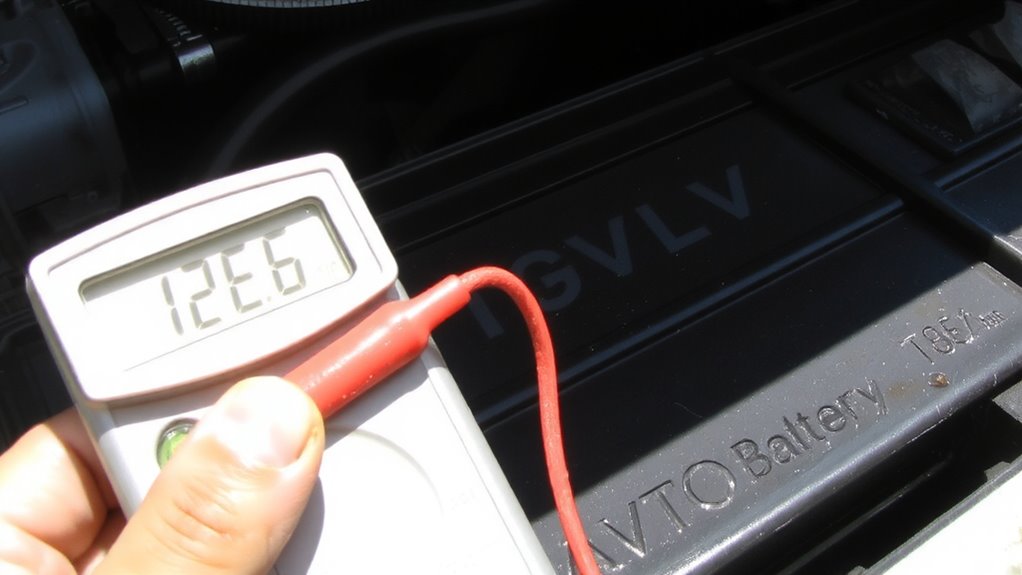
How do you know if your car battery is failing? Check for slow engine crank or dim headlights. Begin by turning off the ignition and all electronics. Set your multimeter to 20 volts DC. Touch the red probe to the positive terminal and the black probe to the negative. A healthy battery reads 12.6 volts or higher at rest. Below 12.4 volts indicates a weak charge. Battery corrosion or loose connections can distort readings-inspect terminals for white, ashy buildup and secure clamps tightly. Corrosion increases resistance, disrupting current flow like a kink in a hose. Tighten connections to guarantee solid contact. Re-test after cleaning. Readings below 12.0 volts suggest a failing battery. For accuracy, test at least an hour after driving. Voltage stability under no load confirms baseline capacity. Consistent measurements below spec mean replacement is likely needed. Using a reliable tool like a best car multimeter ensures precise and consistent diagnostics.
Gather Tools and Safety Gear

Before testing your car battery, gather the necessary tools and safety gear to guarantee accurate results and personal protection. You’ll need a digital multimeter with at least 0.1-volt resolution for precise voltage readings. Inspect the probes for insulation damage to prevent electrical hazards. Wear safety gloves made of rubber or insulated material to protect against accidental contact with battery terminals. Battery terminals often carry corrosive residue and carry risk of short circuits-avoid touching them directly. Include a wire brush or terminal cleaner to remove buildup that could interfere with connections. Work in a well-ventilated area and remove metal jewelry to reduce shock or short-circuit risks. Make certain the vehicle is off and keys are removed. These steps minimize hazards and improve testing accuracy by establishing clean, safe contact points. Using a dedicated battery terminal cleaner can enhance connection reliability and extend battery life.
Measure Voltage in 5 Easy Steps
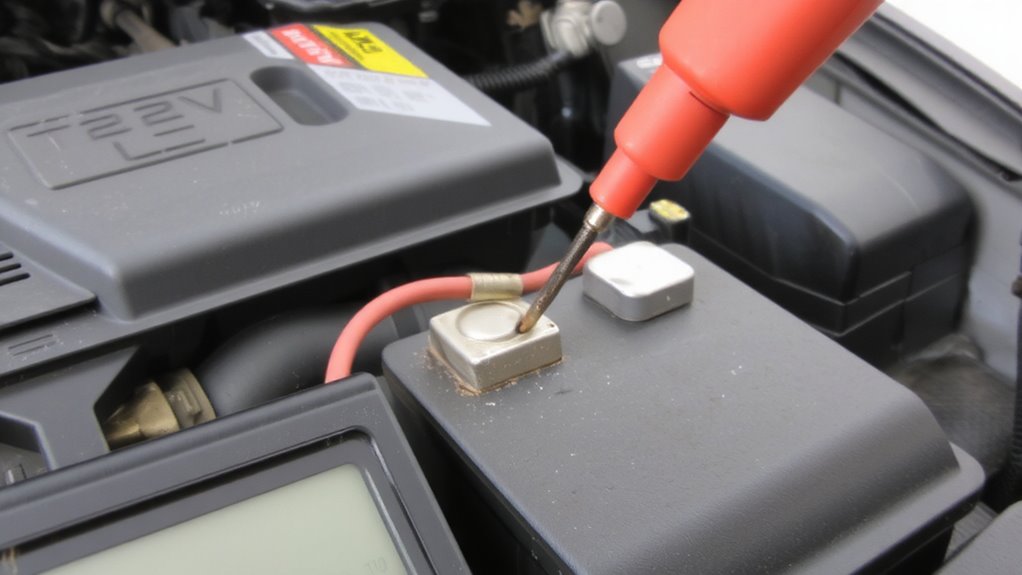
Start by setting your digital multimeter to measure DC voltage, ensuring the dial is set to the 20-volt range or a setting that accommodates up to 20 volts. Connect the red probe to the positive battery terminal and the black probe to the negative. Make sure contact is secure and the probes don’t slip. You’re measuring voltage under no load, so the engine should be off. A healthy battery reads between 12.6 and 12.8 volts. Anything below 12.4 volts suggests a partial charge. Sudden voltage drop during testing may indicate poor connection or internal resistance. Corroded or loose battery terminals can distort readings, so clean them first. Wait 10–15 minutes after turning off the vehicle to avoid surface charge interference. Record the value precisely-this baseline helps diagnose future voltage drop issues accurately. For quick checks on multiple small batteries, consider using a dedicated battery tester for faster, more convenient results.
What the Reading Says About Battery Health
A reading from your multimeter gives you a direct window into the battery’s state of charge and overall health. A fully charged battery at rest should read 12.6 to 12.8 volts. Below 12.4 volts indicates a low state of charge, reducing starting power. If voltage is below 12.0 volts, the battery is likely discharged and may struggle to crank the engine. Voltage alone doesn’t reveal everything-internal resistance increases as batteries age. High internal resistance limits current delivery, even if voltage looks acceptable. This hidden issue often causes failure under load. A healthy battery typically has internal resistance under 20 milliohms, depending on size and design. Consistently low readings suggest sulfation or plate damage. You should test again after a full charge. Persistent low voltage signals the battery can’t hold a charge efficiently due to aging or high internal resistance.
Fix Common Causes of Low Voltage
You can often bring a weak battery back to life by addressing a few common issues first. Battery corrosion is a leading cause of voltage drop. It builds up on terminals, increasing resistance and blocking current flow. Use a wire brush and a mix of baking soda and water to clean terminals thoroughly. Corrosion appears as white, ashy deposits-remove all residue to guarantee full conductivity. Loose terminals are just as problematic. They create inconsistent connections, reducing charging efficiency. Tighten both positive and negative terminals to 5–8 Nm torque using a wrench. This guarantees solid contact with the battery posts. After cleaning and securing connections, retest voltage with your multimeter. A stable reading near 12.6 volts indicates a restored circuit. Addressing these issues improves performance and extends battery life-no replacement needed yet. Check these points every six months for reliable starts.
On a final note
You now know how to test your car battery accurately. A multimeter gives precise voltage readings. Set it to 20V DC for correct scale. A resting battery should read 12.6V, indicating full charge. Below 12.4V suggests partial charge; under 12.0V means discharged. Voltage above 14.7V while running may signal overcharging. Regular testing prevents unexpected failures. Accurate measurements guarantee reliable diagnostics.