How to Install Speakers in Vehicles With Factory Harman Kardon Systems
Replace your factory Harman Kardon speakers with 4-ohm aftermarket models matching the original 45 Hz–20 kHz frequency response and 6.5-inch size. Verify mounting depth to fit OEM enclosures. Keep factory crossovers only if impedance and frequency ranges align closely. Wire each speaker directly to the factory amp using color-coded harnesses, maintaining correct polarity. Disconnect the battery first to protect the amp’s MOSFET and DSP. Balance outputs using an SPL meter and adjust EQ settings-continued steps reveal finer tuning methods.
Notable Insights
- Use 4-ohm nominal impedance speakers to ensure compatibility with the factory Harman Kardon amplifier.
- Verify speaker mounting depth and basket size to fit within shallow OEM enclosures.
- Avoid using factory crossovers with aftermarket speakers due to impedance and tuning mismatches.
- Match wiring polarity and use color-coded harnesses to maintain signal integrity and phase accuracy.
- Disconnect the battery and protect amplifier connections to prevent damage during installation.
Pick Aftermarket Speakers Compatible With Your HK Factory System
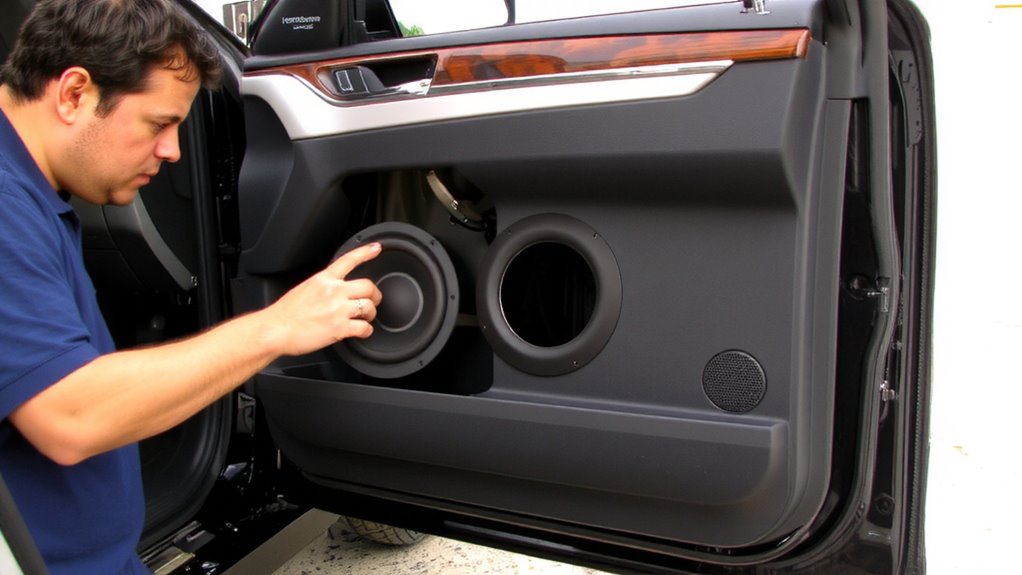
Aftermarket speakers must match your Harman Kardon (HK) factory system’s electrical and mechanical specs to guarantee proper performance. Impedance matching is critical-your new speakers should have a nominal impedance of 4 ohms to align with the HK amplifier’s output. Mismatched impedance can cause distortion or damage the factory amp. You also need to take into account frequency response; most HK systems expect drivers that perform between 45 Hz and 20 kHz. Selecting speakers with a similar range guarantees seamless integration. Mounting depth and basket size matter too-many factory HK enclosures are shallow, so verify speaker dimensions before buying. Use 6.5-inch coaxial or component speakers designed for OEM integration. Avoid low-sensitivity models; stick with 88–92 dB sensitivity for consistent volume. Proper specs mean your upgrade will sound clear, balanced, and factory-smooth without extra gear.
Decide Whether to Keep OEM Crossovers
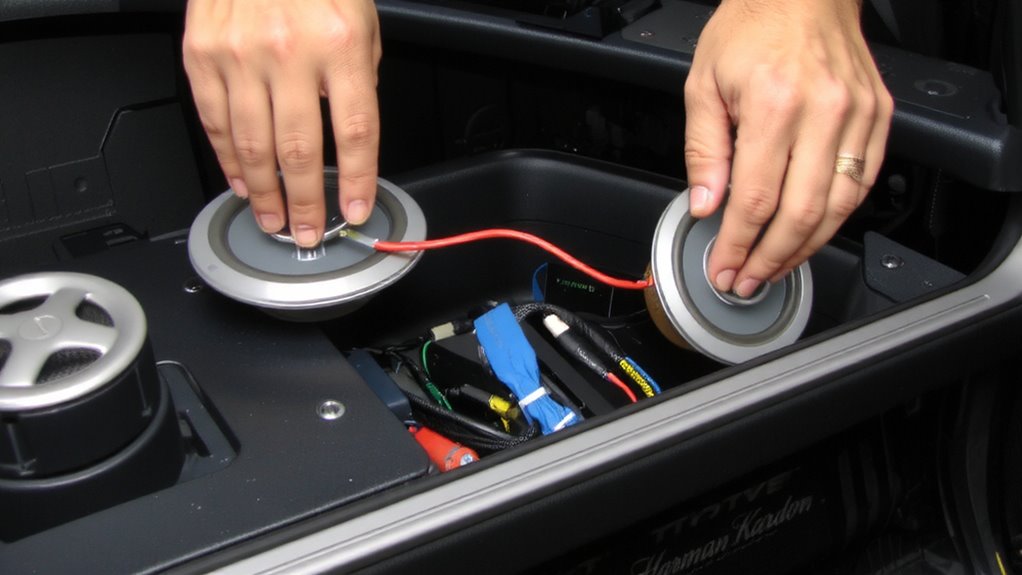
While your factory crossovers might seem like a convenient link in the audio chain, keeping them with aftermarket speakers isn’t always the best move. Factory crossovers are tuned for stock drivers, not upgraded components. Mismatches in speaker impedance and crossover frequency can distort sound and reduce efficiency. Aftermarket speakers often have different impedance ratings, altering how the crossover filters frequencies. This can lead to weak highs or muddy bass.
| Factor | OEM Crossover | Aftermarket Speaker |
|---|---|---|
| Impedance Match | Designed for stock units | May vary (e.g., 3Ω vs 4Ω) |
| Crossover Frequency | Fixed (e.g., 3,500 Hz) | May require tuning |
| Output Accuracy | Risk of phase shift | Improved with matched filters |
Always verify compatibility. When mismatches occur, consider replacing OEM crossovers with passive or active alternatives designed for your new speakers.
Wiring Speakers to the Factory Harman Kardon Amp
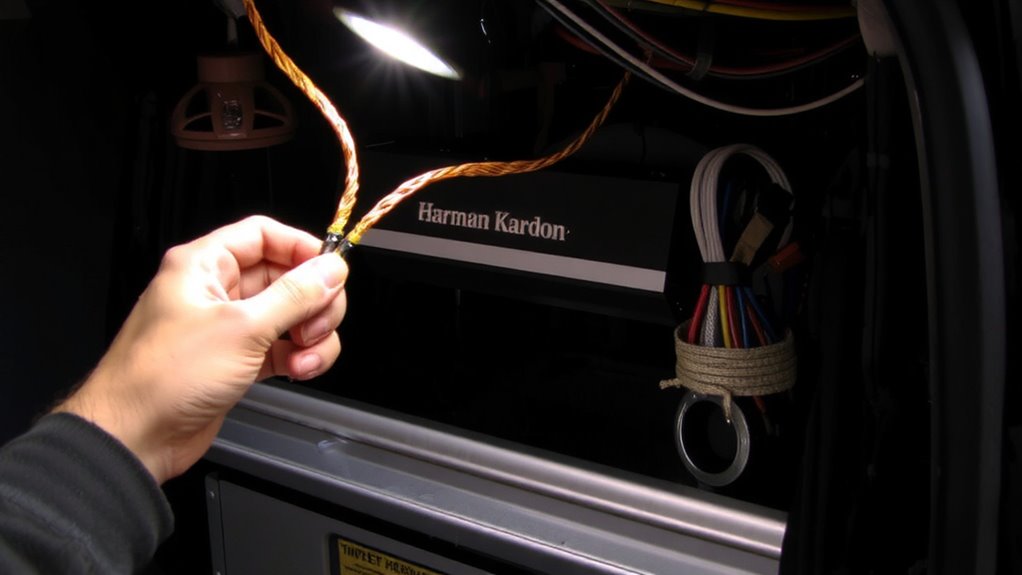
Since your Harman Kardon system is designed to work with specific impedance and signal levels, wiring aftermarket speakers directly to the factory amplifier requires careful attention to electrical compatibility. Impedance matching is essential-your amplifier expects a 4-ohm load per channel. Deviating from this can cause power imbalance or amplifier instability. Use a multimeter to verify speaker impedance before connection. Maintain correct signal phase by aligning positive and negative wire terminals; reversed polarity reduces bass response and distorts sound staging. Factory harnesses typically use color-coded wires-match these precisely to maintain OEM signal integrity. Do not daisy-chain speakers unless the final load remains within spec. The Harman Kardon amp delivers 45–60 watts RMS per channel; exceeding electrical tolerances risks long-term performance degradation. Always double-check connections.
Protect the HK Amplifier During Installation
When handling the Harman Kardon amplifier during installation, you must disconnect the vehicle’s battery before making any electrical connections-this prevents accidental short circuits and protects sensitive amplifier circuitry. Electrical safety is critical; even a small voltage spike can damage the amp’s MOSFET output stage or DSP processor. Always remove the negative terminal first and secure it away from the battery post. Use dielectric grease on connectors to prevent corrosion and maintain signal integrity across speaker wires. Avoid routing signal cables near high-current paths like power wires or ignition systems-this minimizes electromagnetic interference. The HK system operates at 14.4 volts and uses a proprietary 32-bit audio processor; any disruption during installation may cause calibration faults. Handle the amp by its edges to avoid static discharge. Reconnect the battery only after all connections are secure and double-checked.
Balance and Tune Speakers for Premium Sound Quality
Ever wonder why your Harman Kardon audio system doesn’t deliver the concert-hall clarity you expected? Proper sound calibration and audio optimization are essential. Factory HK systems use precise speaker output levels and time alignment to achieve balanced sound. Without tuning, even new speakers underperform. Begin by accessing your vehicle’s built-in equalizer and adjust frequency response to match the new components. Use a sound pressure level (SPL) meter to balance outputs across channels.
| Speaker Position | Recommended SPL (dB) |
|---|---|
| Front Left/Right | 75–78 |
| Rear Left/Right | 72–74 |
| Center Channel | 76 |
Time alignment delays should be set per manufacturer specs, typically 0.2–0.5 ms for rears. Fine-tune crossover points to prevent distortion. Complete audio optimization guarantees seamless sound staging and accurate sound calibration for premium results.
On a final note
You must choose speakers with 4-ohm impedance and 85 dB or higher sensitivity to match your Harman Kardon system’s 70-watt RMS output. Keep OEM crossovers for ideal frequency separation at 3.5 kHz. Use 16-gauge oxygen-free copper wiring for clean signal transfer. Avoid amplifier overload by double-checking polarity and impedance loads. Finally, calibrate balance and fade settings to align with speaker placement and acoustic output.