Evaluating Battery Terminal Integrity to Prevent Starting Failures
Check your battery terminals regularly to prevent starting issues. Loose connections or corrosion increase resistance, potentially dropping voltage below 9.6V needed for proper cranking. Inspect for powdery deposits, guarantee tightness at 5–7 ft-lbs, and verify resistance stays under 0.5 ohms. Clean with a baking soda solution and brass brush, then apply dielectric grease. A 0.002-inch corrosion layer can block current flow. Persistent problems may signal deeper issues worth further investigation.
Notable Insights
- Dim headlights or slow engine cranking below 200 RPM may indicate poor terminal conductivity due to corrosion or looseness.
- Inspect for white, green, or blue deposits on terminals, which signal corrosive buildup impairing electrical flow.
- Ensure terminal resistance is below 0.3 ohms to maintain adequate current for reliable engine starts.
- Clean terminals with a baking soda solution and wire brush, then tighten to 5–7 ft-lbs to prevent voltage drops.
- Apply dielectric grease or petroleum jelly and use anti-corrosion washers to protect against future terminal degradation.
Signs Your Battery Terminals Need Attention
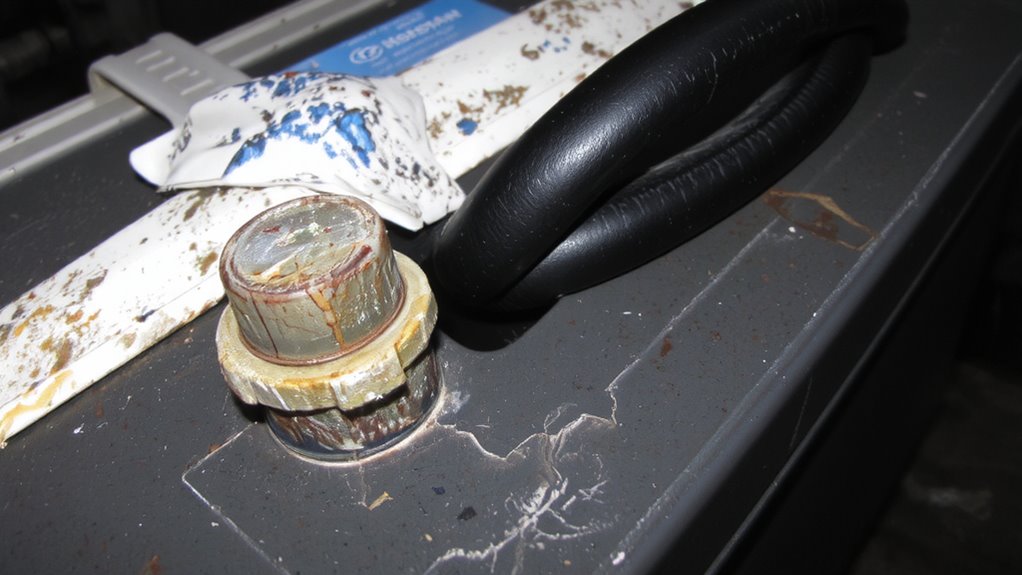
Under normal conditions, your battery terminals should remain clean, tight, and free of corrosion-but if you notice dim headlights or difficulty starting the engine, these could be early warnings of terminal issues. Loose connections disrupt electrical conductivity, reducing the current delivery to your starter motor. A secure terminal should have less than 0.5 ohms of resistance; higher readings indicate poor contact. You might also observe slow cranking-below 200 RPM in a healthy 12V system-pointing to voltage drop from faulty connections. Chemical damage, often from sulfuric acid vapors, corrodes lead terminals and cable ends, forming resistive sulfide layers. This corrosion increases resistance, further limiting amperage. Inspect for white, green, or blue powdery deposits-signs of oxidation and electrolytic reaction. These symptoms compromise starting reliability and reduce battery efficiency, accelerating wear on both the battery and electrical components. Upgrading to high-quality battery terminal connectors can significantly improve conductivity and long-term reliability.
What You Need to Clean Battery Terminals
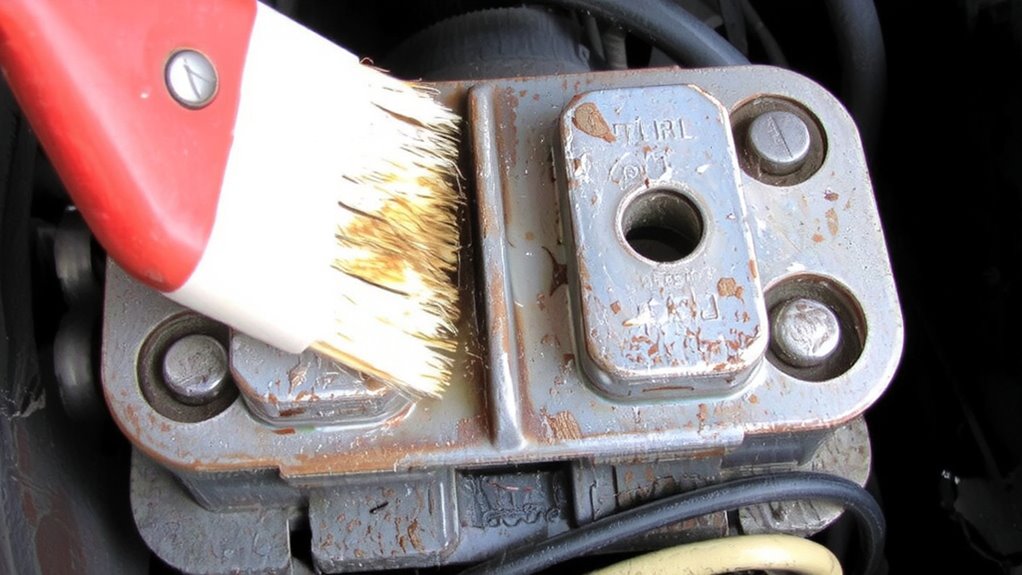
Now that you’ve identified warning signs like dim lights, slow cranking, or visible corrosion, it’s time to gather the right tools and materials for cleaning your battery terminals. Proper safety precautions are essential-always wear safety goggles and nitrile gloves to protect against acid exposure. Make sure the engine is off and keys are removed. Your cleaning tools should include a wire brush, terminal cleaner tool, and a baking soda solution (one tablespoon per cup of water) to neutralize acid. Avoid using metal objects that can short the battery. For more persistent buildup, consider using a dedicated battery terminal cleaner product designed to dissolve corrosion without damaging surrounding components.
| Item | Purpose | Specification |
|---|---|---|
| Safety goggles | Eye protection | ANSI Z87.1 certified |
| Nitrile gloves | Skin barrier | 5–8 mil thickness |
| Wire brush | Remove corrosion | Dual-ended, brass bristles |
| Baking soda solution | Neutralize acid | 1 tbsp per 8 oz water |
How to Clean and Tighten Battery Terminals
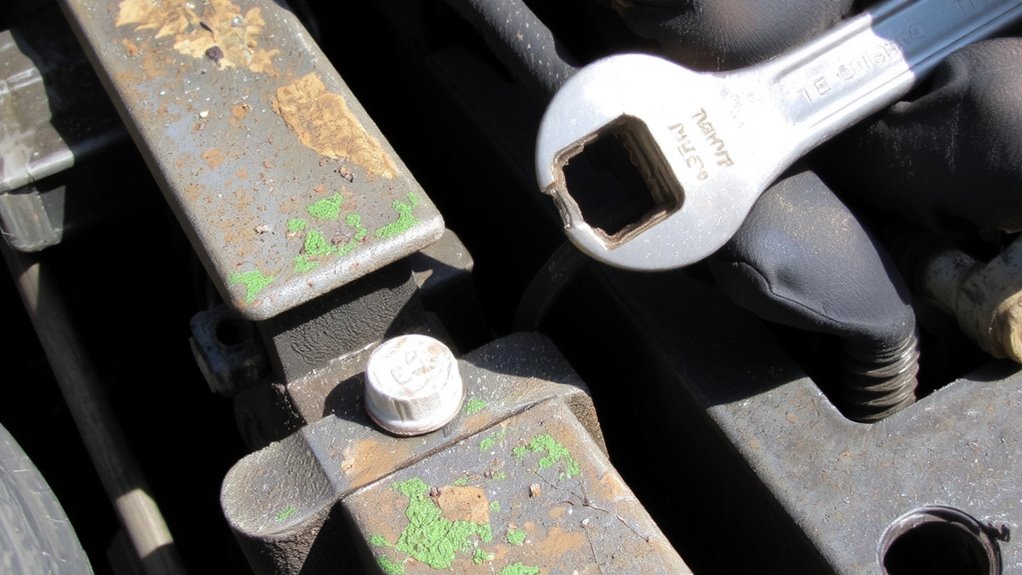
Safety is paramount when addressing battery terminal maintenance, so guarantee the vehicle is powered down and the keys are out of the ignition before beginning. Start by disconnecting the negative terminal, followed by the positive. Use a wire brush to scrub away corrosion until the metal shines-you’re restoring a clean conductive surface. Proper contact improves charging efficiency by minimizing resistance in the circuit. Reattach the terminals in reverse order: positive first, then negative, ensuring snugness with a wrench to achieve 5–7 ft-lbs of torque. A secure connection maintains full battery capacity utilization, preventing voltage drops during cranking. Poor contact can simulate low charge, even in a healthy battery. Clean, tight terminals support consistent energy flow, essential for peak starting performance. This simple step preserves system integrity and sustains long-term reliability.
Common Causes of Battery Terminal Failure
While corrosion is often the first suspect in degraded battery performance, it’s just one of several factors that can compromise terminal integrity over time. Loose connections increase electrical resistance, reducing current flow during engine cranking. A terminal with just 0.5 ohms of added resistance can drop voltage below 9.6V, failing to activate the starter. Vibration from driving can loosen terminals, leading to poor conductivity and intermittent power. Over-tightening damages lead posts, creating micro-cracks that weaken structural and electrical contact. Temperature swings cause repeated expansion and contraction, accelerating wear. Contaminants like dirt or grease also introduce resistance by insulating contact points. Even minor misalignment between the clamp and post reduces surface contact, increasing impedance. You need full metal-to-metal contact-typically 14–22 Nm torque on standard SAE posts-for reliable performance. Ensuring clean, snug, and properly aligned terminals prevents most common failures.
How Corrosion Stops Your Car From Starting
Even a thin layer of corrosion-just 0.002 inches thick-can block your car from starting. That buildup results from electrochemical degradation between the battery terminals and cable connectors, often due to hydrogen gas exposure and electrolyte leakage. This reaction forms lead sulfate or copper sulfate, which aren’t good conductors. As corrosion accumulates, it increases conductive resistance at the connection point. A resistance reading above 0.3 ohms severely restricts current flow. Your starter needs up to 200 amps to engage, but high resistance can cut delivery to under 50 amps. It’s like trying to run a marathon through a blocked hallway. Voltage drops follow, often reducing terminal voltage below 9.6 volts during crank-too low to activate the starter motor. You’ll hear clicking or nothing at all. Even partial corrosion disrupts the circuit enough to halt engine turnover. Conductive resistance from corrosion directly undermines power transfer, making starting unreliable or impossible.
How to Prevent Battery Terminal Corrosion
Your battery’s lifespan and starting reliability hinge on preventing terminal corrosion before it starts. Corrosion forms due to chemical reactions between battery acid vapors and metal terminals, creating buildup that increases electrical resistance. High resistance impedes current flow, reducing cranking power. To prevent this, clean terminals every three to six months using a baking soda–water solution and a wire brush. Dry thoroughly before reconnection. Apply a thin layer of corrosion-resistant grease-such as petroleum jelly or specialized dielectric grease-to block moisture and acid exposure. These greases act as a barrier, minimizing chemical reactions. Use protective felt washers soaked in anti-corrosion solution for added defense. Guarantee the battery cap is tightly sealed to limit vapor escape. Regular maintenance keeps electrical resistance low, preserving maximum conductivity. Prevention is simpler and cheaper than repair-stay ahead of corrosion to maintain strong, consistent starts.
When to Replace Terminals or Call a Mechanic?
How do you know when cleaning and maintenance aren’t enough? When terminal damage is visible-such as deep cracks, warping, or severe corrosion-replacement is necessary. You’ll often notice persistent starting issues despite regular upkeep. High electrical resistance develops in compromised terminals, reducing voltage delivery to critical systems. A voltage drop test showing more than 0.2 volts across the terminal indicates excessive resistance. If the battery post is loose or the terminal feels brittle, it can’t maintain a secure connection. Standard lead terminals should fit snugly-any gap increases resistance and heat. For vehicles with advanced charging systems, even minor resistance can disrupt performance. If you’re unsure how to test resistance or replace terminals correctly, call a mechanic. Incorrect installation risks electrical faults or damage to the charging system. Professional diagnostics guarantee proper fit, conductivity, and long-term reliability.
On a final note
You must inspect battery terminals regularly to guarantee reliable starting. Corrosion, measured as resistivity above 0.05 ohms, disrupts current flow. Loose connections reduce cranking voltage below the 9.6V minimum needed for engine start. Clean terminals with a baking soda solution and a wire brush. Tighten to 5–8 ft-lbs torque. Use dielectric grease to inhibit future corrosion. Replace cracked or swollen terminals immediately.