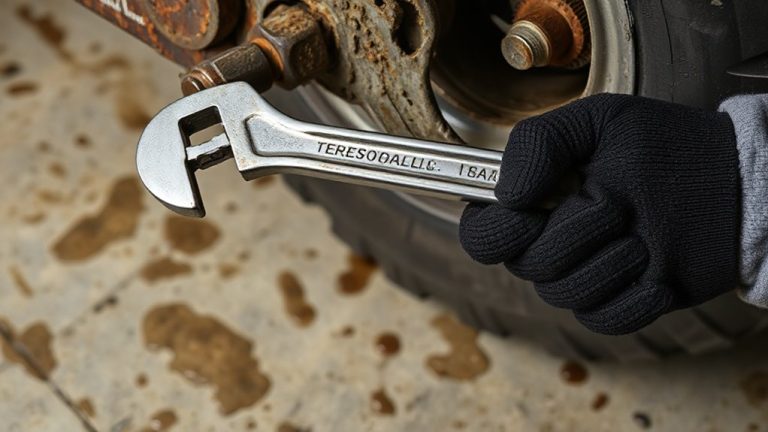
Avoiding Frame Warping by Supporting Vintage Muscle Cars at Designated Hardpoints
Always lift your vintage muscle car at factory-designated hardpoints to prevent frame warping. These reinforced points-typically 6–10 inches behind the front wheels and 4–6 inches ahead of the rear axle-feature thicker steel and structural gusseting. Use a 3-ton floor jack with a centered saddle and pair it with 3-ton steel jack stands rated for at least 6,000 lbs combined support. Never jack on suspension components, floor pans, or pinch welds. Proper lift points distribute stress safely. Further details on exact locations and tool setups follow.
Notable Insights
- Always lift vintage muscle cars at manufacturer-specified hardpoints to prevent frame stress and warping.
- Use reinforced frame sections near the front subframe and behind the rear axle as primary jacking points.
- Support the vehicle with rated jack stands at designated hardpoints, never on floor pans or suspension components.
- Employ a low-profile 3-ton floor jack with a centered saddle to avoid slippage and uneven force distribution.
- Identify hardpoints by visual cues like thicker steel, dimples, or notches located 6–10 inches from axles.
Where to Jack Up a Vintage Muscle Car
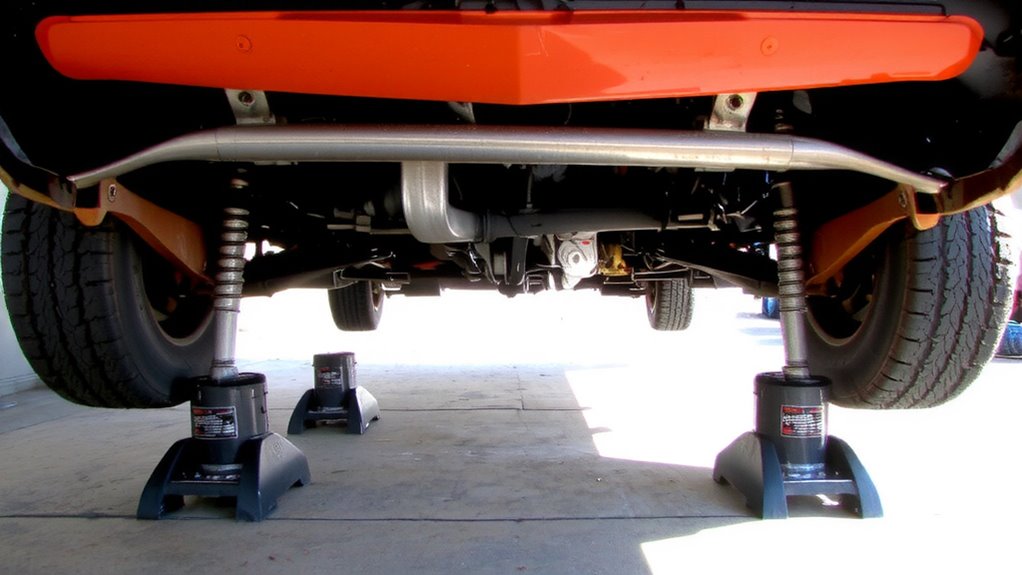
While lifting a vintage muscle car might seem straightforward, choosing the wrong jacking points can lead to frame warping or structural damage. You should only jack from the manufacturer-specified hardpoints-typically reinforced frame sections near the front subframe and just behind the rear axle. These areas are engineered to handle concentrated loads. Avoid lifting directly on the rear axle unless using a padded high-lift point, as it forces uneven suspension compression and risks differential housing damage. When the suspension compresses during lifting, stress redistributes across leaf springs or control arms, potentially deforming mounts. For unibody models, lift only at boxed frame rails where gusseting provides added strength. Always center the jack saddle to prevent slippage. Use a floor jack with at least 3-ton capacity and a low-profile design for clearance. Correct lift points preserve alignment geometry and structural integrity. A reliable floor jack for trucks ensures stability and safety when lifting heavy classic vehicles.
Use Jacks vs. Stands the Right Way
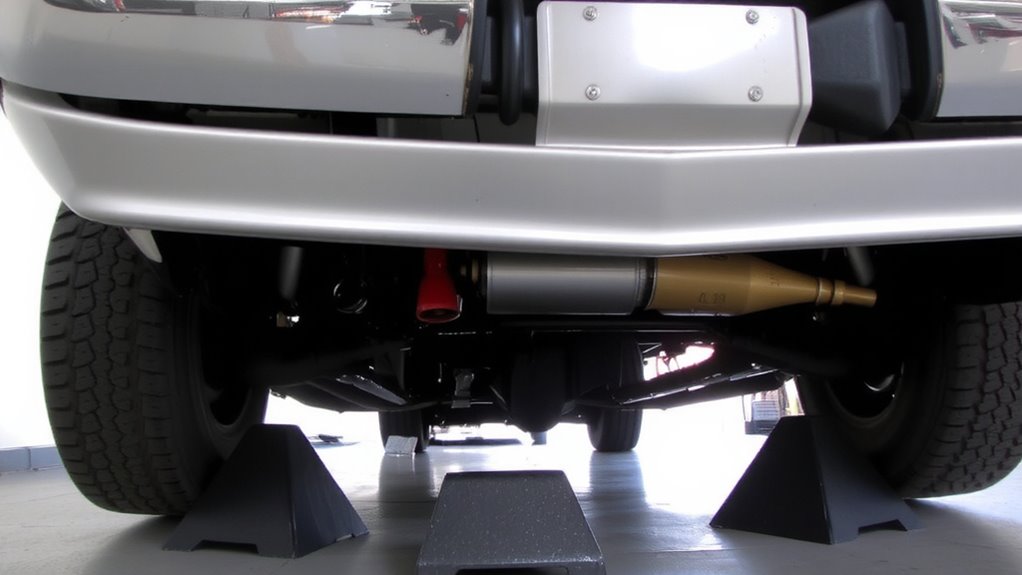
Always secure your vintage muscle car with both jacks and jack stands-never rely on a jack alone to hold the vehicle. Jacks provide hydraulic efficiency for lifting, but lack the lift stability needed for safe, long-term support. Use a hydraulic floor jack with a 2-ton minimum capacity to raise the car smoothly through its 6–8 inch lift range. Once elevated, position steel jack stands rated for at least 3 tons at manufacturer-designated hardpoints. These stands offer rigid lift stability, minimizing frame flex and preventing warping. Never place stands under floor pans or unbraced sections. The jack’s quick lift complements the stand’s passive safety-each serves a distinct role. A quality stand’s 6-inch saddle adjusts to fit frame rails tightly, reducing slip risk. Combining both tools correctly guarantees the car remains stable, protecting both you and the car’s structural integrity during maintenance. For heavy-duty support, consider 6-ton jack stands that provide maximum load capacity and durability for vintage muscle cars.
Avoid These Classic Lifting Mistakes
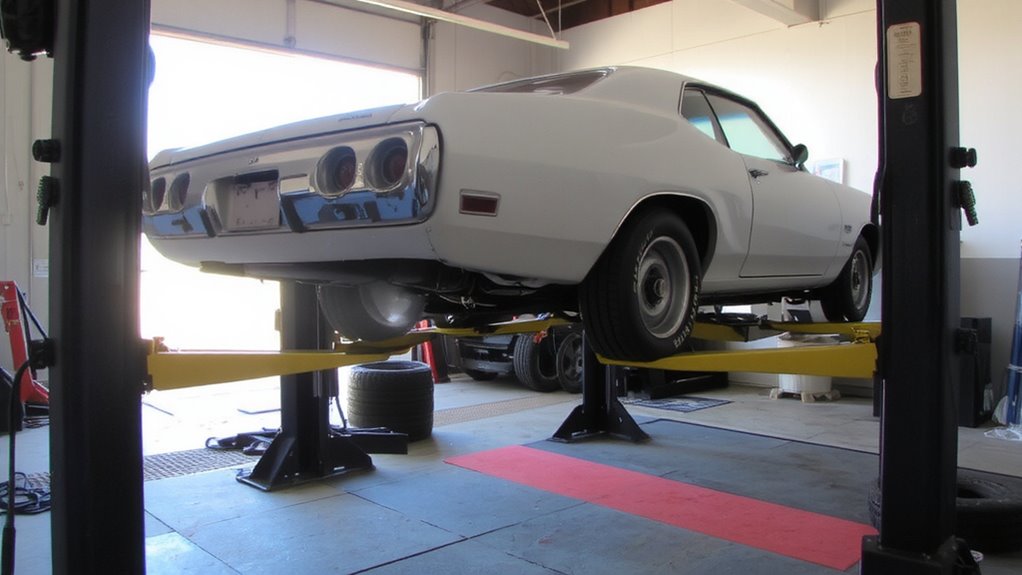
A single mistake during lifting can compromise the entire frame of your vintage muscle car. Improper jack placement stresses weak points, risking cracks or warping. Always lift at designated hardpoints-reinforced sections near the frame rails, typically 6 to 10 inches behind the front wheels and just ahead of the rear axle. Avoid unsupported chassis edges; they aren’t engineered to bear concentrated loads and can deform under pressure. Use a floor jack rated for at least 3,000 pounds with a wide saddle pad to distribute force. Once raised, transfer the vehicle’s weight to jack stands under solid frame sections. Never rely on pinch welds or floor pan seams for support. A momentary lapse-like jacking on a suspension component-can lead to collapse. Slow, deliberate lifts aligned with your car’s blueprints prevent damage. Precision guarantees longevity.
How to Store a Muscle Car Safely
Your muscle car’s longevity hinges on proper storage-neglect can lead to irreversible damage in as little as six months. Store it in a clean, dry, enclosed space with stable climate control; humidity below 50% prevents rust, while temperatures between 60–75°F minimize material stress. Use a breathable, multi-layer car cover with non-abrasive lining to protect paint and trim. Elevate tires slightly or use tire savers to prevent flat-spotting during long static loads. Fuel system degradation is halted by adding stabilizer and filling the tank to reduce condensation. Disconnect the battery and use a maintenance charger with a 1.5-amp output to prevent sulfation. For rodent prevention, install ultrasonic deterrents (20–25 kHz range) and seal all gaps with steel wool or mesh. Avoid plastic sheeting-it traps moisture. Regular inspections every 30 days guarantee early detection of pests or moisture buildup.
Best Tools for Lifting Without Damage
Lifting a vintage muscle car demands the right equipment to avoid structural harm, especially after it’s been stored for long periods with fluids settled and suspension compressed. You need tools offering both hydraulic capacity and lift precision to protect aging frames. Poorly distributed force risks warping-precision placement and controlled rise are essential. For maximum safety and long-term reliability, consider investing in a two-post lift purpose-built to support classic vehicles at their designated hardpoints.
| Tool | Hydraulic Capacity / Lift Precision |
|---|---|
| Floor Jack (4-ton) | 8,000 lb capacity, 6.5″ min height |
| Scissor Lift (Portable) | 6,600 lb, 1/8″ rise increments |
| Frame-Engaging Lift Pads | Rubber-coated, 2″ width for even pressure |
| Rally Stands (3-ton) | 6,000 lb max, micro-adjustable screws |
Choose gear that guarantees gradual, even elevation. High hydraulic capacity prevents system strain; fine lift precision aligns force exactly where needed. Always verify load ratings exceed your car’s weight by 25%.
Find Your Car’s Factory Hardpoints
The factory hardpoints on your vintage muscle car’s frame aren’t just stamped metal-they’re engineered load zones designed to handle stress without deformation. These reinforced sections, typically located near the front and rear suspension mounts, are marked by thicker gauge steel and specific dimples or notches. You’ll find them symmetrically placed along the frame rails, usually 6 to 8 inches behind the front axle and 4 to 6 inches ahead of the rear axle. During frame inspection, clean all debris and use a flashlight to locate these factory identifiers. Rust detection is critical-any corrosion near hardpoints compromises structural integrity. Never lift on corroded or modified areas. Use a floor jack with a rubber puck to distribute pressure evenly. Always reference your factory service manual for exact hardpoint locations and weight limits-most can support 1,500 to 2,000 pounds per side when undamaged.
On a final note
Always lift your vintage muscle car at the factory-specified hardpoints. These reinforced frame sections are engineered to handle load stress. Use a 3-ton hydraulic floor jack with a rubber pad attachment to prevent metal gouging. Pair with adjustable jack stands rated for 3,000 lbs each. Position stands under frame rails, not pinch welds. Incorrect support risks frame warping or collapse. Proper lifting guarantees safety and preserves structural integrity during maintenance or storage.