Why Using a Water-Repellent Drying Towel Enhances Coating Beading
You preserve your coating’s hydrophobic performance when you use a water-repellent drying towel. These towels have hydrophobic fibers with low surface energy (20–30 dynes/cm), matching ceramic-coated surfaces. They minimize friction-coefficients as low as 0.10-preventing micro-abrasion that disrupts beading. Ultra-dense microfiber (700–900 GSM) and sub-0.8 mm pile lift water without absorption. This maintains surface tension, allowing tight, consistent bead formation. Poor towels leave residues or scratches that scatter water. The right towel keeps beads round and high, up to 3.8 mm. Better materials mean longer-lasting protection and cleaner results every time.
Notable Insights
- Water-repellent towels preserve low surface energy by minimizing friction and maintaining hydrophobic layer integrity.
- Their hydrophobic fibers prevent water absorption, promoting uniform beading on ceramic-coated surfaces.
- Low-friction surfaces reduce shear forces that disrupt molecular alignment essential for strong water beading.
- High GSM and ultra-low pile thickness ensure streak-free, spot-free drying that sustains surface tension.
- Unlike traditional towels, they avoid micro-abrasion and contamination that degrade coating performance and beading.
What Coating Beading Tells You About Protection
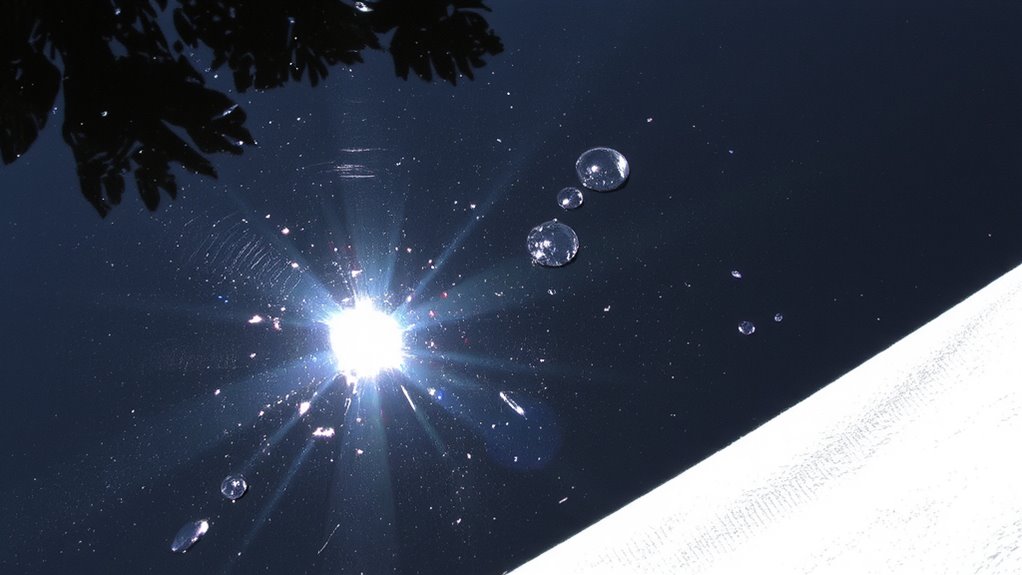
Why do water droplets bead up and roll off your car’s surface after applying a coating? The answer lies in surface energy and chemical composition. Coatings lower your paint’s surface energy, causing water to contract into tight beads. Low surface energy means contaminants and water can’t spread easily. Most ceramic coatings have a surface energy between 20–30 dynes/cm, far below untreated paint at 40–50 dynes/cm. This shift results from silica- or siloxane-based chemical composition, forming a dense, hydrophobic layer. Beading indicates a continuous, intact coating. If water sheets instead, surface energy is too high, and protection may be compromised. Strong beading confirms proper application and coating performance. It’s not just visual-it shows your surface resists water, dirt, and pollutants effectively. Beading is a measurable indicator of durability, chemical resistance, and long-term protection. Using a high-quality car drying towel can preserve this hydrophobic effect by minimizing surface contamination and swirl marks during drying.
How Water-Repellent Drying Towels Work
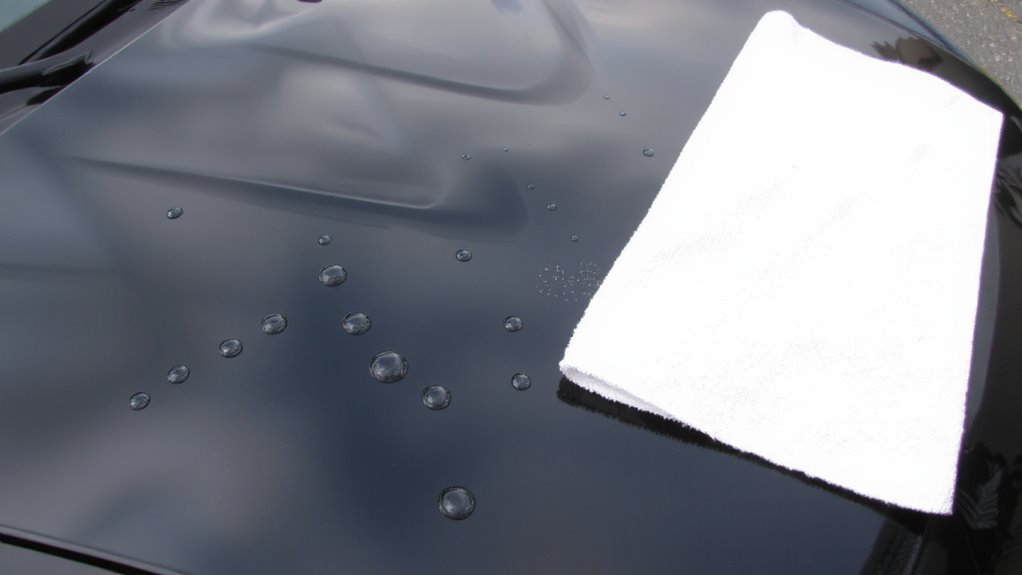
While most drying towels rely solely on absorbency, water-repellent drying towels combine advanced fiber technology with hydrophobic treatments to actively resist water saturation. You benefit from their engineered microfiber density, typically ranging from 300 to 500 grams per square meter, which provides structure without water retention. These fibers are treated with silicone or fluoropolymer coatings, enhancing their hydrophobic properties. Unlike standard towels, they don’t swell when wet, maintaining surface contact and efficiency. The hydrophobic properties prevent capillary absorption, so water beads up and rolls off instead of soaking in. High microfiber density guarantees durability and minimizes linting on sensitive coated surfaces. Capillary action is redirected across the towel’s surface, allowing you to glide it smoothly while sheeting water away. This mechanism preserves the coating’s integrity and boosts beading performance post-dry. You achieve faster, cleaner results with reduced friction. Top picks in the market often feature microfiber density optimized for both performance and longevity.
Why Traditional Towels Ruin Coating Beads
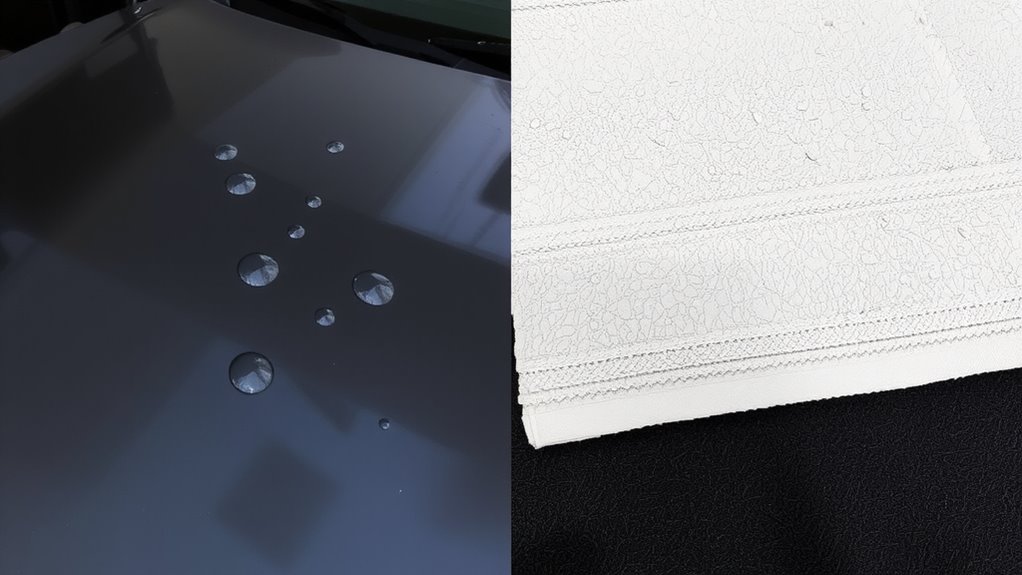
Ever wonder what happens to those tight, glossy water beads after a careful wash and coat? Using a traditional towel often destroys them. Most conventional microfiber towels cause microfiber abrasion, even if they feel soft. Their fibers are frequently too coarse or improperly woven, scratching the coating’s surface at a microscopic level. These tiny scratches disrupt the uniform surface tension needed for proper beading. Worse, used towels trap contaminants like dirt and oils, leading to surface contamination. When you dry with a contaminated towel, you’re rubbing pollutants directly onto the coated surface. This compromises hydrophobic performance immediately. Standard microfibers may have a 300–500 thread count, but without proper split-fiber construction, they retain water poorly and increase friction. The result? Broken beads, streaks, and degraded protection. Your coating’s performance depends on a flawless surface-traditional towels simply can’t deliver that. They harm both appearance and function.
Why Less Friction Means Stronger Beading
When you dry your vehicle with a high-friction material, even light pressure can disturb the delicate surface energy needed for strong hydrophobic effects. Low-friction drying preserves molecular alignment within the coating, maintaining peak surface tension. Disrupted molecules scatter water unevenly, weakening bead formation. A water-repellent drying towel minimizes shear forces, protecting the coating’s integrity. Selecting the right drying towel material can significantly impact the longevity and performance of your vehicle’s protective coating.
| Material Type | Friction Coefficient | Bead Height (mm) |
|---|---|---|
| Cotton Terry | 0.45 | 1.2 |
| Microfiber Standard | 0.30 | 2.0 |
| Waffle Weave | 0.25 | 2.3 |
| Silicone Rubber | 0.15 | 3.1 |
| Hydrophobic Towel | 0.10 | 3.8 |
You achieve maximum beading when surface tension remains undisturbed. Less friction means stronger, more consistent water repellency.
Why a Spot-Free Dry Keeps Water Beading
Since water beading depends on a smooth, uncontaminated surface, any residue left behind during drying can disrupt the uniformity of the hydrophobic effect. You need a spot-free dry to preserve surface tension and maintain consistent bead formation. Minerals and dried water spots create microscopic peaks that scatter water, inhibiting tight beading. A high-quality drying towel prevents this by ensuring microfiber integrity-meaning the fibers remain intact without shedding or trapping contaminants. Damaged fibers leave behind lint and oils, which compromise the finish. Your towel must absorb completely without streaking. Opt for ultra-low pile thickness (0.8 mm or less) and high GSM (700–900) for maximum absorbency. This combination pulls water off efficiently, leaving a pristine, dry surface. When no residues remain, surface tension stays uniform, and water beads tightly.
Coating-Safe Towel Features That Matter
You’ll want to choose a drying towel that won’t degrade or scratch your vehicle’s protective coating. Material compatibility is critical-microfiber towels with a blend of 80% polyester and 20% polyamide offer a safe, non-abrasive surface. The fibers should be split to at least 1/100 the thickness of a human hair, enabling effective water pickup without marring delicate ceramic layers. Poor material compatibility can lead to micro-scratching, which compromises coating integrity over time. Also, consider chemical sensitivity: your towel must resist residues from detailing chemicals, waxes, or improper detergents that could transfer back onto the surface. Towels labeled as low-lint and machine-washable maintain performance after repeated use. Opt for ones with reinforced edges to prevent fraying. Clean towels regularly using mild, coating-safe detergents to preserve absorbency and avoid cross-contamination.
How to Dry Your Car Without Breaking the Bead
Though maintaining a pristine water bead is often seen as a sign of strong hydrophobic protection, disrupting that bead during drying isn’t always unavoidable-your technique and towel selection play decisive roles. Use a water-repellent microfiber towel with a density of at least 300–400 g/m² to preserve bead integrity. High microfiber density guarantees minimal water absorption in the fibers, reducing drag across the coating. Your drying technique should emphasize light, straight-line motions instead of circular wiping, which can disturb surface tension. Start at the roof and work downward, using one flat section of the towel per pass to avoid redepositing moisture. Never press hard-let the towel’s pile lift water via capillary action. A hydrophobic treatment on the towel’s fibers enhances sheeting, allowing water to roll off rather than break into droplets. Proper technique paired with superior microfiber density maintains the coating’s beading performance after every dry.
On a final note
You preserve coating integrity by using a water-repellent drying towel. These towels, made with hydrophobic synthetic microfibers (0.3–0.5 denier), minimize surface friction and water retention. Less abrasion maintains the coating’s smooth, tightly cross-linked layer, essential for strong water beading. A clean, streak-free dry prevents mineral deposits that disrupt surface tension. Choose plush, lint-free towels (300–400 GSM) to extend hydrophobic performance.