Chipped Brake Pad Edges: Why It Means Poor Friction Material
Chipped edges on your brake pads often signal poor-quality friction material. Low-grade organic pads lose up to 40% compressive strength after 50 high-speed stops. Heat cycles exceeding 600°F cause cracks, especially without chamfers or heat sinks. Uneven stress and micro-cracking start at the edges, reducing contact area by 30%. This leads to rotor scoring and brake fade. Premium ceramic or low-metallic pads with 1,800+ psi strength resist chipping. You’ll see how material choice directly impacts safety and longevity.
Notable Insights
- Chipped edges on brake pads often indicate poor-quality friction material unable to withstand thermal and mechanical stress.
- Repeated heating and cooling cycles cause low-grade pads to develop cracks and edge damage due to weak structural integrity.
- Inadequate compressive strength (<1,800 psi) in cheap pads accelerates chipping and material separation at the edges.
- Lack of chamfers, slots, or edge coatings in budget pads increases stress concentration, promoting edge chipping.
- Severe chipping reduces friction surface, compromises braking performance, and accelerates rotor wear.
What Causes Chipped Brake Pad Edges?
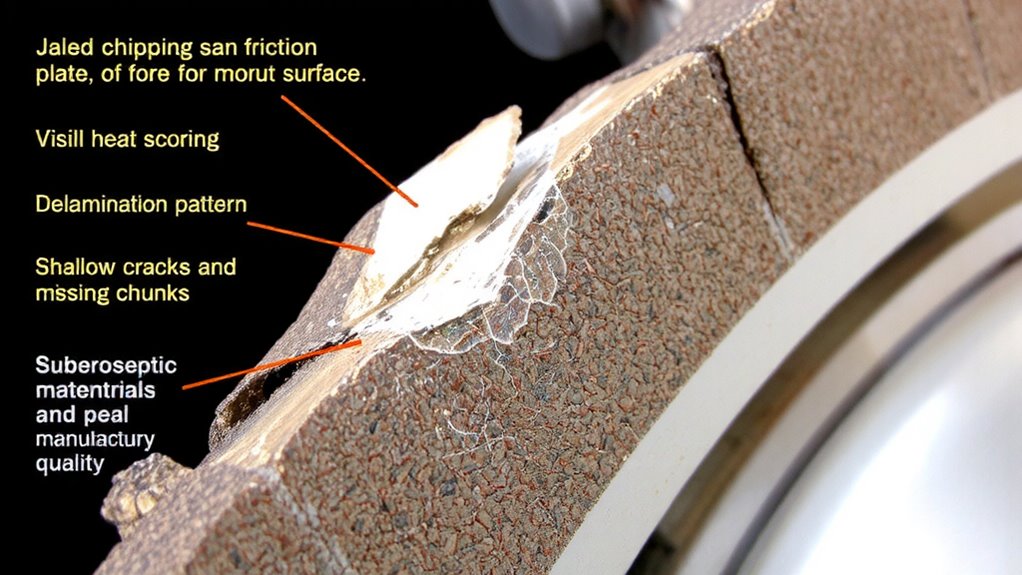
Why do brake pad edges start to chip over time? You’re seeing material fatigue from repeated compression and release during braking. Each stop generates heat and pressure, stressing the pad’s structure. Over time, this cyclic loading degrades the bond within the friction material. Edge deformation occurs when uneven force concentrates on the pad’s perimeter, especially during aggressive stops. The edges, being less supported, fracture more easily. Most OEM pads use a 1.2–1.8 mm steel backing plate, but edge integrity still depends on consistent material density. Once micro-cracks form from fatigue, they propagate with use. You’ll notice chipping first at corners where stress is highest. This isn’t immediate failure, but it reduces effective contact area by up to 15%, compromising stopping efficiency. Chipped edges signal wear progression, not poor initial quality-monitor them regularly. Upgrading to high-performance brake rotors can reduce thermal stress and improve pad longevity.
Why Cheap Brake Pads Crack Under Heat
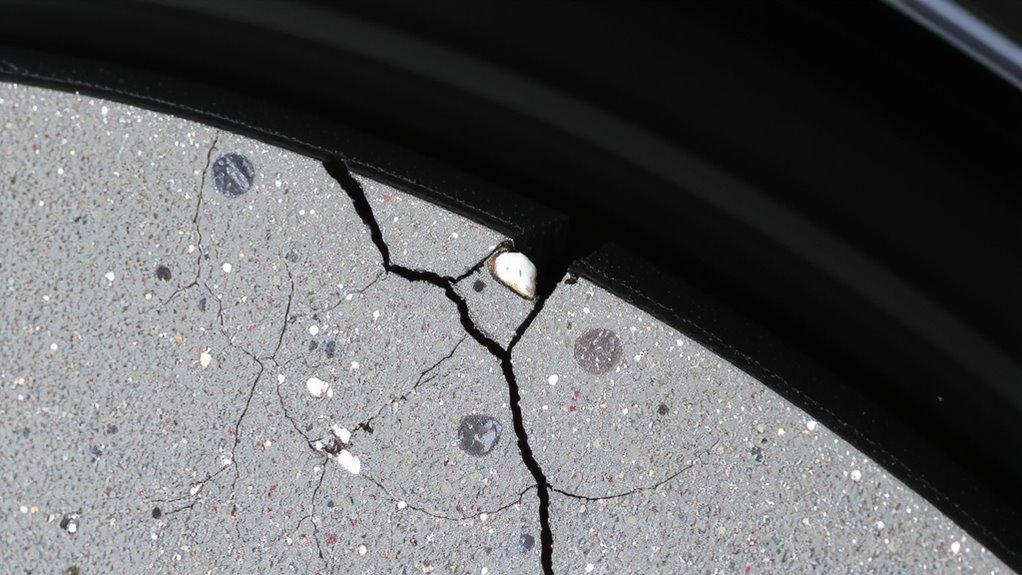
When inferior materials can’t handle thermal stress, cracks form in cheap brake pads. You’re dealing with material fatigue-repeated heating and cooling weaken the pad’s structure over time. Low-grade friction compounds and inadequate steel backing plates expand unevenly, creating internal stresses. These pads often lack proper heat sinks or chamfers to dissipate energy. Temperatures can exceed 600°F during aggressive stops, pushing substandard materials past their tolerance. Thermal shock occurs when rapid temperature changes cause surface layers to contract faster than the core, inducing fractures. Cracks typically start at edges or slots where stress concentrates. Unlike premium ceramics or semi-metals rated for 800°F+, cheap organic pads degrade quickly. Their compressive strength drops by up to 40% after just 50 high-speed stops. This structural failure compromises braking efficiency and pad integrity long before wear indicators engage.
Visible Warning Signs of Pad Damage
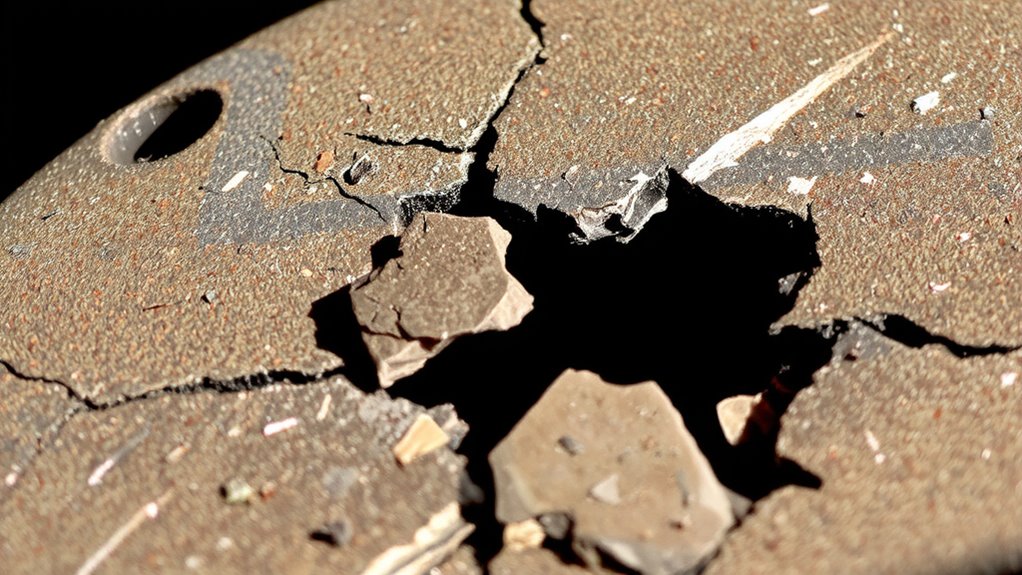
Look for chipping along the edges of your brake pads-this kind of damage is a clear red flag. Edge deformation indicates structural weakness, often from poor material bonding or excessive heat cycles. You might also notice pad corrosion, especially on the backing plate, where moisture leads to rust that compromises adhesion. Corrosion typically starts at the corners and spreads inward, reducing overall pad integrity. Visible cracks or missing chunks along the friction surface are signs of advanced deterioration. The edges should be smooth and uniform; any jaggedness suggests material separation. Standard pads measure 10–14 mm thick-anything below 3 mm requires immediate replacement. Asymmetry in wear patterns may point to caliper issues, but surface damage like chipping is usually material failure. Inspect pads every 15,000 miles. Early detection prevents rotor damage and maintains braking efficiency.
How Chipping Harms Brakes and Safety
Even though chipping may seem like a minor surface issue, it substantially undermines brake pad performance and overall safety. You experience reduced stopping power because chipped edges create uneven contact with the rotor, decreasing effective friction area by up to 30%. This irregular surface leads to inconsistent brake response, especially under heavy loads or wet conditions. Furthermore, debris from chipped material can embed into the rotor surface, causing scoring and increased rotor wear over time. Tests show rotor lifespan can drop by 40% when paired with damaged pads. The compromised structural integrity also promotes heat buildup, elevating the risk of brake fade during repeated stops. Thermal imaging reveals hotspots exceeding 650°F on affected zones. These failures directly impact system reliability. Ultimately, chipping doesn’t just degrade components-it jeopardizes your ability to stop safely and predictably under real-world driving demands.
Choose Brake Pads That Resist Chipping
Durability begins with material composition, and selecting brake pads engineered to resist chipping is critical for maintaining consistent performance. You need pads with high material durability, formulated with reinforced fibers and bonding agents that withstand thermal stress. Ceramic and low-metallic formulations typically offer superior resistance to chipping versus organic types. These materials maintain structural integrity under temperatures exceeding 500°F. Performance consistency relies on uniform friction surfaces-chipping disrupts contact, leading to uneven wear and reduced stopping power. Look for pads with a minimum compressive strength of 1,800 psi and edge coatings that resist microfractures. OEM-spec pads often include chamfers and slotting to manage stress distribution. Choosing premium-grade replacements isn’t just about longevity-it guarantees predictable braking, lower dust output, and compliance with safety standards. Your vehicle’s stopping ability depends on material durability and design precision, not just initial grip.
On a final note
You see chipping edges on brake pads because inferior friction materials lack structural integrity. Cheap pads use low-grade resins and inconsistent filler ratios-typically below 15% metallic content-that degrade under temperatures exceeding 350°C. This causes edge cracking and uneven wear. High-quality pads contain precision-engineered compounds with 20–30% metal fibers, ensuring thermal stability. They resist chipping, maintain pad integrity, and deliver consistent 0.35–0.45 coefficient of friction for safer, longer-lasting performance.