How to Select the Right Amplifier Class (A, AB, D) for Your Car Audio System
Choose Class A if you want the purest sound, but know it’s inefficient-only 20–30%-and runs hot. Class AB gives warm, detailed audio with 50–70% efficiency, ideal for vocals and instruments. For high power and efficiency, Class D delivers over 90%, handles bass-heavy genres, and fits tight spaces. Match your pick to your music, electrical system, and space. Modern designs close the quality gap-discover how each performs under real conditions.
Notable Insights
- Choose Class A for the purest sound quality, but expect high heat and low efficiency, making it rare in car applications.
- Select Class AB for balanced sound fidelity and efficiency, ideal for rock, pop, and vocal-heavy music genres.
- Opt for Class D when prioritizing power and efficiency, especially for bass-heavy hip-hop or electronic music.
- Consider space and cooling: Class A and AB need ventilation, while Class D runs cooler in compact installations.
- Ensure your electrical system supports high-power amps, especially Class D units drawing over 100 amps, with proper 4-gauge wiring.
Understand How Amp Classes Differ for Car Audio
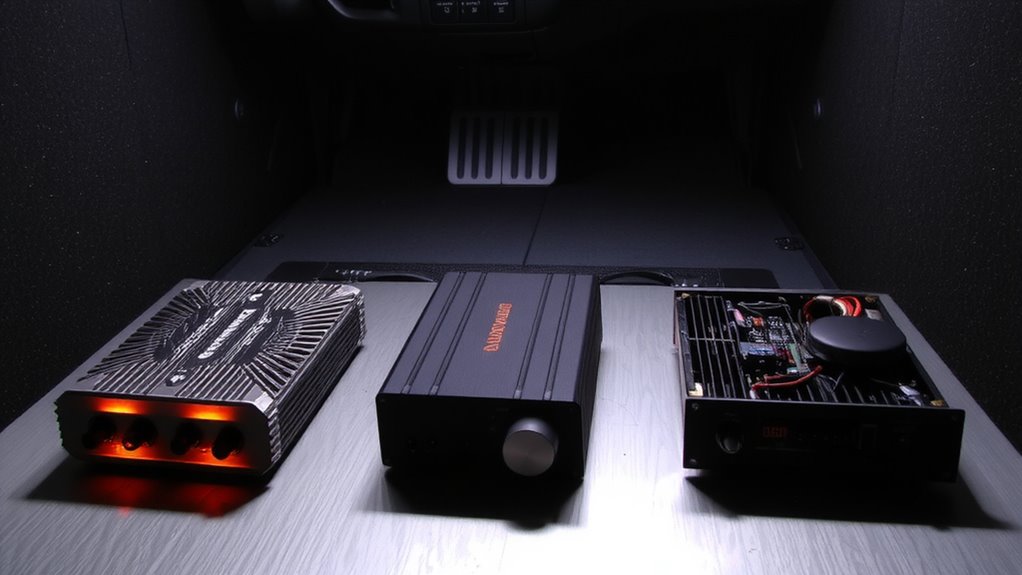
Efficiency, distortion, and power output-these three factors define how amplifier classes differ in car audio. You’ll notice that tube amplifiers, while rare in cars, rely on analog circuits to produce warm, natural sound. These analog circuits operate with continuous signal processing, minimizing harshness. Class A amps, like tube amplifiers, use analog circuits fully on at all times, generating high distortion and low efficiency-usually around 20–30%. Class AB improves efficiency to 50–70% by combining analog circuits that partially bias output transistors, reducing crossover distortion. Class D uses switching technology, achieving up to 90% efficiency with minimal heat. Unlike tube amplifiers, Class D sacrifices some signal purity. You get precise power delivery: Class A offers 50 watts with high heat; Class D delivers 300+ watts efficiently. Each class balances analog circuits and efficiency differently. Know these technical trade-offs to choose wisely. Top-performing systems often use Class D amplifiers for their balance of power and efficiency.
Match Your Music Taste to the Right Amp Class
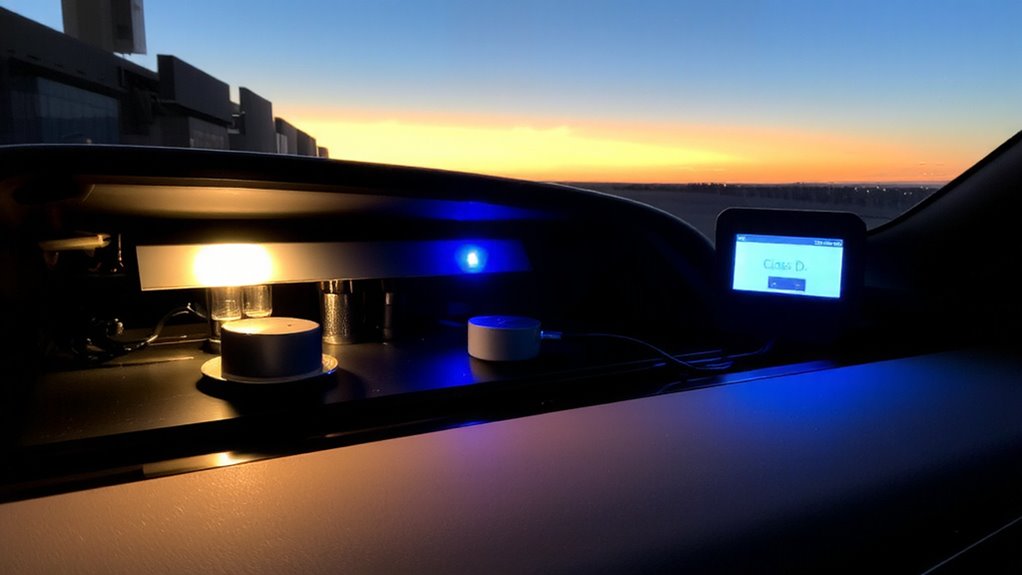
Your music preferences shape the amplifier class that will best deliver your ideal listening experience. Matching your music preference to the correct amp guarantees peak performance and genre alignment.
| Genre | Preferred Amp Class | Key Reason |
|---|---|---|
| Classical/Jazz | Class A or AB | High linearity and low distortion preserve acoustic detail |
| Rock/Metal | Class AB | Balanced power and fidelity handle dynamic range effectively |
| Hip-Hop/Electronic | Class D | Efficient high-power output supports heavy bass demands |
| Pop/Country | Class AB | Warm sound signature complements vocal-centric mixes |
Class A offers pure sound but runs hot. Class AB delivers strong fidelity with better efficiency, making it ideal for most genres. Class D provides high power in compact size, perfect for bass-heavy music. Your genre alignment directly impacts which amp class enhances clarity, detail, and impact. Choose based on technical performance matched to your listening habits.
Weigh Efficiency vs. Sound Quality in Amp Classes
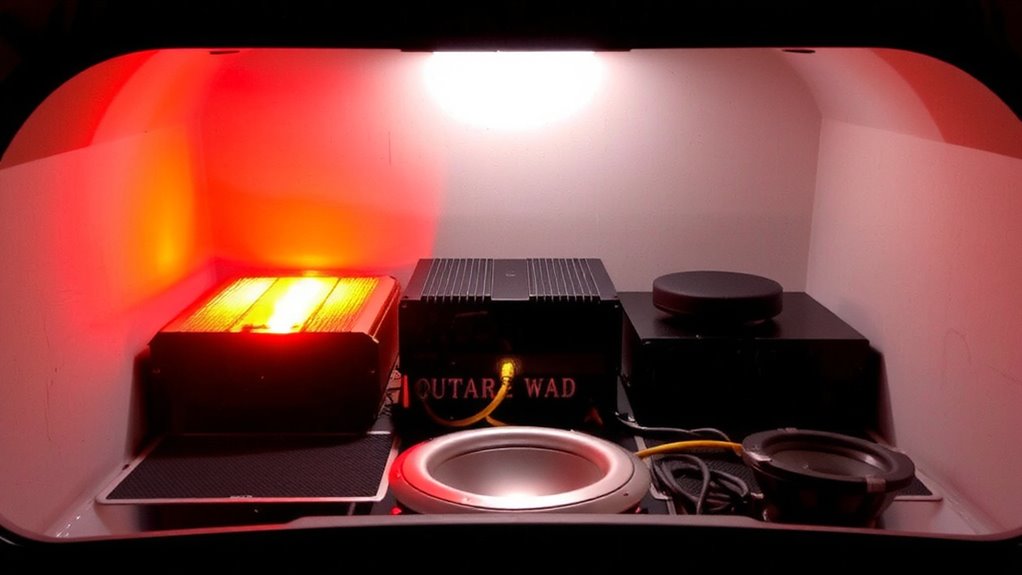
While sound fidelity often takes priority in high-end audio setups, you can’t ignore how much power gets wasted as heat. Class A amplifiers offer exceptional signal fidelity due to continuous biasing, minimizing distortion. However, they operate at only 20-30% power efficiency, converting over 70% of energy into heat. That means higher current draw and added strain on your car’s electrical system. Class AB amps strike a balance, achieving 50-70% power efficiency while maintaining strong signal fidelity through reduced crossover distortion. They’re ideal when you want better sound without excessive heat. Class D amps prioritize power efficiency, reaching 90% or more by using pulse-width modulation. Though early models sacrificed signal fidelity, modern designs rival AB in clarity. Efficiency matters in cars with limited alternator output. But if pristine audio is your goal, slight losses in fidelity may be worth the trade-off. Choose based on your needs. A top-performing 4-channel amplifier can deliver both power efficiency and high-quality sound when matched with the right amp class.
Pick the Right Amp Class for Your Car and Goals
What kind of driving experience are you after? If you want clean, high-fidelity sound and don’t mind lower efficiency, Class A amps offer the best audio quality but generate significant heat and have low power output relative to energy consumed. They’re rare in cars for this reason. Class AB amps strike a balance-better efficiency than Class A, with less distortion than Class D. They’re ideal for audiophiles wanting warmth in vocals and instruments. For most drivers, Class D is ideal. These amps deliver high power output in compact sizes, with minimal heat generation. They’re up to 90% efficient, meaning less strain on your car’s electrical system. While early models had sound quality issues, modern Class D amps rival AB in clarity. Match the amp class to your priorities: sound precision, space, or efficiency. Choose based on measurable performance, not hype.
Avoid These Common Amp Class Mistakes
Choosing the right amplifier class sets the foundation for your car audio system’s performance, but even the best choice can’t compensate for common implementation errors. Installing a Class A amp in a small cabin space increases overheating risks due to constant power dissipation-these amps operate at only 20-30% efficiency. Class AB amps offer a balance, but their 50-70% efficiency still demands proper ventilation. Neglecting heat management leads to thermal shutdown and component failure. You also can’t ignore power draw. A high-output Class D amp may require 100+ amps of current, stressing your vehicle’s alternator and battery. Use 4-gauge wiring for amps drawing over 500 watts RMS to prevent voltage drops. Always match your electrical system’s capacity to the amp’s peak current demands. Poor power supply planning results in dimming lights and unstable performance. For reliable performance, consider investing in one of the Top Car Stereo Amplifiers recommended by audio experts.
On a final note
Choose Class A for pristine sound with high distortion specs under 0.01%, but expect low efficiency around 20%. Class AB offers a balanced 50–70% efficiency with distortion near 0.1%, ideal for most music. Class D delivers 90% efficiency and compact size, suited for bass-heavy systems with THD up to 0.05%. Match your vehicle’s power capacity, listening preferences, and thermal tolerance to the right class. Avoid overheating or power strain by aligning specs with real-world demands.