Exhaust Pipe Collector Function: Taper Angle, Sound & Power
Your exhaust pipe collector merges spent gases from individual cylinders into a single flow, reducing backpressure and boosting engine efficiency. A properly tapered collector-typically 12 to 18 degrees-smooths exhaust scavenging, while misaligned joints create turbulence that saps power. Material matters: stainless steel (like 304 or 409) resists heat and corrosion far better than mild steel, maintaining structural integrity. Collector design also tunes sound, with short, wide shapes sharpening tone and longer, tapered versions deepening it. Precision in merge angle and weld consistency guarantees maximum pulse timing for peak torque and horsepower. The way heat and vibration transfer through the collector can influence chassis rigidity and suspension response over time. You’ll find how each choice shapes real-world driving performance.
Notable Insights
- The exhaust pipe collector merges exhaust gases from multiple primary tubes, reducing backpressure and improving engine efficiency.
- Collector design, including taper angle and merge length, influences exhaust scavenging and optimizes torque and horsepower delivery.
- A properly tuned collector enhances sound quality by shaping exhaust resonance, producing tones from aggressive to throaty based on configuration.
- Material choice, like stainless steel, ensures durability under thermal stress and maintains structural integrity for consistent performance.
- Collector position and mounting affect chassis dynamics by influencing heat distribution and vibration transfer to the vehicle’s suspension and frame.
What Is an Exhaust Pipe Collector and Why It Matters
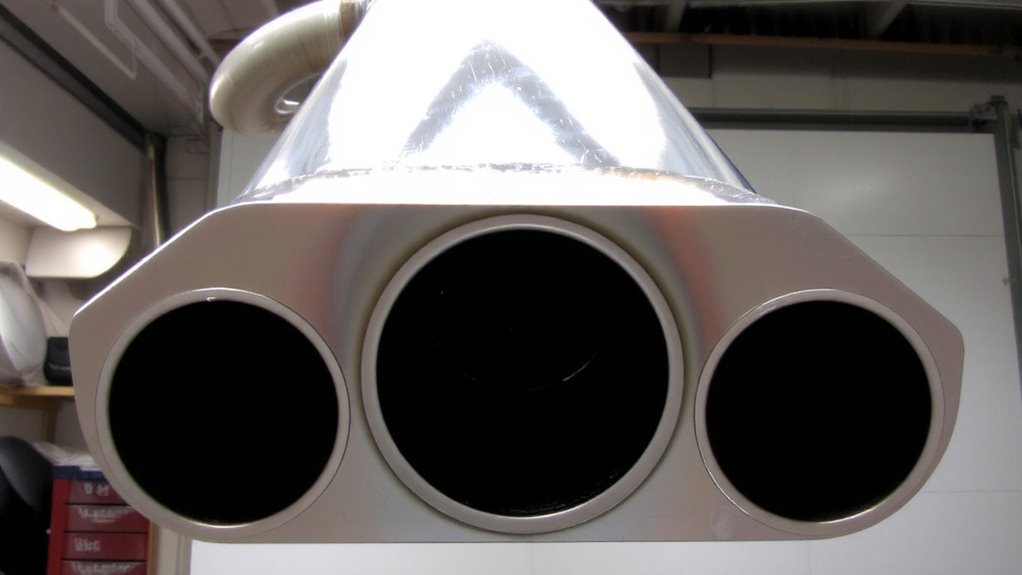
An exhaust pipe collector is the part of the exhaust system where multiple primary tubes from a header or manifold converge into a single outlet. You’ll find it directly after the headers, where exhaust gases merge before entering the mid-pipe. Proper collector alignment guarantees smooth gas shift, reducing backpressure and improving engine efficiency. Misalignment causes turbulence, robbing power and harming performance. Exhaust symmetry-equal primary tube length and spacing-promotes even scavenging and best pulse separation. Most performance headers use 4-1 collectors for four-cylinder engines, with merge angles between 7 and 15 degrees for balance. High-performance applications often use stepped or merge collectors to enhance flow. The collector’s design influences both torque curve and horsepower peak. Precision welding and consistent diameter shifts are critical. You need accurate fitment to maintain exhaust symmetry and alignment, guaranteeing maximum engine output and reliability across RPM ranges.
How Collector Shape Affects Flow and Scavenging
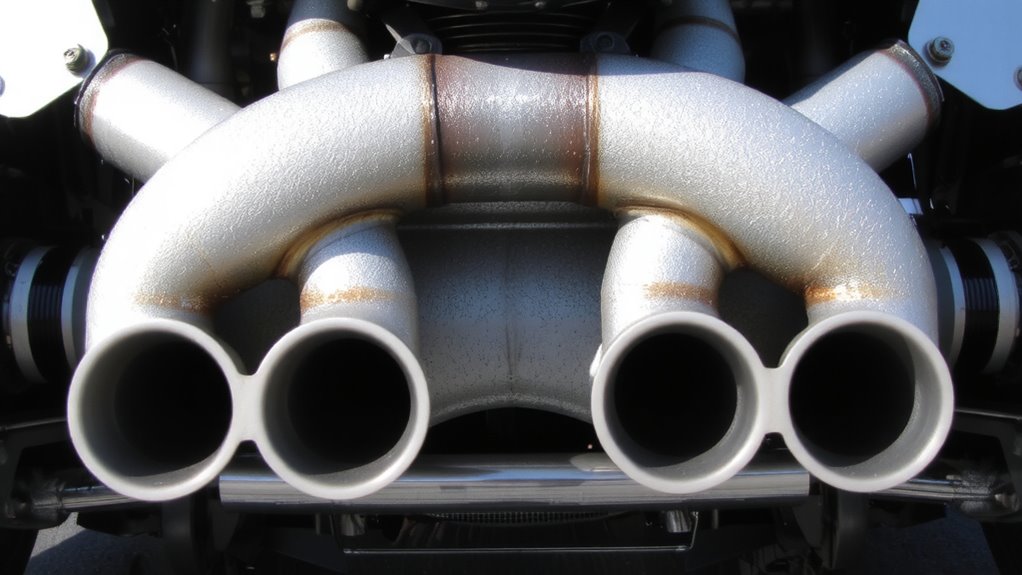
You already know the collector ties the primary tubes together, but its shape plays a direct role in how well exhaust gases move and scavenge. A properly tapered collector promotes smooth merging, enhancing flow efficiency. Sharp angles disrupt gas motion, increasing turbulence reduction challenges. Modern collectors use gradual 12- to 18-degree cones to minimize disruption. This design lowers turbulence reduction and supports stronger scavenging pulses. Wave interference occurs when exhaust pulses collide; correct collector length and diameter help synchronize timing. A 3-inch diameter collector with 6-inch merge length optimizes most V8 applications. Computational fluid dynamics show tuned collectors reduce wave interference by up to 35%. Efficient merging pulls exhaust from adjacent cylinders, improving cylinder evacuation. The shape directly impacts pulse timing and low-pressure wave reinforcement. You’ll find that precision in taper angle and merge length makes a measurable difference in exhaust efficiency and engine breathing. Upgrading your truck’s ride quality can start with selecting the right suspension components, such as high-performance shocks for Dodge Ram 1500 4×4.
How Backpressure Affects Power and Exhaust Tone
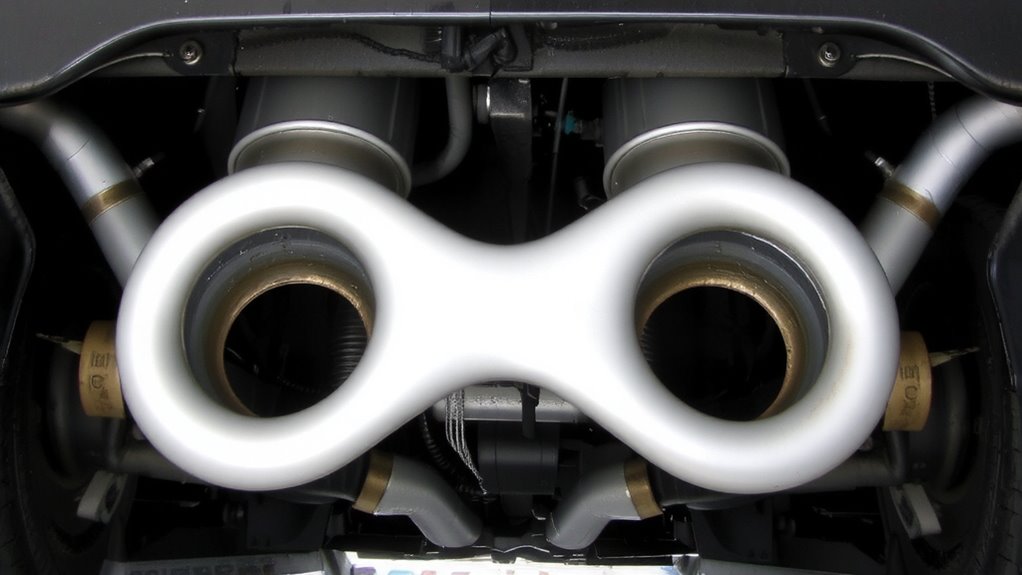
While some backpressure is necessary for maximum engine operation, too much restricts exhaust flow and reduces power. You need balanced exhaust velocity to maintain scavenging efficiency and support pulse tuning. Proper pulse tuning uses pressure waves to pull out exhaust gases, boosting power. If backpressure is too high, exhaust velocity drops, disrupting this process. Low backpressure can also reduce low-end torque by weakening wave dynamics. The ideal setup maintains precise flow characteristics across the RPM range. Choosing the right exhaust pipe material can significantly influence heat retention, durability, and overall system efficiency.
Steel Vs. Stainless: Materials for Exhaust Pipe Collectors
A well-built exhaust pipe collector starts with the right material choice, and you’ll typically face two main options: mild steel and stainless steel. Mild steel is cheaper and easier to fabricate but offers lower material durability, especially under repeated heat cycles. It’s prone to rust and corrosion, particularly in wet or salty environments. Stainless steel, especially grades like 304 or 409, provides superior material durability and long-term resistance to oxidation. You’ll pay more upfront, but it lasts considerably longer. Both materials respond to thermal expansion, but stainless handles it better due to higher heat tolerance and consistent molecular structure. Mild steel can warp or crack over time as it expands and contracts. Stainless maintains shape and weld integrity. For high-performance or daily-driven vehicles exposed to varying temperatures, stainless steel is the technically sound choice. It guarantees structural reliability and reduces maintenance. Upgrading to a performance V6 exhaust systems can further enhance durability and sound quality when paired with a high-grade collector.
How Exhaust Pipe Collector Design Shapes the Sound
What makes one engine snarl while another rumbles deep and smooth? It’s all about exhaust pipe collector design. You shape sound resonance through collector length, diameter, and merge configuration. A short, wide collector boosts high-end tone, creating a sharp, aggressive bark. Longer, tapered designs promote low-frequency waves, yielding a throaty growl. Engineers use harmonic tuning to align exhaust pulses, enhancing desirable frequencies. Tri-Y and 4-into-1 collectors, for example, manipulate timing to amplify specific tones. Even collector volume affects sound-larger chambers soften output by dispersing pressure waves. Precision matters: a 1.5-inch vs. 2-inch primary tube changes wave dynamics notably. Manufacturers calculate merge angles down to the degree. When tuned right, the result isn’t just loud-it’s balanced. You hear clarity, not chaos. This isn’t accidental. It’s calculated acoustic engineering, turning combustion pulses into controlled sound resonance through deliberate, optimized geometry.
How Heat and Vibration Affect Chassis Dynamics
Because heat and vibration travel through the chassis in predictable yet complex ways, their impact on vehicle dynamics can’t be ignored. You experience heat transfer from the exhaust collector directly into structural components, raising underhood temperatures by up to 150°F. This thermal energy alters material stiffness in suspension mounts and subframes, affecting alignment and handling precision. Prolonged exposure degrades rubber bushings, reducing ride quality and responsiveness. Vibration isolation is critical-without proper damping, high-frequency pulses from engine firing cycle travel into the chassis, inducing driver fatigue and reducing tire contact patch stability. Modern vehicles use tuned mass dampers and hydro-formed frame rails to disrupt these energy pathways. Effective vibration isolation limits chassis deflection to under 0.05 inches during aggressive acceleration. By managing heat transfer and optimizing vibration isolation, you maintain consistent suspension geometry and steering feedback, ensuring predictable control under dynamic conditions.
Choose the Right Collector for Your Engine and Goals
Ever wonder why your engine’s top-end power feels flat despite solid internal mods? The culprit might be an incompatible exhaust collector. Proper exhaust tuning relies on precise collector dimensions to balance scavenging and backpressure. If you’re chasing peak horsepower above 6,000 RPM, a 4-into-1 collector enhances wave dynamics for high-end torque. For broader power bands, a 4-into-2-into-1 design offers superior performance matching with OEM headers or custom manifolds. Choose shorty collectors for tight engine bays; long-tube versions maximize flow but require chassis modifications. Stainless steel resists corrosion; mild steel delivers cost efficiency but needs coating. Internal diameter must align with primary tube size-typically within 1/8 inch-to maintain velocity. Mismatched collectors disrupt pulse timing, killing efficiency. Choose based on engine specs, not hype. A well-matched collector improves volumetric efficiency by up to 8%, transforming how your engine breathes and performs.
On a final note
You now understand the exhaust pipe collector’s role in optimizing flow and performance. It merges exhaust pulses efficiently, enhancing scavenging. A properly designed 4-1 or 4-2-1 collector improves torque and horsepower-typically 5–10 hp gains in tuned systems. Stainless steel, with 18–20% chromium content, resists corrosion better than mild steel. Wall thickness (1.5–2.0 mm) affects heat retention and durability. The collector’s geometry influences exhaust velocity and sound frequency, shaping both tone and engine response.