Demystifying Hybrid Transmission Systems: A Detailed Breakdown of How They Work and Their Advantages Over Conventional Transmissions
You experience instant torque-up to 150 lb-ft-from the electric motor at low speeds, while the gasoline engine powers the wheels or recharges the battery. Toyota’s power-split system uses a planetary gearset to seamlessly blend power sources. This design eliminates the need for a torque converter and allows EV-only, engine-only, or combined operation. Hybrids achieve 40–60 MPG, cut emissions by 30–50%, and recover energy via regenerative braking. See how each component interacts to optimize efficiency and performance.
Notable Insights
- Hybrid transmissions combine internal combustion engines and electric motors to seamlessly switch or blend power sources for optimal efficiency.
- A planetary gearset splits engine power between the wheels and a generator, enabling flexible power distribution in power-split hybrids.
- Electric motors provide instant torque at low speeds, enhancing acceleration and eliminating the need for traditional gear shifts.
- Regenerative braking captures kinetic energy during deceleration, converting it to electricity to recharge the battery without external charging.
- Hybrid systems achieve 40–60 MPG and reduce emissions by 30–50% compared to conventional transmissions, thanks to efficient power management and fewer mechanical losses.
What Is a Hybrid Transmission System?
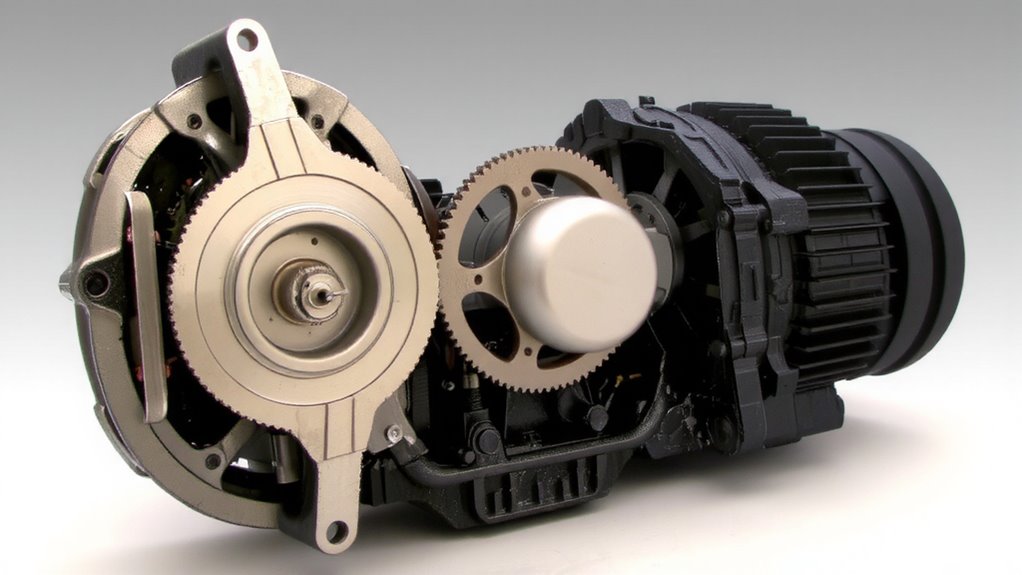
A hybrid transmission system blends the strengths of mechanical and electrical power transfer to optimize vehicle performance and efficiency. You’ll find it in modern hybrids that use both an internal combustion engine and one or more electric motors. This setup allows seamless switching or combining of power sources. The transmission evolution from manual and automatic systems to hybrid designs marks a major engineering shift. Early hybrid history includes the 1997 Toyota Prius, which introduced mass-market power-split transmissions. These use planetary gear sets to balance engine speed and electric motor input. Most operate without traditional gears, relying instead on continuously variable functions. They maintain ideal RPMs, improving fuel economy by up to 30% compared to conventional automatics. Modern versions weigh between 100–140 lbs and handle torque outputs from 120 to over 200 lb-ft. You get precise control through integrated electronic management systems.
How Hybrid Transmissions Blend Power Sources
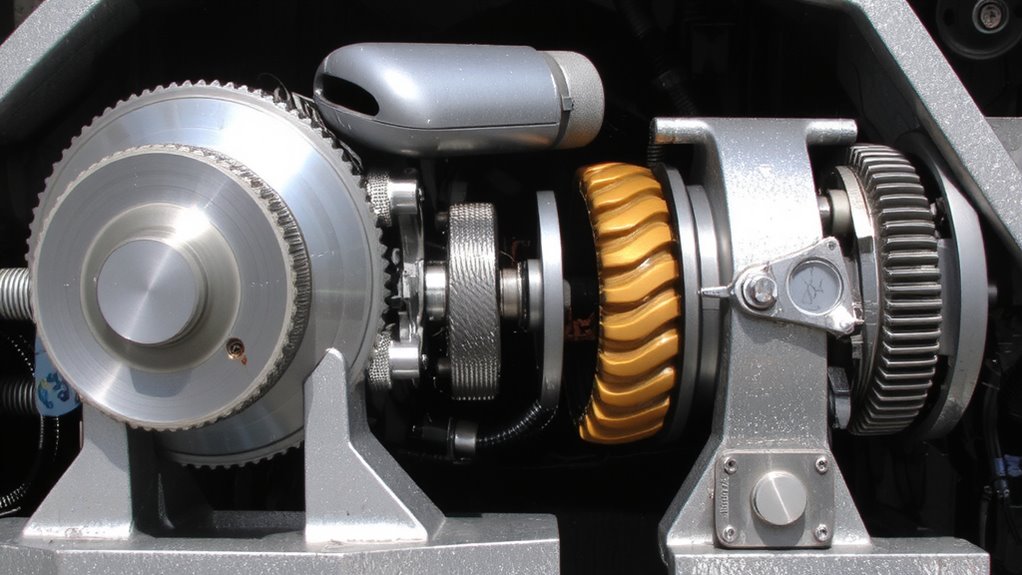
When properly coordinated, mechanical and electrical power streams combine within a hybrid transmission to deliver smooth, efficient performance. You’ll find power splitting at the core of this integration, where a planetary gearset divides engine power between the wheels and a generator. This allows simultaneous mechanical drive and battery charging. Torque coordination guarantees the electric motor’s output complements engine torque seamlessly, eliminating hiccups during shifts. The control system adjusts motor torque in milliseconds, matching load demands with precision. In many systems, the motor provides up to 150 lb-ft of torque instantly at low speeds. Power splitting enables the engine to run in its most efficient range, improving fuel economy by up to 30% compared to conventional setups. Through exact torque coordination, acceleration feels continuous, whether drawing from fuel or stored electricity. You experience optimized performance without sacrificing efficiency.
The Engine, Motor, and Battery: How They Work Together
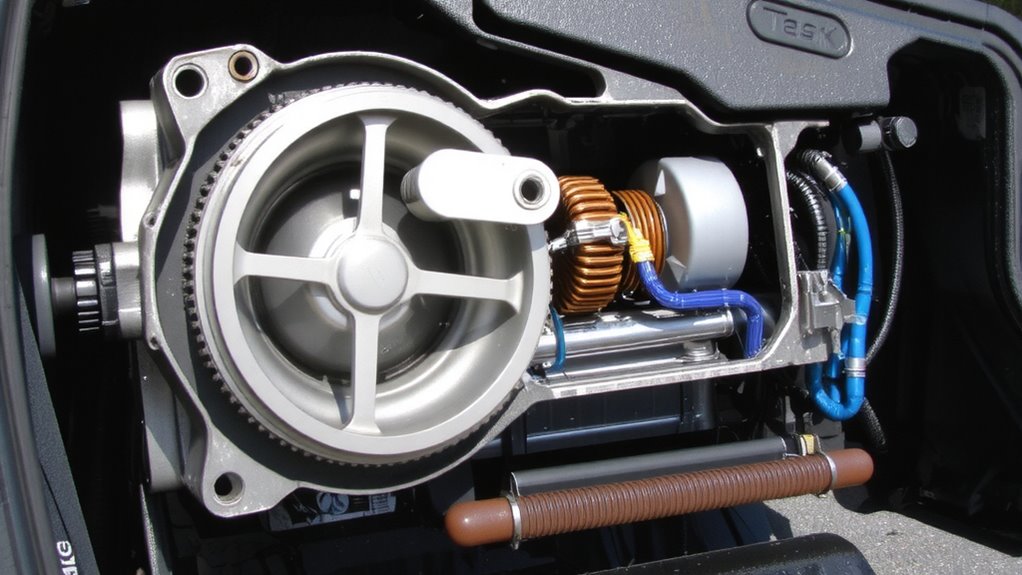
Because the engine, motor, and battery must operate in sync, their integration defines the core efficiency of any hybrid system. You rely on seamless power sharing between the internal combustion engine and electric motor to optimize performance and fuel economy. During acceleration, both systems deliver torque; during cruising, the engine powers the wheels and recharges the battery. Energy recovery occurs under braking, converting kinetic energy into electricity stored in the battery. This stored energy drives the motor at low speeds or supplements engine power when needed.
| Component | Function |
|---|---|
| Gas Engine | Provides primary power at high load |
| Electric Motor | Assists with torque and EV driving |
| Battery Pack | Stores energy from recovery and engine |
Different Types of Hybrid Transmissions
While all hybrid vehicles pair an internal combustion engine with an electric motor, the way power is transmitted to the wheels varies considerably depending on the transmission type. You’ll encounter three main designs: series, parallel, and power split. The power split design, used in most Toyota and Lexus hybrids, combines both engine and motor power seamlessly using a planetary gear set. This setup allows the vehicle to run on electric power alone, gasoline alone, or a blend. Regenerative braking captures kinetic energy during deceleration, converting it into electricity to recharge the battery. Unlike conventional systems, power split transmissions don’t require a traditional gearbox. They deliver smooth, stepless acceleration. Honda’s dual-motor system operates similarly but with simpler coupling. Each design optimizes efficiency, though power split systems lead in fuel economy, often exceeding 50 mpg in combined driving.
Why Hybrids Beat Conventional Transmissions
Hybrid transmissions outperform conventional ones by eliminating inefficient mechanical processes and optimizing power delivery. You get better fuel efficiency because the system seamlessly switches between electric motor and internal combustion engine. Most hybrids achieve 40–60 MPG, compared to 20–30 MPG in conventional models. The electric motor provides instant torque, reducing engine load and improving acceleration response. Regenerative braking captures kinetic energy, converting it into electricity to recharge the battery-energy conventional systems waste as heat. This contributes to significant emission reduction, with hybrids producing 30–50% fewer greenhouse gases. Power electronics manage energy flow with microsecond precision, ensuring ideal performance. The transmission design reduces mechanical losses through fewer gear stages and intelligent torque vectoring. Unlike traditional automatics, there’s no torque converter-cutting slippage and boosting efficiency. You’re not just driving smarter; you’re driving with engineered precision that maximizes every joule of energy.
Daily Benefits of Driving a Hybrid
When you drive a hybrid, everyday commutes become more efficient and cost-effective. Fuel efficiency improves markedly, with many hybrids achieving 48–55 mpg combined, compared to 25–30 mpg in conventional vehicles. This efficiency stems from regenerative braking and electric motor assistance, reducing engine load. You experience immediate cost savings at the pump, especially in stop-and-go traffic where the electric motor operates independently. Hybrids typically use continuously variable transmissions (CVTs) that optimize power delivery, minimizing energy loss. Over 15,000 miles annually, drivers save $600–$900 in fuel costs. The internal combustion engine cycles off during idle, cutting fuel consumption and emissions. Lightweight battery packs, usually 1–2 kWh, integrate seamlessly without sacrificing cargo space. These systems operate within strict thermal tolerances, ensuring longevity. With fewer mechanical parts under strain, maintenance needs also decrease.
On a final note
You’re driving a future-ready machine. Hybrid transmissions combine an internal combustion engine-typically 2.0L to 3.5L-with one or more electric motors producing 80 to 140 kW. They use regenerative braking to recharge a 1.5 to 10.5 kWh battery. Power delivery is seamless, managed by a planetary gear set or dual-clutch system. This achieves up to 50 mpg, surpassing conventional automatics by 25%.