Why Avoiding Abrasive Sponges Preserves Ceramic Coating Thickness
You’re removing precious microns of protection every time you use an abrasive sponge. Ceramic coatings are only 1–5 microns thick, and aggressive scrubbing can strip up to 0.5 microns per wash. These sponges cause micro-scratches that weaken the SiO₂ matrix, reducing hardness and accelerating erosion. Even with 9H-rated durability, friction degrades structural integrity. Avoiding abrasives preserves coating longevity and performance-discover how proper techniques further protect your investment.
Notable Insights
- Abrasive sponges remove up to 0.5 microns of ceramic coating per wash, accelerating degradation of the 1–5 micron protective layer.
- Micro-scratches from abrasive pads compromise the SiO₂ matrix, reducing hardness and increasing vulnerability to erosion.
- Scratched areas erode 3–5 times faster than smooth surfaces, diminishing hydrophobicity and long-term protection.
- Embedded contaminants in abrasive sponges act as grinding agents, causing cumulative coating wear with each use.
- Avoiding abrasive sponges maintains coating integrity, preserving UV resistance, gloss, and water-repellent properties.
Why Abrasive Sponges Degrade Ceramic Coating Thickness
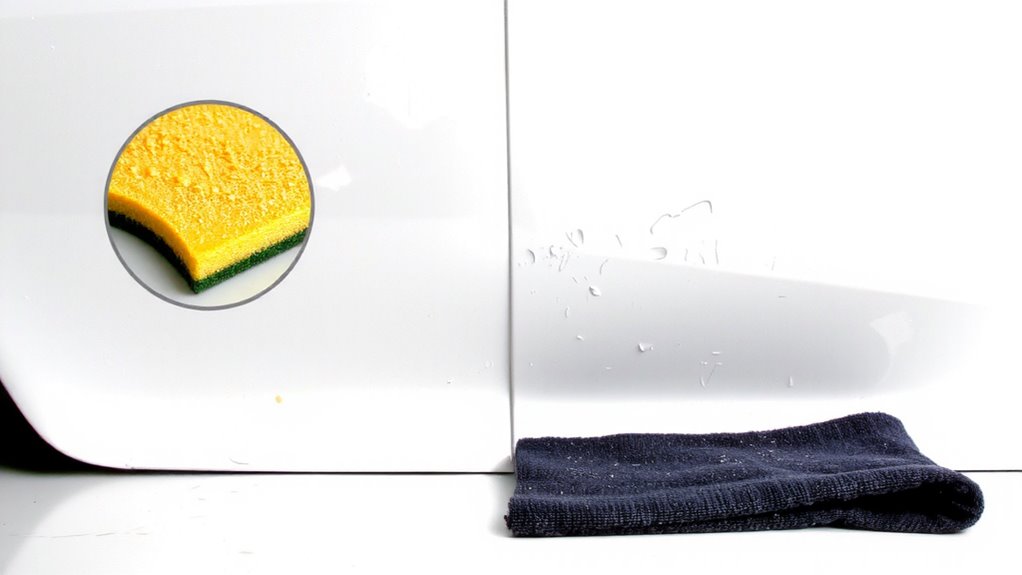
You might not realize it, but using an abrasive sponge on a ceramic-coated surface can do more harm than good. These sponges accelerate surface erosion by removing microns of the coating with each use. Most ceramic coatings range from 1 to 5 microns thick; aggressive scrubbing can remove up to 0.5 microns per cleaning session. This gradual loss reduces protective performance and exposes the underlying material. Surface erosion weakens the coating’s resistance to UV rays, water, and contaminants. Over time, this leads to chemical breakdown, where environmental pollutants penetrate micro-damaged areas, degrading the SiO₂ or TiO₂ matrix. The coating’s hydrophobic properties diminish, and gloss retention drops. Unlike gentle microfiber cloths, abrasive pads create friction-induced stress, compromising structural integrity. Even coated surfaces with high hardness ratings (e.g., 9H pencil hardness) can’t withstand repeated mechanical abuse. Prevent premature degradation-avoid abrasive tools to maintain coating thickness and longevity.
How Micro-Scratches Compromise Coating Integrity
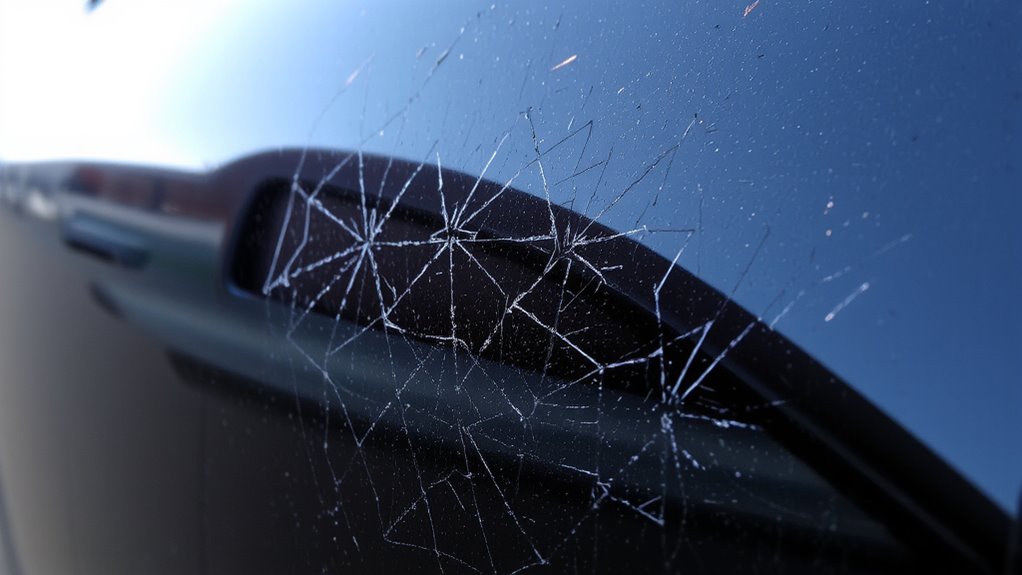
Micro-scratches introduce weak points in ceramic coatings by disrupting the uniform cross-linked matrix of SiO₂ or TiO₂. These tiny fractures compromise the coating’s structural continuity, reducing its hardness from 9H to as low as 6H in affected zones. Surface fatigue accelerates as repeated stress concentrates along scratch edges, promoting micro-crack propagation. Even minor abrasion cycles, like automated car washes, exploit these flaws, deepening the damage over time. Particle embedment occurs when fine contaminants lodge within scratches, acting as abrasive nuclei during subsequent washes. These embedded particles generate additional micro-scratches, creating a degenerative feedback loop. Coating hydrophobicity drops by up to 40% as surface texture shifts from smooth to micro-rough. Thickness loss isn’t uniform-micro-scratched areas erode 3–5 times faster than intact regions. This localized degradation undermines long-term protection, exposing the underlying clear coat to environmental damage.
The Science Behind Coating Degradation From Improper Washing
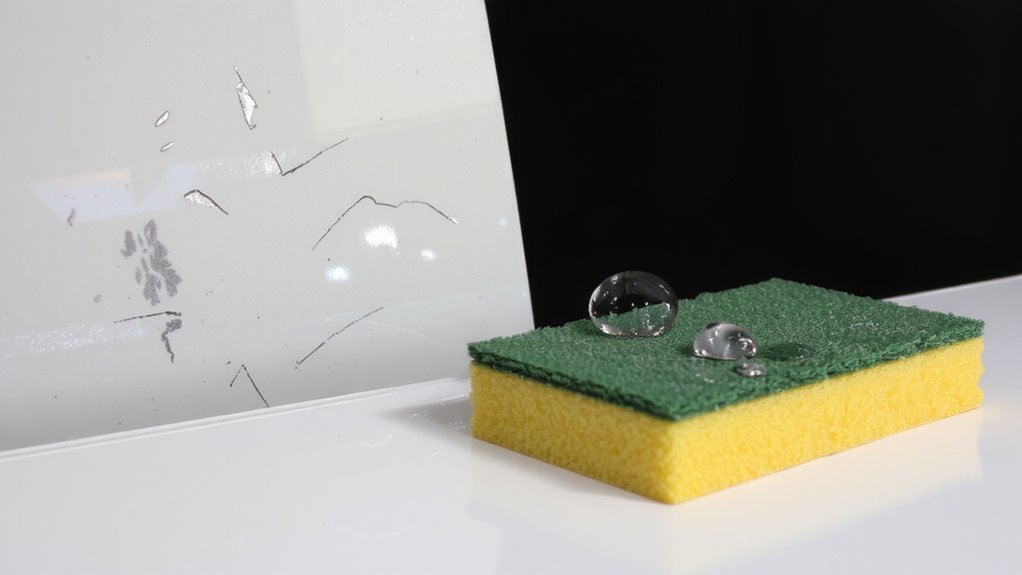
A single wash with the wrong technique can undo months of protection. Improper washing accelerates coating erosion and triggers chemical breakdown, reducing the effectiveness of your ceramic layer. Using harsh tools or incorrect pH cleaners degrades the SiO₂ matrix, which typically ranges from 1 to 2 microns thick. This compromises hydrophobic performance and UV resistance.
| Factor | Effect on Coating | Outcome |
|---|---|---|
| High-pH soap | Causes chemical breakdown | Loss of gloss and repellency |
| Abrasive sponge | Induces micro-scratches | Increased surface friction |
| Dry wiping | Promotes coating erosion | Thin spots and uneven wear |
| Contaminated mitt | Embeds debris | Permanent surface marring |
You must maintain proper washing protocol to preserve cross-linked polymer integrity. Even minor friction over time reduces coating lifespan by up to 50%. Always use clean, soft materials and neutral pH solutions to sustain long-term performance.
Best Washing Tools to Maintain Coating Longevity
When maintaining ceramic-coated surfaces, selecting the right washing tools isn’t just recommended-it’s essential to prevent premature degradation. Foam cannons apply thick, consistent layers of soap, minimizing surface contact and reducing shear forces during cleaning. They typically operate at 30–50 psi, ensuring ideal suds coverage without aggressive spray patterns. Use microfiber wash mitts with a plush depth of 360–480 gsm to trap contaminants safely, reducing marring. Pair mitts with a two-bucket method and Grit Guards to prevent redepositing dirt. After rinsing, apply drying aids like hydrophobic spray waxes or quick detailers to enhance sheeting. Use dedicated microfiber drying towels with 90%+ split fiber density to wick water efficiently. These towels should measure at least 16” x 24” for full coverage. For optimal results, consider using a high-quality foam cannon that ensures even chemical distribution and minimizes direct contact with the coated surface. Proper tools markedly extend coating life by preserving surface integrity.
Why pH-Neutral Soaps Are Essential for Ceramic Coatings
pH-neutral soaps are critical for preserving the integrity and performance of ceramic coatings. These coatings have a specific pH balance, typically between 6.5 and 7.5, making them sensitive to acidic or alkaline cleaners. Regular soaps often fall below pH 5 or above pH 9, triggering chemical sensitivity that degrades the silica-based layer. That breakdown reduces hydrophobicity and shortens coating lifespan. A pH-neutral formula, by contrast, cleans without disrupting molecular bonds in the coating. It removes contaminants like brake dust and road grime without etching the surface. Think of it like using saline solution on contact lenses-compatible and non-reactive. Products labeled pH-neutral (pH 6.5–7.5) prevent etching, hazing, and premature wear. Always verify the pH on the manufacturer’s spec sheet. Using the right soap maintains the coating’s surface energy and durability, ensuring long-term protection and performance. For optimal results, choose a best car shampoo that is specifically formulated for use on ceramic-coated vehicles.
Building a Safe and Effective Washing Routine
Because improper washing techniques can compromise even the most durable ceramic coatings, establishing a safe and effective routine is essential for long-term protection. Always use cool to lukewarm water temperature to prevent thermal shock and avoid trapping contaminants. Hot water can degrade the hydrophobic layer over time, reducing slick forces and self-cleaning ability. Wash in shaded areas to minimize water spotting and drying time. Use a pH-neutral soap diluted to 10:1 (water to soap ratio) with a high-quality foam gun for maximum coverage. Employ a two-bucket method with Grit Guard® to prevent swirls. Rinse thoroughly before and after soaping. Use a plush microfiber mitt, not a sponge, for lifting dirt safely. After rinsing, apply a dedicated drying technique: use a clean, absorbent 100% microfiber drying towel-never let water air-dry. For optimal results, consider using a complete car wash kit that includes all essential tools designed to work together safely on coated surfaces.
On a final note
You preserve coating thickness by avoiding abrasive sponges. They create micro-scratches as deep as 0.5 µm, accelerating degradation. These flaws compromise the ceramic layer’s cross-link density, reducing hydrophobic performance by up to 40%. Use ultra-soft microfiber towels with ≥300 GSM and pH-neutral soaps to maintain integrity. A proper wash routine extends coating life beyond two years. This approach protects the SiO₂ matrix’s hardness, rated at 9H on the pencil scale, ensuring maximum durability and surface protection.