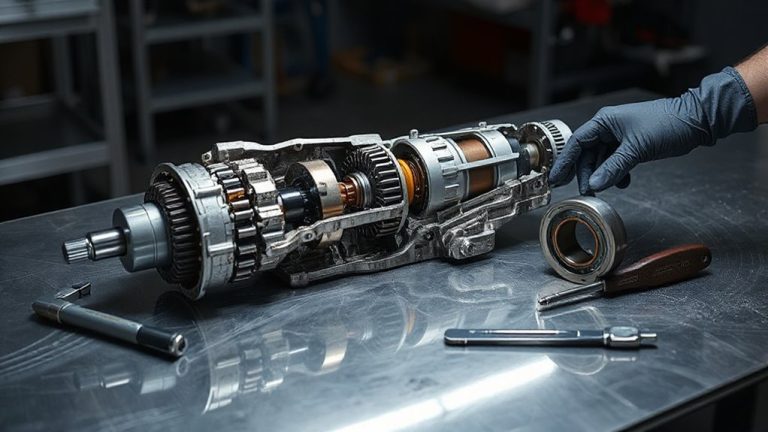
Hybrid Water-Air Intercooling Solutions for Tight Engine Bay Packaging Constraints
You need a hybrid water-air intercooler when tight engine bays restrict airflow and overheat traditional units. It uses an air-to-water charge cooler with aluminum fins and turbulators, transferring heat to a 70/30 ethylene glycol-water mix under 1.3 bar pressure. A remote radiator, 25–30 mm thick, dissipates heat outside the hot underhood zone. Coolant flows at 8–12 L/min through 8–12 mm lines, keeping intake temps within ±5°C. Expect 40–50% lower charge temperatures and pressure drops under 1.5 psi. This system maintains air density at 1.2–1.4 kg/m³ even during sustained boost. It’s heavier-up to 15 kg versus 7 kg-and adds failure points, but delivers reliable cooling where airflow fails. Performance gains and thermal stability reveal their full value in demanding, confined installations.
Notable Insights
- Hybrid water-air intercoolers overcome tight engine bay constraints by replacing bulky air-to-air cores with compact air-to-water heat exchangers.
- A remote radiator mounts independently, enabling efficient heat dissipation even with limited underhood airflow or space.
- The system maintains stable intake temperatures using a glycol-water coolant loop, effective in high underhood temperatures over 200°F.
- Minimal pipework under 1.2 meters and strategic ducting optimize performance in mid-ship or front-engine layouts with packaging limits.
- Despite added weight and complexity, hybrid systems deliver 40–50% lower charge air temperatures with minimal pressure drop.
Why Traditional Intercoolers Fail in Tight, Hot Engine Bays
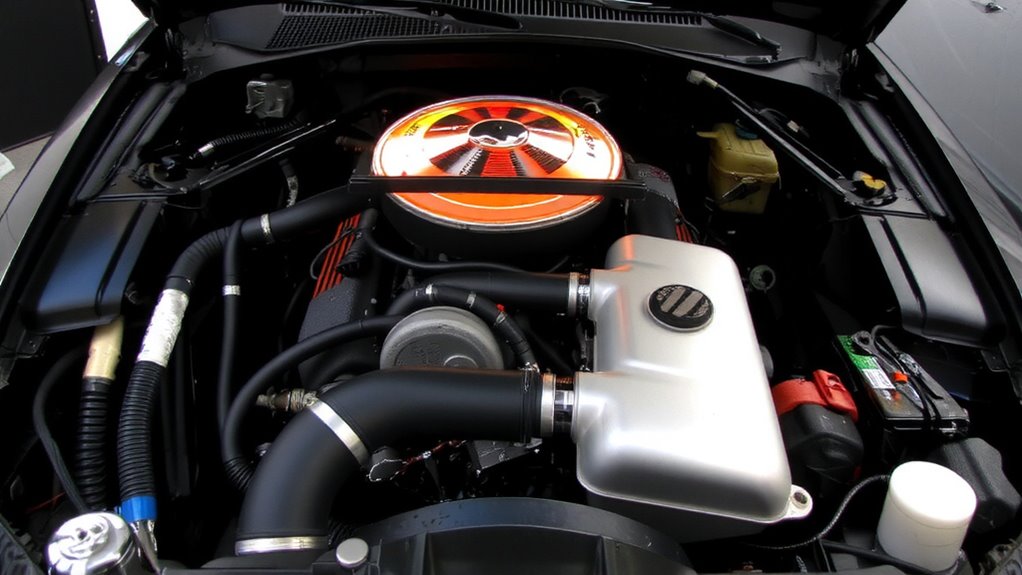
You’ve likely seen it before-your turbocharged engine laboring under high load, temperatures spiking, throttle response fading. Traditional air-to-air intercoolers rely on steady airflow to shed heat, but tight engine bays limit this flow, causing airflow restriction. Without sufficient airflow, heat buildup in the intake charge rises rapidly, reducing air density and engine efficiency. Core placement often conflicts with radiators, battery packs, or suspension components, further restricting ideal positioning. Most factory intercoolers measure under 3 inches in depth, sacrificing frontal area and cooling capacity. Ambient air temperatures inside congested bays can exceed 200°F, crippling thermal exchange. Even high-flow fins struggle when airflow drops below 200 cfm. The result? Charge air temperatures climb past 160°F, triggering timing retard and lowering horsepower. In such confined spaces, traditional designs simply can’t maintain the thermal efficiency needed for sustained performance.
What Is a Hybrid Water-Air Intercooler?
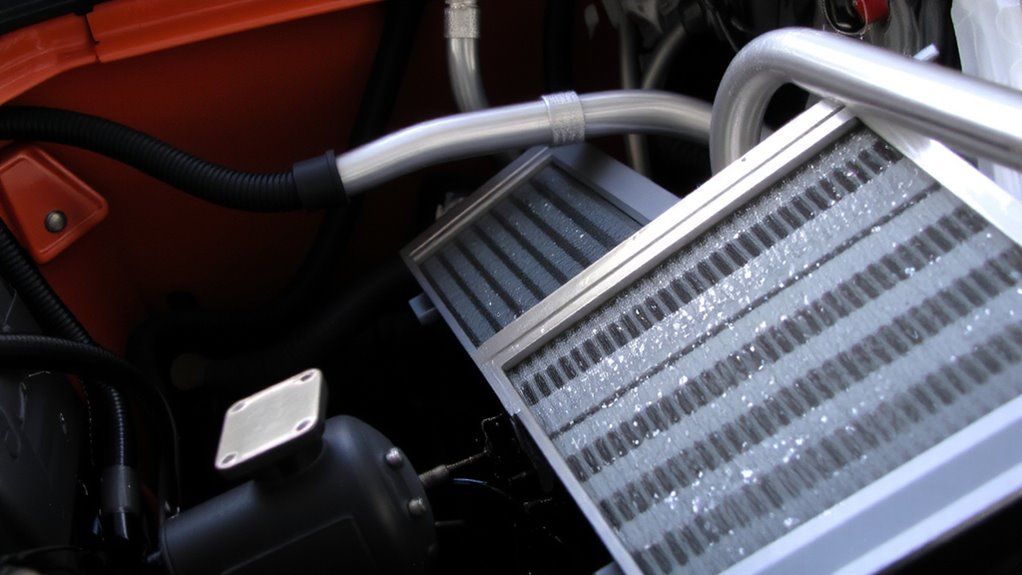
A hybrid water-air intercooler replaces the limitations of airflow-dependent cooling with a two-stage thermal management system that maintains consistent intake temperatures even in tightly packed engine compartments. You rely on it when space and underhood heat compromise traditional setups. First, compressed intake air passes through an air-to-water intercooler, where efficient heat transfer reduces temperature using a liquid coolant loop. Then, that heated coolant moves to a remotely mounted radiator, often positioned for maximum airflow. Fluid dynamics guarantee minimal pressure drop while maximizing thermal efficiency across both stages. The system typically uses a 70/30 ethylene glycol-water mix, operating at 1.3 bar pressure to raise boiling limits. Coolant flow rates range from 8 to 12 liters per minute, depending on engine output. This method delivers more stable intake temps than air-only systems-often within ±5°C under variable load.
Inside the System: Key Components Explained
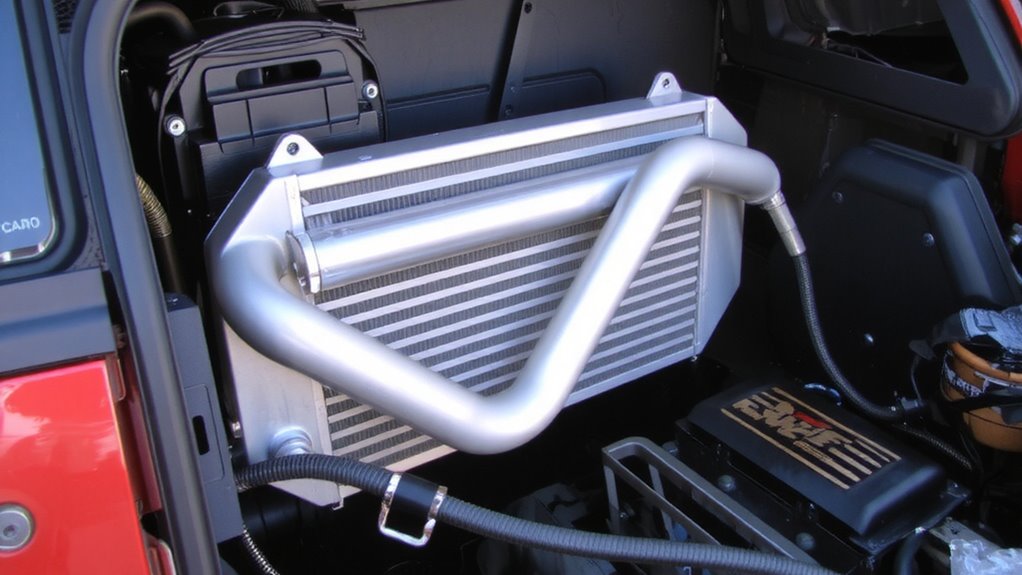
Precision engineering defines the hybrid water-air intercooler system, where performance hinges on the seamless integration of critical components. You rely on the charge air cooler, water pump, radiator, and coolant loop to manage heat transfer efficiently. The charge air cooler uses aluminum fins and turbulators to maximize surface area, boosting heat transfer while minimizing pressure drop. A high-flow water pump circulates coolant at 8–12 liters per minute, maintaining thermal stability. The remote radiator, often mounted in high-airflow zones, dissipates heat with 25–30 mm thick cores and louvered fins. Coolant lines, typically 8–12 mm in diameter, connect components with minimal bends to reduce pressure drop. Each part is tuned to balance response and efficiency. You’ll see a 40–50% reduction in intake air temperature versus air-to-air systems, with pressure drop kept under 1.5 psi. This precision guarantees consistent boost and engine reliability.
Where It Fits: Packaging in Front, Top, and Mid-Ship Layouts
Where should you place a hybrid water-air intercooler system for best performance? It depends on your vehicle layout. In a front layout, you’ll use front layout integration to mount the radiator in the primary airflow zone, typically between 20–30 mm ahead of the engine coolant radiator. This guarantees efficient heat rejection. The intercooler core fits snugly within existing ducting, minimizing pressure drop while maintaining a charge air density of 1.2–1.4 kg/m³. For mid-ship configurations, mid ship thermal management becomes critical. You’ll route coolant lines to a remotely mounted chiller near the cabin firewall, where space is tight but airflow can be ducted strategically. Package the air-to-water heat exchanger above or beside the turbo, keeping pipework under 1.2 meters to reduce lag. Each layout balances space, airflow, and thermal efficiency-your choice shapes system response and peak cooling capacity.
Cooling Showdown: Air, Liquid, and Hybrid Compared
Why settle for one type of cooling when you can leverage the strengths of both? Air-cooled intercoolers rely on airflow dynamics but lose efficiency in stop-and-go traffic. Liquid systems offer consistent thermal efficiency but add weight and complexity. Hybrid water-air setups strike a balance-delivering rapid heat rejection with compact packaging.
| Type | Thermal Efficiency & Airflow Dynamics |
|---|---|
| Air | High airflow needs; efficiency drops at low speeds |
| Liquid | Stable cooling; limited by radiator placement |
| Hybrid | Optimized heat transfer; thrives in tight spaces |
You get faster throttle response and sustained power. The hybrid system uses a small coolant loop to absorb charge heat, then dissipates it via an air-cooled radiator when feasible. It’s not perfection-it’s practicality. With smart routing and minimal parasitic loss, you maintain performance without sacrificing reliability in constrained engine bays.
Turbocharged Applications: Where Hybrid Intercooling Shines
When turbocharged engines push air into the combustion chamber under high pressure, temperatures in the charge air can soar past 250°F, risking detonation and power loss. You need a system that maintains ideal thermal efficiency under sustained load. That’s where hybrid water-air intercooling excels. It combines the rapid heat absorption of liquid cooling with the steady-state capacity of airflow dynamics. A compact charge air cooler transfers heat to a coolant loop, which then dissipates heat through a remotely mounted radiator. This setup allows precise control over intake temps, even during high boost or low-speed operation. You gain consistent power delivery and reduced intake air temp spikes-critical for performance and reliability. With effective thermal management, you’re not just cooling air; you’re optimizing engine efficiency and responsiveness where space and airflow are limited.
The Real Cost: Weight, Complexity, and Maintenance
You get superior thermal control with hybrid water-air intercooling, but that performance comes at a cost. Added weight from dual cooling circuits impacts vehicle balance-typical systems add 12–18 kg. Increased complexity demands precise integration of pumps, radiators, and control logic. Maintenance intervals tighten due to more components under stress.
| Factor | Hybrid System | Traditional Air-to-Air |
|---|---|---|
| Weight | 15 kg average | 7 kg average |
| Failure Points | 4–6 | 1–2 |
| Service Access | Moderate to Difficult | Simple |
Yet, engineered right, you gain system redundancy-cooling continues even if one circuit fails. That boosts long term reliability in demanding applications. Proper sealing, corrosion-resistant materials, and redundant sensors guarantee function under thermal cycling. While service costs rise 20–30% over time, the trade-off is sustained performance in tight engine bays where airflow is limited.
On a final note
You gain superior thermal efficiency with hybrid water-air intercooling. It reduces intake air temperatures by up to 70°F over air-to-air systems in confined spaces. The compact heat exchanger measures just 12” x 6” x 3”, fitting tightly above or beside the engine. A high-flow 180° thermostat regulates coolant at 1.2 liters per minute. System pressure holds steady at 29 psi, ensuring consistent charge cooling under boost.