Optimizing Bluetooth Range for Hands-Free Operation When Exiting Your Car
You can boost your car’s Bluetooth range by ensuring both your phone and vehicle support Bluetooth 5.0 or later, which maintains stable connections up to 300 feet in open conditions. Position your phone vertically in a dashboard mount to align antennas properly. Keep it 30–50 cm from the car’s module and away from metal surfaces. Key fobs and steel frames weaken signals by up to 70%. Use a 2.4 GHz amplifier with a 3 dBi antenna for better reach. Connection stays reliable within 10 meters when exiting. Higher latency disrupts audio past 150 ms. Test in driveways or garages to map dead zones. Further refinements in signal tuning and setup adjustments offer even greater consistency.
Notable Insights
- Ensure both your phone and car support Bluetooth 4.0 or later for maximum range and stable connections.
- Position your phone vertically in a dashboard or windshield mount to optimize antenna alignment and signal strength.
- Keep your phone at least 30–50 cm from the car’s Bluetooth module and away from metal obstructions.
- Avoid placing your phone near key fobs, metallic surfaces, or electronic devices that cause signal interference.
- Test connectivity while walking away from the car to map reliable range, especially in open, multi-level, or obstructed areas.
Check Your Phone and Car Bluetooth Compatibility
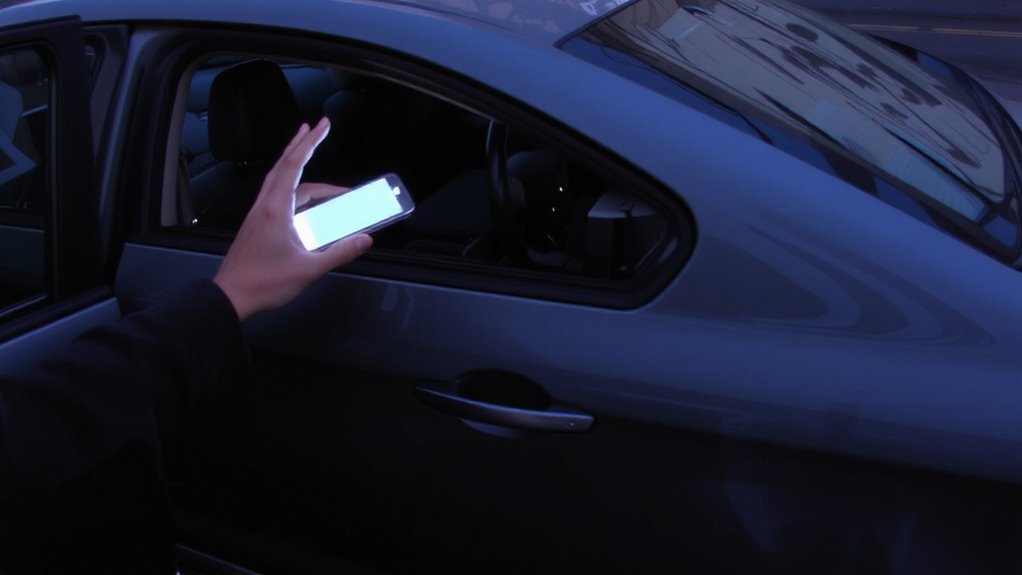
Bluetooth range begins with compatibility. You must verify that your phone and car support matching Bluetooth versions. Current devices typically use Bluetooth 4.0 or later, with versions 5.0 and 5.2 offering range up to 300 feet under ideal conditions. Older cars or phones using Bluetooth 2.1 may limit range to 33 feet. Mismatched Bluetooth versions can reduce effective performance, even if pairing occurs. Pairing protocols also affect connectivity; Secure Simple Pairing (SSP), introduced in Bluetooth 2.1, improves connection reliability and encryption. However, both devices must support the same protocol. If your phone uses modern pairing protocols and your car uses legacy ones, connection stability degrades. Check technical specifications in both device manuals. Ensuring aligned Bluetooth versions and compatible pairing protocols maximizes signal integrity. This foundation directly influences hands-free functionality as you exit your vehicle.
Fix Device Placement to Extend Range
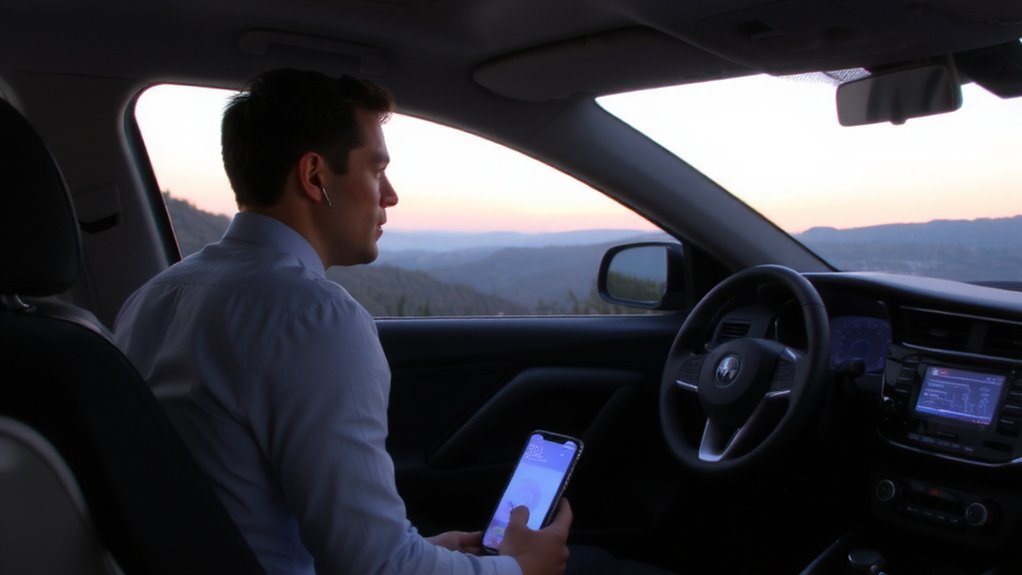
Even when your devices support the latest Bluetooth standards, poor placement can cut your effective range by more than half. Antenna positioning plays a critical role in maintaining a stable connection. Your phone’s internal antenna works best when aligned vertically, not lying flat or buried in a bag. Place it face-up in a center console or dedicated cradle, ideally within 30–50 cm of the car’s Bluetooth module. Signal reflection off metal surfaces can either strengthen or disrupt the connection, depending on angles and distance. Avoid placing the phone near large metallic objects that cause destructive interference. Instead, use dashboard or windshield mounts to elevate the device, minimizing obstructions. Proper orientation maximizes radiation pattern efficiency, preserving link stability up to 10 meters during exit. Correct placement guarantees consistent hands-free performance without relying solely on hardware upgrades.
Stop Interference From Key Fobs and Metal
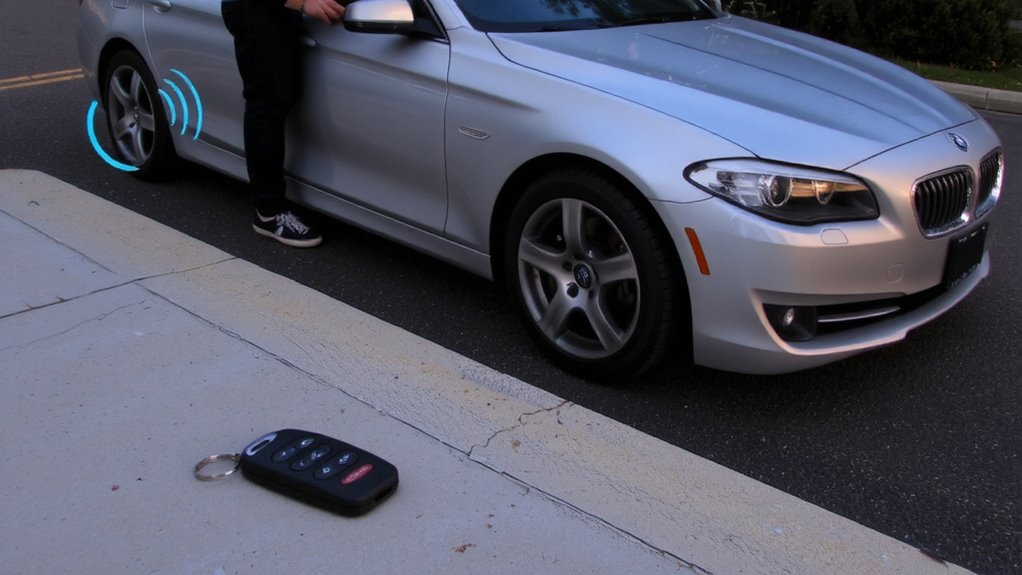
Why does your phone sometimes lose connection just as you step out of the car? Metal in vehicle frames and nearby key fobs can disrupt Bluetooth signals. Key fobs emit radio frequencies near the 2.4 GHz band, causing interference that degrades signal strength. Metallic surfaces reflect Bluetooth waves, leading to signal reflection that distorts the transmission path. This reflection creates dead zones, especially near doors and pillars. Material shielding from steel in doors, roofs, and chassis blocks or absorbs wireless signals, reducing effective range by up to 70%. Even aluminum trim or mirrored windows contributes to attenuation. Keep your phone away from metal surfaces and key fobs to minimize disruption. Position it in a center console or jacket pocket to maintain a clear signal path. Avoid placing it near metallic objects or electronic keys, which act as barriers. A clear line of sight enhances signal reliability.
Boost Signal With Adapters or Amplifiers
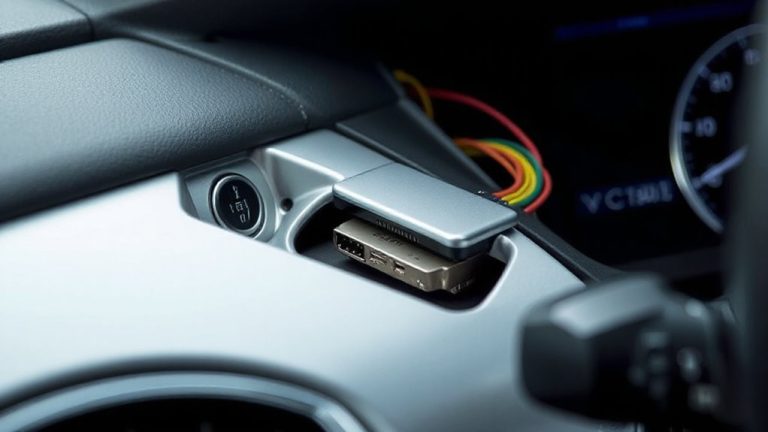
A few well-placed upgrades can nearly double your Bluetooth range when exiting the car. Signal boosters amplify weak transmissions between your phone and car system. Active amplifiers, like the ones operating at 2.4 GHz, increase output power up to 20 dBm, extending reliable connectivity beyond 50 feet. These devices draw minimal current-usually under 100 mA-so they won’t drain your car’s battery. External antennas, especially omnidirectional types with 3 dBi gain, capture more signal across wider angles. They attach via RP-SMA connectors and should mount near the dashboard or windshield for clearest line-of-sight. Combining a signal booster with an external antenna improves both transmission strength and reception sensitivity. Most adapters plug into USB or OBD-II ports, ensuring constant power. Choose models with built-in noise filters to reduce interference. These components work together like a relay team-each passing the signal farther and more clearly than the last.
Test Connection While Walking Away
While moving away from your car, test the Bluetooth connection to pinpoint the effective range and identify potential drop-off points. Start with your phone in the cup holder and walk at a steady pace, monitoring signal stability. Most Bluetooth 5.0 systems maintain strong signal stability up to 33 feet (10 meters) in open air. Observe connection latency during playback-delays beyond 150 milliseconds become noticeable. Concrete walls, metal structures, and crowded 2.4 GHz bands degrade performance. Signal strength typically degrades gradually, but obstacles can cause abrupt disconnections. Test multiple paths: driveways, parking lots, and multi-level garages. Repeat tests at different times to account for wireless interference. Keep your phone unobstructed and avoid placing it in pockets lined with metal. Consistent signal stability guarantees seamless hands-free use. Low connection latency preserves audio sync, especially for voice commands. Record results to map reliable coverage zones. This data helps optimize device placement and expectations.
Troubleshoot Dropouts in Seconds
How quickly can you fix a sudden Bluetooth dropout? Within seconds, if you know what to check. Signal strength degrades rapidly beyond 33 feet, especially with obstructions. Environmental factors like metal structures or Wi-Fi interference disrupt connections.
| Issue | Solution |
|---|---|
| Low signal strength | Move closer to the car’s Bluetooth antenna (typically in the dashboard) |
| Interference from environmental factors | Turn off nearby wireless devices or switch phone to airplane mode briefly |
Restarting your phone’s Bluetooth takes 8–10 seconds and often restores stability. Modern systems auto-reconnect within 5 seconds if within 20 feet and line-of-sight. Firmware updates can improve tolerance to signal fluctuations. Keep your device at chest level-height affects transmission efficiency. Avoid placing phones in pockets during exit; fabric and body mass weaken signal strength. Immediate diagnostics prevent prolonged disconnections.
On a final note
Your Bluetooth system works best when devices are compatible and properly positioned. Make sure your phone and car support Bluetooth 5.0 or higher for stable connections up to 30 meters line-of-sight. Place your phone within 10 cm of the car’s antenna, typically in the center console. Metal and key fobs disrupt signals above 2.4 GHz. Use a powered Bluetooth amplifier if range remains below 15 meters. Test walking tests confirm real-world performance.