Understanding Glass Surface Treatments and How They Enhance Visibility and Safety
You rely on treated glass daily for clearer, safer vision. Anti-reflective coatings reduce glare by causing light waves to cancel out, allowing over 99% light transmission. Tempered glass withstands 10,000 psi and shatters safely. Hydrophobic layers repel water with contact angles above 100°, while scratch-resistant coatings achieve 6–9H hardness. Anti-fog treatments maintain clarity during humidity shifts. Edge polishing cuts failure risk by 70%. These enhancements work together to boost performance in demanding environments-discover how each technology applies to real-world safety and visibility.
Notable Insights
- Tempered glass is four times stronger than annealed glass and breaks into safer, smaller pieces upon impact.
- Edge polishing reduces microcracks and stress concentration, improving glass durability and resistance to cracking.
- Anti-reflective coatings increase light transmission to over 99%, reducing glare and enhancing visual clarity.
- Anti-fog treatments prevent droplet formation by promoting a uniform water film, maintaining visibility in humid conditions.
- Hydrophobic and scratch-resistant coatings repel water, resist abrasions, and enable self-cleaning for sustained visibility and safety.
What Are Glass Surface Treatments: And Why They Matter
Glass surface treatments are processes applied to modify the physical and chemical properties of glass. You use them to improve strength, clarity, and safety. Glass tempering, for example, heats glass to over 600°C and rapidly cools it, increasing strength fourfold. Tempered glass withstands impacts up to 10,000 psi, far beyond standard annealed glass. When it breaks, it crumbles into small, less hazardous pieces-enhancing safety. Edge polishing removes microcracks and surface flaws from cut edges. This process uses abrasive belts or wheels to achieve smooth, rounded edges with a surface roughness under 0.5 µm. Polished edges reduce stress concentration, decreasing the likelihood of chipping or cracking by up to 70%. Both treatments improve durability and optical quality. Together, they guarantee glass performs reliably in demanding environments. You’ll see them in automotive, architectural, and electronics applications where safety and precision matter most.
How Anti-Reflective Coatings Reduce Glare and Boost Clarity

Glare is the enemy of clarity. You experience it whenever stray light reflects off glass, reducing visibility. Anti-reflective (AR) coatings combat this using the principle of light interference. These coatings consist of thin layers-often magnesium fluoride or silicon dioxide-applied to the glass surface. Each layer is precisely ¼ the wavelength of visible light, typically around 125 nanometers. When light hits the coating, some reflects off the top layer and some off the glass beneath. These reflected waves are out of phase by half a cycle. That causes phase cancellation, effectively neutralizing reflected light. The result? Over 99% of light transmits through the glass. With less glare, you get sharper vision, improved contrast, and reduced eye strain-especially in bright or low-light environments. AR coatings don’t eliminate reflections entirely, but they reduce them dramatically, boosting both clarity and safety.
How Anti-Fog Treatments Prevent Condensation on Glass
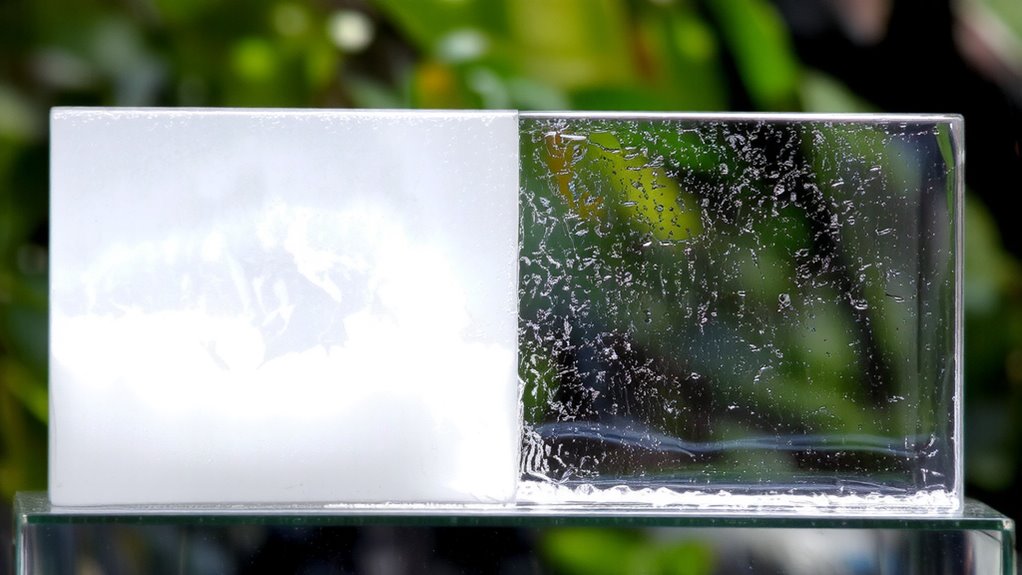
When humidity rises, moisture tends to condense on cool glass surfaces, forming fog that scatters light and obscures vision. Anti-fog treatments prevent this by minimizing condensation formation through improved surface wetting. Instead of beading, water spreads into a uniform thin film, reducing light scattering. This happens because the coating is hydrophilic, attracting water molecules and lowering surface tension. Achieving thermal equilibrium faster between the glass and surrounding air reduces temperature differentials that drive fogging. Most anti-fog layers are made of surfactants or polymers like polyvinyl alcohol, applied via dip-coating or plasma deposition. These coatings last 6–12 months under regular use, though durability improves with cross-linked formulations. Performance is measured by condensation onset time-high-quality treatments delay fog by over 90% compared to untreated glass. In lab tests, treated glass maintains 85% visible light transmission during rapid humidity shifts, ensuring continuous clarity.
How Hydrophobic Coatings Repel Water for Clearer Vision
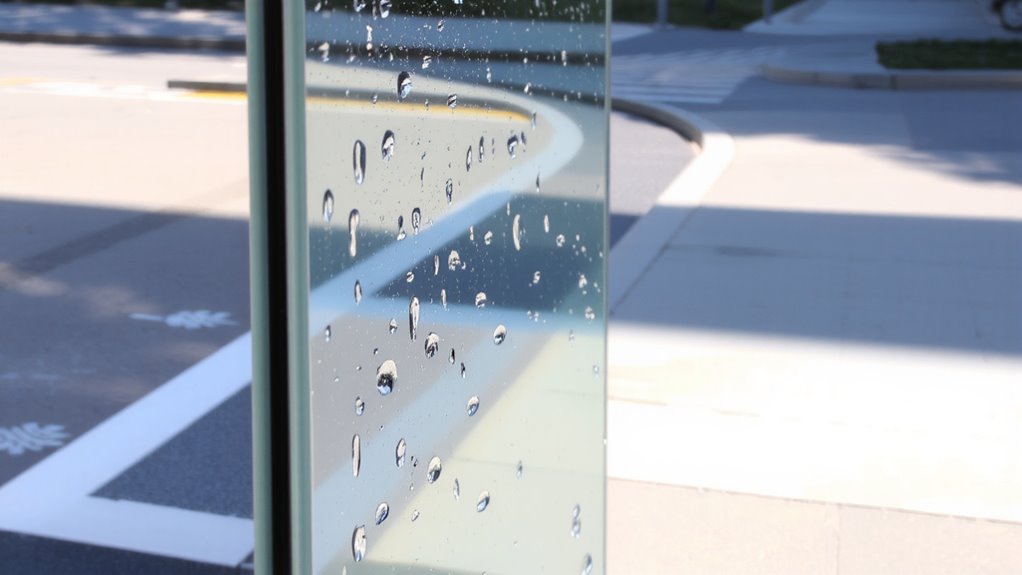
Even though water constantly interacts with glass surfaces, you don’t need visibility compromised by droplets scattering light. Hydrophobic coatings minimize water adhesion, allowing droplets to roll off quickly. These coatings increase the contact angle-the measure of how sharply water beads on the surface-typically to over 100 degrees. A higher contact angle promotes bead formation, reducing the spread of water. Beads form because the treated surface has low surface energy, making it difficult for water to wet the glass. As these beads grow, they combine and slide off with gravity, taking dust and debris with them. This self-cleaning effect maintains clarity during rain or high humidity. Most hydrophobic layers are only a few nanometers thick, often based on silicone or fluoropolymer compounds. They’re applied via vapor deposition or liquid curing. Over time, these coatings can degrade from abrasion or UV exposure, but they markedly boost visibility while driving or using eyewear.
Scratch-Resistant Glass Treatments for Long-Term Durability
A thin, invisible shield keeps your glass from showing every flaw. This coating boosts surface hardness, often to 6-9H on the pencil hardness scale, making scratches far less likely. You benefit from long-term wear resistance, even with frequent cleaning or exposure to abrasive particles. Most scratch-resistant treatments use silica-based layers applied via chemical vapor deposition, creating a bond stronger than the glass itself. The coating thickness typically ranges from 1 to 5 microns-thin enough to stay clear, yet dense enough to endure daily use. These treatments don’t alter optical clarity but markedly reduce micro-scratching from dust, wiping, or contact. Surface hardness improvements translate directly to durability, maintaining smoothness and transparency over years. Unlike untreated glass, treated surfaces resist fine abrasions that scatter light and weaken structural integrity. You get lasting performance with minimal maintenance, ideal for high-use environments where clarity and resilience matter.
Where Surface Treatments Improve Safety: Cars, Planes, Hospitals
Surface treatments play a critical role in enhancing safety across high-stakes environments like cars, planes, and hospitals by modifying glass to withstand stress, resist failure, and reduce hazards. You rely on treated glass daily, often without knowing it. Impact resistance and thermal stability are essential for performance under extreme conditions. In vehicles, laminated glass stays intact during collisions. Aircraft windows resist pressure changes and temperature swings. Hospital glass partitions block contaminants while enduring frequent cleaning.
| Application | Key Benefit |
|---|---|
| Cars | Laminated glass offers high impact resistance, preventing shattering |
| Planes | Multi-layer glazing provides thermal stability up to ±70°C |
| Hospitals | Coated glass resists microbes and maintains clarity after sterilization |
| All | Surface treatments improve durability and safety compliance |
Choose the Right Treatment for Clarity and Safety Needs
How do you guarantee your glass performs reliably under stress while maintaining crystal-clear visibility? You select a surface treatment tailored to your specific clarity and safety demands. Anti-reflective coatings reduce glare by up to 90%, enhancing optical clarity without compromising structural integrity. For high-impact environments, ion-exchange tempering increases surface compression to over 600 MPa, boosting strength. Consider glass aesthetics-low-iron formulations offer near-transparent clarity, ideal for display and architectural uses. Treatments like hydrophobic or oleophobic layers maintain visibility in harsh conditions by repelling water and oils. Evaluate the environmental impact: some coatings use toxic solvents, while newer plasma-enhanced options are eco-friendly and durable. Always match the treatment to the application-automotive glazing needs different performance than hospital enclosures. Choose wisely: the right balance of clarity, durability, and sustainability guarantees long-term safety and performance.
On a final note
You rely on treated glass for clearer vision and improved safety. Anti-reflective coatings cut glare by up to 90%, enhancing contrast. Hydrophobic layers bead water at contact angles over 100°, improving visibility in rain. Anti-fog treatments maintain light transmission above 95% by preventing condensation. Scratch-resistant coatings withstand 4–6 H pencil hardness, preserving clarity. These technologies meet ISO 10545 and ANSI Z26.1 standards, ensuring performance in vehicles, aircraft, and medical facilities where reliability is critical.