Efficiency Curves of TVS-Series Eaton Superchargers Across RPM Bands
You get peak efficiency from TVS-series Eaton superchargers between 1,800 and 6,000 RPM, where 160° twisted four-lobe rotors deliver up to 85% adiabatic efficiency. This design reduces internal leakage and heat, moving over 1,300 CFM in high-output models. Efficiency drops outside this range due to scavenging limits and rising discharge temperatures. Precise rotor synchronization and internal compression outperform older Roots-style blowers. Tuning the system to your engine’s demand optimizes airflow and response-there’s more to how this works under real-world conditions.
Notable Insights
- The TVS-series superchargers achieve peak adiabatic efficiency of 85% at 4,000 RPM.
- Maximum efficiency is maintained between 1,800 and 6,000 RPM, aligning with typical engine operating ranges.
- Below 1,800 RPM, efficiency drops due to reduced airflow scavenging and lower rotor loading.
- Above 6,000 RPM, rising discharge temperatures and parasitic losses reduce overall efficiency.
- Tuned systems like the TVS1900 reach 82% efficiency at 4,500 RPM with optimized pulley and calibration settings.
How TVS Superchargers Maximize Power Across RPMs
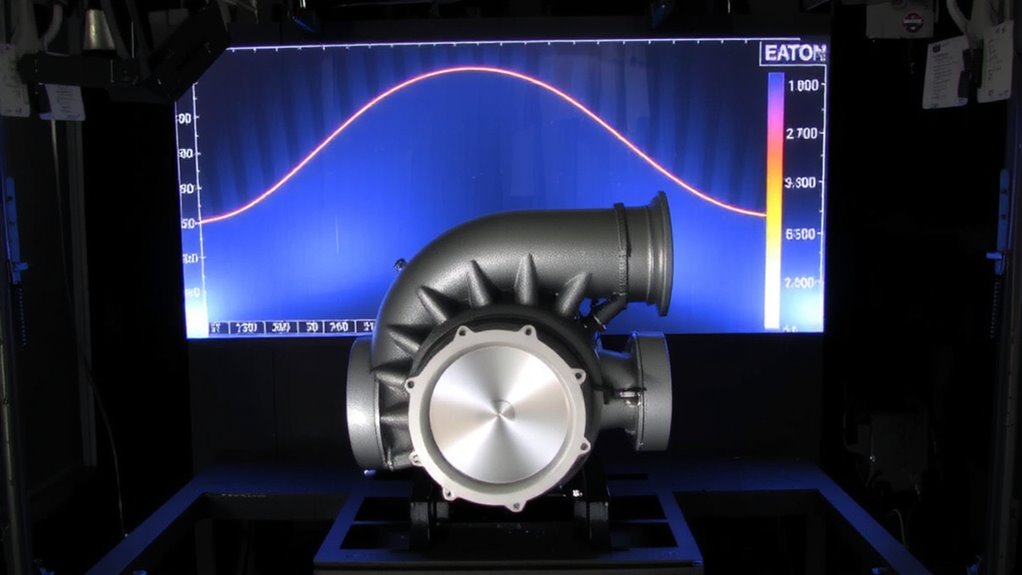
While many superchargers struggle to deliver consistent power across the entire RPM range, TVS-series Eaton superchargers excel by combining twin four-lobe rotors with a 160° twist angle to optimize airflow efficiency from idle to redline. You get immediate boost response, even at low engine speeds, thanks to reduced internal leakage and tight rotor clearances. The four-lobe design moves more air per revolution than traditional three-lobe units, enhancing airflow dynamics across all RPM bands. This means pressure builds faster and sustains smoothly, eliminating traditional supercharger lag. Flow rates exceed 1,300 cubic feet per minute in high-output models, supporting over 1,000 horsepower applications. Rotors are precisely synchronized without contact, minimizing friction and heat generation. You benefit from linear power delivery, whether idling or at peak load. The design’s efficiency guarantees that boost remains stable and predictable, making TVS superchargers ideal for both street performance and track use.
Why 160° Twisted Rotors Keep Air Cooler Under Load
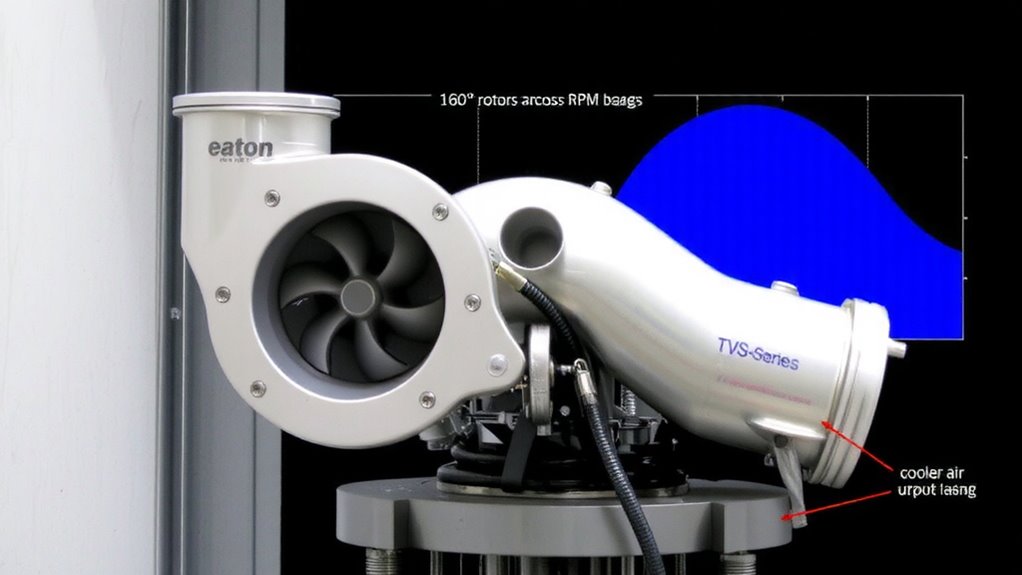
The 160° twisted rotors in TVS-series Eaton superchargers aren’t just about moving more air-they’re engineered to manage heat like no other. You get cooler discharge temperatures because the twist optimizes rotor dynamics, reducing air turbulence and shear. Each rotor’s helix angle allows smoother meshing, minimizing friction-induced heat. That’s critical for thermal management under high boost. Unlike older designs, the 160° twist enables near-continuous airflow, cutting pulsation and energy loss. You’ll see discharge temps drop up to 30°F compared to 60° rotors under identical load. The rotors’ asymmetric profile and tighter clearances improve sealing without metal contact. This means less recirculation, a major heat source. Efficient rotor dynamics reduce work per compression cycle. Less work means less heat generated. So when you’re pushing hard, the system stays efficient. Your engine gets denser, cooler air-ideal for performance and reliability. Thermal management isn’t an add-on; it’s built into the design.
Where TVS Efficiency Peaks: and Why It Matters
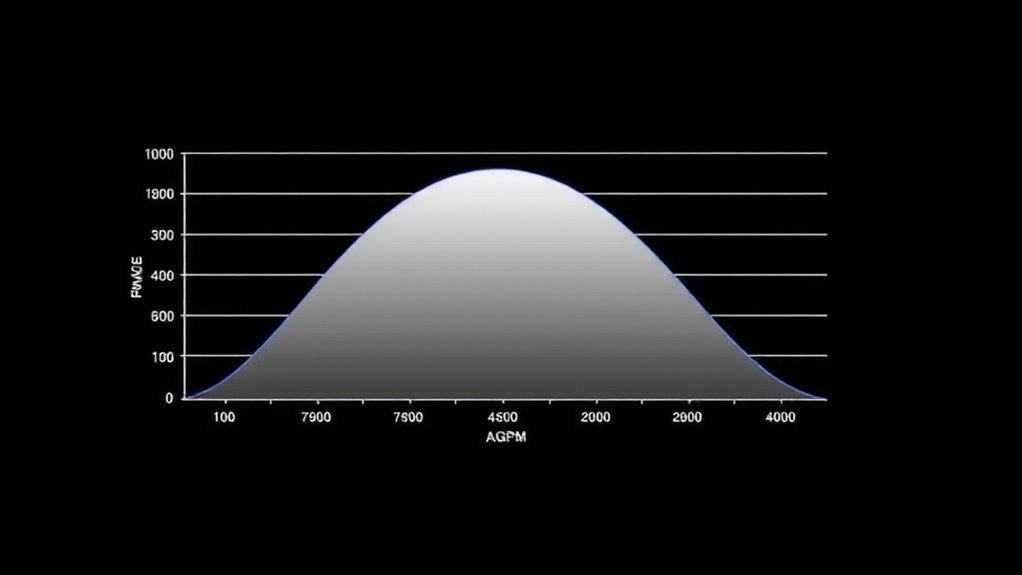
Because efficiency isn’t uniform across the entire operating range, you’ll find the TVS supercharger hits its peak performance between 1,800 and 6,000 rpm, where thermal and volumetric efficiency align. This sweet spot optimizes air density delivery and minimizes heat buildup, thanks to advanced thermal dynamics in rotor design. Below 1,800 rpm, you lose scavenging efficiency; above 6,000 rpm, parasitic losses and rising discharge temps reduce effective output.
| RPM | Efficiency (%) |
|---|---|
| 1,000 | 68 |
| 2,500 | 82 |
| 4,000 | 85 |
| 5,500 | 84 |
| 7,000 | 74 |
You get maximum power per unit of air when thermal dynamics and compressor maps are balanced. Higher air density means better combustion, and that’s where your engine gains responsive, reliable performance without overstressing components.
How TVS Superchargers Beat Older Blower Designs
Though older blower designs laid the groundwork, TVS superchargers outperform them with a modern twin-screw architecture that delivers higher efficiency across a broader rpm range. You get immediate boost due to precise rotor synchronization, minimizing internal slippage and heat. The rotors spin in exact coordination, reducing parasitic loss and improving throttle response. Older Roots-style blowers lack this synchronization, causing airflow disruption and reduced efficiency. TVS units also optimize intake dynamics with helical rotors and tighter housing tolerances. This design compresses air internally, not just in the manifold. You see measurable gains-up to 20% better thermal efficiency and sustained airflow at higher rpm. The result is more power with less strain. You benefit from cooler discharge temps and improved volumetric efficiency. These aren’t minor tweaks. They’re engineered advantages proven in airflow benches and dyno runs. TVS superchargers set a new baseline.
RPM-Specific Tuning for TVS Supercharger Performance
When tuned correctly, a TVS supercharger delivers peak efficiency at your target rpm range, not just on the dyno but on the street. You can optimize pulley size and tune to lower the boost threshold, guaranteeing strong forced induction starts earlier-often as low as 2,000 rpm. This reduces airflow lag, the delay between throttle input and pressurized delivery, by matching rotor speed to engine demand. TVS models like the 2300 and 1900 are engineered with asymmetric rotors and tighter tolerances, improving volumetric efficiency across mid-to-high rpm bands. At 4,500 rpm, a properly tuned TVS1900 achieves 82% adiabatic efficiency, minimizing heat soak. Calibration must account for inlet restriction, exhaust backpressure, and duty cycle. You’re not just adding power-you’re refining response. Matching the supercharger’s efficiency curve to your cam profile and displacement guarantees linear power delivery without sudden surges.
On a final note
You achieve maximum efficiency with TVS-series Eaton superchargers between 2,500 and 6,500 RPM. Their 160° twisted rotors reduce air temperature by up to 30°F versus older designs. This thermal efficiency prevents detonation and preserves power. At peak operation, they deliver 70% adiabatic efficiency-5–15% higher than roots-type blowers. The result is consistent, reliable boost without parasitic loss.