Diagnosing Misfires Caused by Cracked Coil Pack Insulation
You’ll notice misfires under acceleration or wet conditions if your coil pack insulation is cracked. Voltage leaks through hairline fractures, especially when moisture lowers dielectric strength by up to 60%. This causes spark output to drop below 8,000 volts, triggering P030X codes. Inspect for carbon tracking or blue arcing at night. Test with a spark tester across a 0.25-inch gap-weak orange sparks mean failure. Replacement with upgraded silicone or EPDM packs restores reliability, and applying dielectric grease helps prevent recurrence. There’s more to uncover about long-term prevention.
Notable Insights
- Cracked coil pack insulation often causes misfires under load or in wet conditions due to voltage leakage.
- Check for faint blue arcing at night near the engine to identify insulation breakdown and electrical leakage.
- Inspect coil packs for hairline cracks, carbon tracking, or burn marks on the silicone boot and housing.
- Use a spark tester to confirm weak or inconsistent spark output indicative of a failing coil pack.
- Replace faulty coils and apply dielectric grease to prevent moisture intrusion and improve insulation.
Symptoms of Cracked Coil Pack Insulation
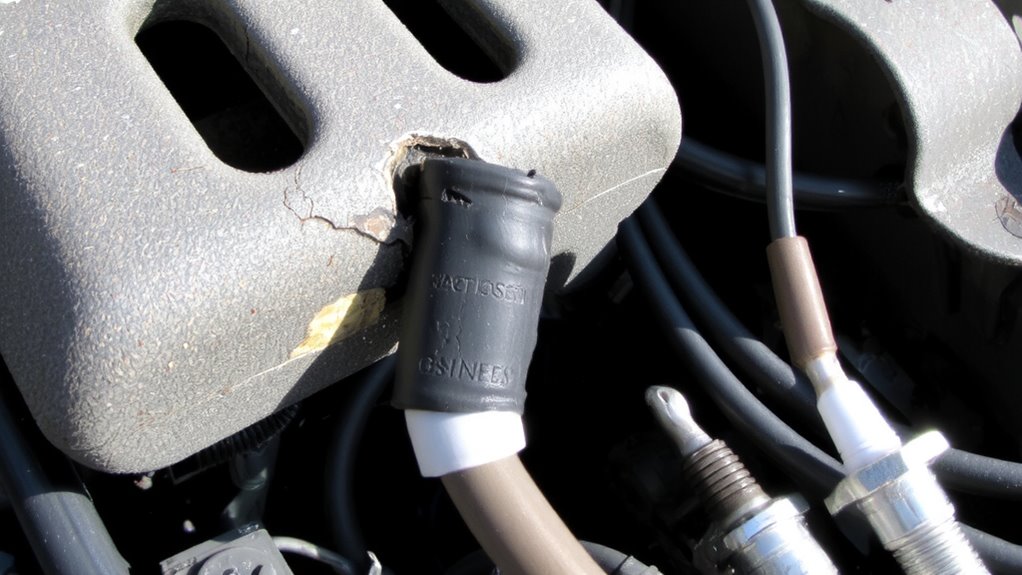
What does a failing coil pack feel like when it’s hiding in plain sight? You’re driving normally, then suddenly experience engine stalling or rough idling without warning. These symptoms often point to cracked coil pack insulation. A damaged insulator disrupts high-voltage delivery, causing misfires under load. You’ll notice hesitation during acceleration, especially in wet conditions. Internally, the coil generates over 30,000 volts-any insulation breach diverts this current, weakening spark. Misfires may register as P030X trouble codes. Visually, cracks might not be obvious; dielectric testing at 15–25 kV reveals hidden faults. Compression and fuel systems check normal, but spark output drops below 8,000 volts, insufficient for reliable ignition. The engine runs on fewer cylinders intermittently. Over time, unburned fuel damages the catalytic converter. Diagnose with a scope pattern: erratic waveforms confirm weak spark. Don’t rely solely on resistance readings-many faulty coils test within spec. Upgrading to one of the best ignition coils can prevent recurrent failures and improve spark efficiency.
Why Moisture Triggers Misfires With Cracked Insulation?
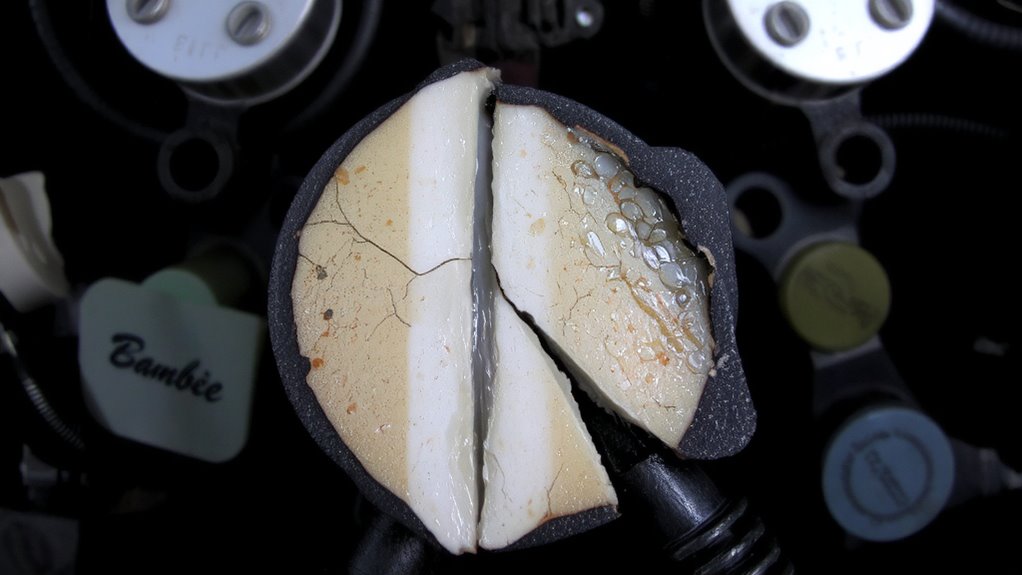
How does a seemingly minor crack become a major source of engine trouble when the weather turns damp? Moisture seeps into microscopic fractures in the coil pack’s housing, exploiting the material’s compromised structure. You see, intact insulation resists electrical leakage, but cracked insulation allows moisture conductivity to create unintended current paths. This moisture conductivity increases the risk of misfires, especially in high-humidity conditions or after rain. Over time, insulation degradation weakens the dielectric strength of the polymer housing-typically rated for 30–40 kV-reducing it by up to 60%. When voltage escapes through wet cracks, the spark at the plug weakens or fails. The engine control module can’t compensate fast enough, causing hesitation or misfires. Even small amounts of surface moisture on degraded insulation disrupt the precise high-voltage delivery the ignition system depends on.
How Cracks Cause Electrical Arcing in Coil Packs
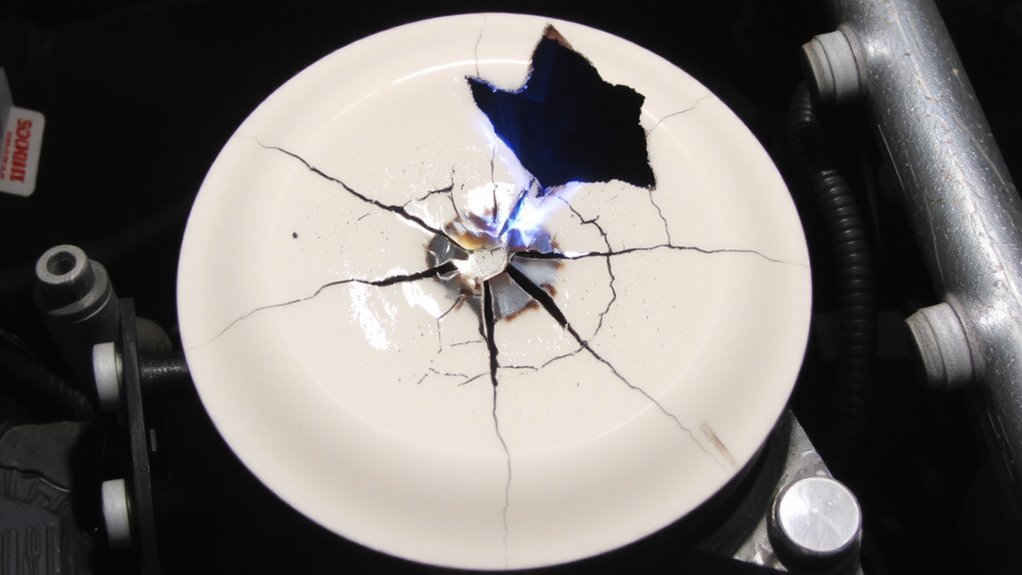
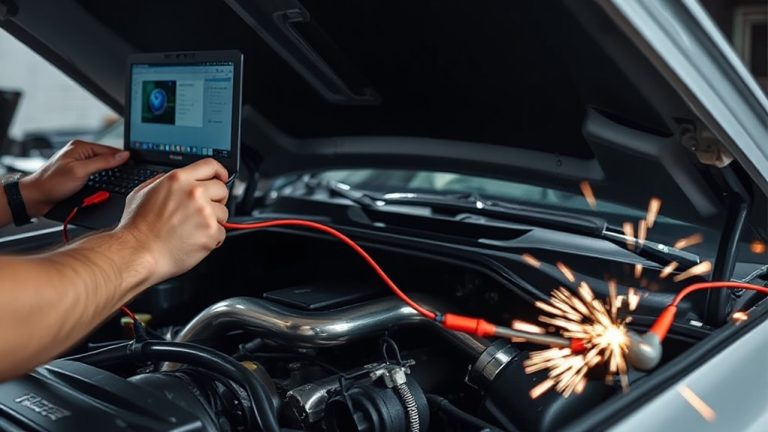
Traveling along the surface of a compromised coil pack, high-voltage current can jump to nearby metal parts when insulation cracks provide a path. This stray current creates electrical leakage, diverting energy meant for the spark plug. You lose critical voltage needed for combustion, resulting in a measurable voltage drop across the system. Modern coil packs operate at 30,000 to 50,000 volts; even small cracks can reduce output by 20% or more. The arc follows the path of least resistance, often visible in dark conditions as a faint blue flash. This arcing disrupts spark timing and intensity, causing misfires under load. Unlike uniform insulation, cracked surfaces trap contaminants, worsening conductivity. The engine control module can’t compensate fully, especially at high RPM. Left unchecked, arcing accelerates coil degradation and increases misfire rates.
How to Inspect for Cracked Coil Pack Insulation
Ever noticed a faint blue glow near your engine at night? That’s a telltale sign of electrical arcing from cracked coil pack insulation. Start with a visual inspection using a flashlight and mirror to examine each coil. Look closely for physical damage like hairline fractures, carbon tracking, or burnt spots on the coil’s silicone boot. Cracks often appear near the base or along high-voltage pathways, especially where thermal stress is greatest. Most coil insulation operates at 30,000 to 50,000 volts-any breach compromises performance. Inspect connections for corrosion and make sure coils are fully seated. Even small imperfections can allow voltage to escape, causing misfires. Focus on coils near hot components, such as exhaust manifolds, since repeated expansion and contraction accelerate wear. A damaged boot won’t seal properly, letting moisture in and worsening arcing.
Test for Weak or Intermittent Spark
Why does your engine stumble under load or at idle when the coil packs appear intact? A weak or intermittent spark may be the culprit. Use a spark tester to check output; connect it to each coil and ground it to the engine block. A strong spark should jump a 0.25-inch gap with bright blue intensity. Flickering, orange, or weak sparks indicate problems. For deeper analysis, connect an ignition scope to monitor coil performance in real time. The scope displays voltage rise time and spark duration-healthy coils produce 8–15 kV with consistent waveform patterns. Look for spikes, dropouts, or irregular firing lines, which suggest internal insulation breakdown. Even if no cracks are visible, voltage leakage can occur under load. Testing under actual operating conditions guarantees accurate diagnosis. The spark tester and ignition scope together provide definitive proof of faulty coil output without guesswork. Upgrading to high-quality coils can prevent recurrence, especially when selecting models known for reliable performance.
Replace Faulty Coil Pack Insulation
When you’ve confirmed that cracked insulation is causing erratic spark output, replacing the faulty coil pack is essential to restore proper ignition performance. A successful coil pack replacement prevents misfires and guarantees consistent spark delivery. Consider an insulation material upgrade to silicone or EPDM rubber for better heat and UV resistance. These materials withstand engine bay temperatures up to 200°C and reduce the risk of premature cracking. Always match the new coil’s primary resistance (0.4–0.8 ohms) and secondary resistance (4,000–8,000 ohms) to OEM specs.
| Feature | Value |
|---|---|
| Operating Temp | -40°C to 200°C |
| Primary Resistance | 0.6 Ω ±10% |
| Secondary Resistance | 6,000 Ω ±15% |
| Insulation Material | Silicone (upgrade) |
| Spark Output | 30 kV minimum |
Use dielectric grease during installation to enhance insulation and simplify future service.
Prevent Future Coil Pack Insulation Damage
Since heat, vibration, and UV exposure continually stress ignition components, taking proactive steps is critical to extend coil pack insulation life. You must prioritize material selection when replacing or upgrading coil packs. High-temperature silicone or EPDM rubber insulators resist cracking better than standard polymers. These materials maintain flexibility from -40°C to 200°C, preventing premature failure. Environmental exposure accelerates wear, so install heat shields or reroute wiring away from exhaust manifolds and direct sunlight. Guarantee secure mounting to minimize vibration fatigue-loose coils suffer microfractures over time. Use dielectric grease to seal connections and reduce moisture intrusion. Inspect boots annually for hardness or surface cracking. OEM-specified coils typically use reinforced fiberglass insulation with 15 kV dielectric strength-match or exceed that. Prevent future damage by combining quality materials with smart installation practices.
On a final note
You must address cracked coil pack insulation promptly to restore ignition performance. Even small cracks compromise dielectric strength, allowing voltage leaks. Moist游戏副本 worsens arcing by providing a conductive path across compromised insulation. Inspect boots for visible splits or carbon tracking. Test with a multimeter; resistance outside 6–12 kΩ per inch indicates failure. Replace damaged coils immediately. Use dielectric grease during installation to prevent moisture ingress and extend service life. Proper maintenance guarantees reliable spark delivery.