LED Lights for Micro-Marring: Lux, Angle & Color Temp Guide
You can’t see swirls on dark paint under normal light because it absorbs 95% of visible light, reducing surface contrast. High-power LED lights emit 10,000–15,000 lux at 5000K–6500K color temperature, mimicking daylight and exposing micro-marring through enhanced reflection and shadow formation. Hold the light at a 15°–30° angle to reveal defects as faint shadows. Professional-grade LEDs with CREE chips and flood-beam optics provide uniform coverage without glare. There’s more to mastering flaw detection than just the tool you use.
Notable Insights
- High-power LED lights (10,000–15,000 lux) reveal micro-marring by increasing surface reflection on dark paint.
- Use LED lights with 5000K to 6000K color temperature for accurate contrast and true defect visibility.
- Shine the light at a 15° to 30° angle to enhance shadow formation and expose shallow swirls.
- Opt for flood or spot-flood beam patterns to ensure even coverage and eliminate hotspots.
- Move the light slowly across the panel to detect scattered reflections caused by microscopic scratches.
Why Dark Paint Hides Swirls in Normal Light
Have you ever wondered why your black car looks flawless in daylight but shows a web of swirls under showroom lights? Dark paint hides defects in normal light due to high light absorption. Your car’s clear coat scatters minimal ambient light, reducing surface contrast. Most environmental lighting lacks intensity and low-angle incidence needed to expose micro-marring. Black paint absorbs up to 95% of visible light, leaving only 5% to reflect imperfections. This absorption dampens visibility of shallow scratches under 0.1mm depth. Without strong directional lighting, scratches don’t cast detectable shadows. Surface contrast remains low, camouflaging damage. The human eye requires a minimum 12:1 contrast ratio to resolve fine detail on glossy surfaces. Standard daylight provides diffuse illumination, failing to meet this threshold. Swirls become invisible, not absent. Your paint isn’t perfect-it’s just hiding in plain sight.
See Swirls Clearly With High-Power LED Lights
High-power LED lights reveal what your eyes can’t see under normal conditions. These lights produce high light intensity, typically 10,000 to 15,000 lux, far exceeding ambient indoor lighting. This intense illumination increases surface reflection, making microscopic imperfections visible. Swirl marks scatter light differently than smooth paint, creating contrast under direct beam exposure. You see these distortions clearly because the LED’s focused beam highlights variations in paint flatness. The angle of incidence matters-position the light at 15 to 30 degrees relative to the panel surface. At this angle, surface reflection amplifies texture differences. Cool white LEDs (5000K to 6500K color temperature) provide the most accurate color rendering. Their spectral output closely mimics daylight, reducing visual distortion. You don’t just see more-you see accurately.
Best LED Lights to Spot Paint Defects
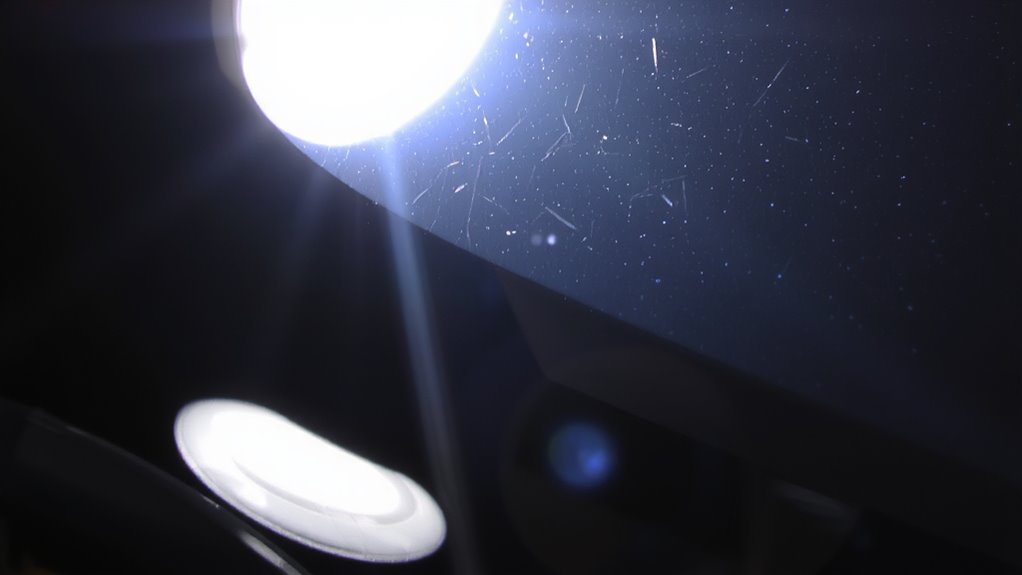
A few top-tier LED lights stand out for detecting paint defects with precision. You need consistent LED beam patterns and the right light color temperature to reveal flaws. Lights with 5000K to 6000K color temperature mimic natural daylight, offering accurate reflection and contrast on dark paint. Cooler temperatures expose microscopic scratches better than warmer ones. Opt for flood or spot-flood hybrid beam patterns-they evenly illuminate large panels while highlighting subtle imperfections. Narrow beams create harsh shadows, often exaggerating defects. Professional-grade LED inspection lights deliver 10,000 to 15,000 lux at 30 cm, guaranteeing high surface brightness. They use CREE or Luminus LEDs for superior intensity and longevity. Battery-powered models with flat backings allow hands-free use. Choose lights with aluminum housings for heat dissipation and durability. These specs guarantee reliability and accuracy during repeated inspections. For extended coverage and flexible positioning, consider adhesive LED light strips that can be mounted around work areas to provide ambient, shadow-free illumination.
Find Swirls Like a Pro Using LED Lighting
How do the pros catch swirls the naked eye misses? They use high-power LED lighting with precise light diffusion and shadow enhancement. You’re not just looking-you’re revealing. Swirls scatter light differently than clean paint, and LEDs expose these flaws through controlled angles. Hold the light at 45 degrees. Move slowly. Watch how micro-scratches cast subtle shadows.
| What You See | What It Feels Like |
|---|---|
| Invisible marks suddenly appear | Like finding dust on a mirror |
| Clear swirl patterns emerge | As if someone etched the surface |
| Depth becomes visible | You realize it was never clean |
Effective inspection relies on consistent light diffusion to eliminate glare and maximize shadow enhancement. Cheap lights create hotspots; pro LEDs deliver uniform output. Use 5,000–6,500K color temperature for true color representation. You’ll spot defects others miss-fast, accurate, and repeatable.
How to Fix Swirl Marks on Dark Paint
Now that you’ve identified micro-marring with precision LED lighting, it’s time to correct what you’ve found-especially critical on dark paint, where swirls stand out like cracks in glass. Proper paint correction requires selecting the right polishing techniques based on defect depth. Start with a cutting polish using a dual-action polisher at 4,000–6,000 orbital motions per minute. Apply moderate pressure in 2×2 foot sections, overlapping passes by 50%. For finer refinement, switch to a mid-grade polish and foam pad. Maintain consistent speed and coverage to prevent heat buildup. Always wipe test areas with isopropyl alcohol to assess clarity. A final inspection under LED light confirms defect removal. Professional-grade compounds remove 1–2 microns of clear coat per pass-effective yet safe when applied correctly. Finish with a sealant to enhance contrast and protect the corrected surface. High-quality car detailing lights ensure optimal visibility of surface defects during both inspection and correction phases.
Daily Habits to Protect Your Dark Paint Finish
Three daily habits make all the difference in preserving the integrity of dark paint finishes exposed to environmental and mechanical stress. First, maintain consistent wash frequency-weekly hand washing removes contaminants before they bond to the surface. Use pH-neutral car shampoo and two-bucket method with grit guards to prevent micro-scratches. Second, apply the right wax types: synthetic sealants last 4–6 months and offer 9H hardness protection, while carnauba wax provides a deep glossy finish but requires reapplication every 6–8 weeks. Third, always use a clean, microfiber drying towel to avoid introducing swirls. Store your vehicle in a garage or use a breathable cover to shield from UV, bird droppings, and acid rain. These steps reduce light refraction disruptions, keeping your finish optically flat and resistant to micro-marring under high-power LED inspection. For best results, choose a high-quality microfiber towel with a plush pile and tightly woven fabric to maximize scratch resistance and absorbency.
On a final note
You can detect micro-marring on dark paint using high-power LED lights emitting 3,000 lumens or more at 5,000–6,500K color temperature. These lights create intense, daylight-balanced illumination that reveals defects through directional glare. Use a 90-degree beam angle for focused inspection. The contrast highlights shallow scratches invisible under normal lighting. Correct flaws with precision compounding and 1,500–2,000 grit polish. Maintain results with pH-neutral washes and microfiber tools.