The Purpose of Shock Absorbers in Controlling Wheel Movement and Bounce
Your shock absorbers control wheel movement by damping spring rebound in 1.5 to 2.5 oscillations per bump, limiting excessive travel after impacts. They convert kinetic energy into heat through hydraulic resistance, operating at 600–800 psi to stabilize the vehicle. This keeps tires firmly on the road, maintaining grip and contact during bumps. Without them, tires can lift, reducing steering precision and braking efficiency by up to 30%. You’ll see how failure affects safety and handling next.
Notable Insights
- Shock absorbers limit excessive wheel movement caused by bumps to maintain tire contact with the road.
- They dampen spring rebound, typically controlling oscillations within 1.5 to 2.5 cycles after a bump.
- By converting kinetic energy into heat, they reduce wheel bounce and stabilize the vehicle quickly.
- Proper damping prevents tires from lifting off the ground, ensuring consistent grip and control.
- They work with the suspension to control wheel motion and ensure a smooth, stable ride.
What Happens When Shock Absorbers Fail?
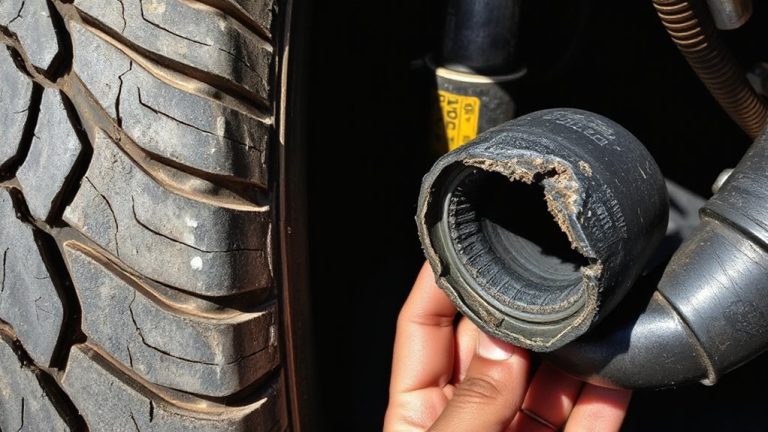
When your shock absorbers fail, the vehicle’s ability to maintain tire contact with the road deteriorates rapidly. Loss of traction reduces braking efficiency and steering precision, increasing stopping distances by up to 20% on wet surfaces. Fluid leakage is a leading cause of failure, often visible as oil stains on the shock body-once 50% of internal damping fluid is lost, performance drops markedly. Seals degrade over time, allowing fluid to escape under high-pressure operation. Mounting damage, such as cracked brackets or worn bushings, misaligns the suspension, causing uneven tire wear and vibration. Rubber isolators deteriorate, permitting metal-to-metal contact that compromises structural integrity. Without secure mounting, shocks can’t control spring oscillations effectively. These failures reduce ride stability and accelerate wear on related components. Routine inspection prevents sudden degradation. Installing a leveling kit for GMC Sierra 1500 can help maintain proper alignment and reduce strain on shock absorbers caused by uneven suspension geometry.
How Shock Absorbers Dampen Wheel Motion
Although the springs in your vehicle’s suspension absorb impacts from bumps and dips, it’s the shock absorbers that keep the motion under control. They do this by converting kinetic energy into heat through hydraulic resistance. Inside each shock absorber, a piston moves through fluid, creating resistance as it travels. This damping force slows down piston oscillation, reducing how fast the suspension moves. The piston rod connects to the piston, which slides within a fluid-filled cylinder. Small valves in the piston control fluid flow, adjusting resistance based on movement speed. Greater piston oscillation increases hydraulic resistance, ensuring consistent damping. Modern shocks use valving tuned for specific loads and road conditions. Without this precise resistance, your wheels would bounce uncontrollably. The system balances stiffness and smoothness, maintaining ride quality. Hydraulic resistance doesn’t stop motion-it manages it efficiently. That’s how shock absorbers dampen wheel motion. Top-performing shocks often come from best shock brands, which engineer their products for optimal damping and durability.
How Shock Absorbers Keep Tires on the Road
Because maintaining constant tire contact with the road is critical for control, shock absorbers play a key role in stabilizing your vehicle’s ride. They limit excessive wheel motion caused by bumps or dips, ensuring your tires stay firmly planted. Without them, springs would oscillate too long, lifting tires off the ground. This reduces tire traction and compromises steering, braking, and acceleration. Shock absorbers dampen spring rebound, typically controlling movement within 1.5 to 2.5 oscillations per bump. Maintaining consistent road contact lets tires respond instantly to driver inputs. High-performance shocks adjust damping force between 300 to 800 newtons, depending on road conditions. They work with suspension systems to minimize air time, keeping contact patches engaged. Properly functioning shocks improve grip on uneven surfaces by up to 35%. That means better control, shorter stopping distances, and safer handling-all because your tires stay in contact with the pavement where they belong. Upgrading to the best car suspension for bumpy roads can significantly enhance ride comfort and vehicle stability on rough terrain.
Why Damping Improves Vehicle Stability
How does your car stay steady during sharp turns or sudden stops? Damping in shock absorbers plays a crucial role in vehicle stability. It controls spring oscillations through energy dissipation, converting kinetic energy into heat. Without damping, your tires would bounce, reducing grip. Proper force distribution across all four wheels guarantees balanced handling. Shock absorbers regulate how quickly weight transfers during maneuvers-critical in maintaining alignment and minimizing body roll. Hydraulic damping, achieved via fluid flow through precision valves, adjusts resistance based on movement speed. This allows ideal control without harshness. Advanced dampers use twin-tube or monotube designs, with gas-charged systems reducing fade. By managing suspension motion, damping maintains tire contact and chassis composure. It guarantees force distribution remains even across uneven surfaces. Effective damping improves steering response and overall stability, giving you predictable performance in dynamic driving situations.
How Shock Absorbers Enhance Braking Safety
When you hit the brakes hard, your vehicle’s weight shifts forward, and without effective shock absorbers, that transfer can compromise stopping power. Good shocks maintain tire contact with the road, improving braking distance by up to 20% on rough surfaces. They prevent the front end from diving excessively, allowing more consistent pedal response. Without damping control, the rear tires can lift, reducing grip and increasing stopping distance. High-quality shock absorbers use valving tuned to your vehicle’s weight and brake bias, managing kinetic energy during deceleration. You’ll feel firmer pedal response because the suspension isn’t oscillating. This control means shorter braking distances, especially in emergency stops. Shocks with monotube designs offer better heat dissipation, maintaining performance during repeated braking. Consistent damping guarantees the brake system works efficiently, not fighting uncontrolled suspension movement. Your safety relies on this precision every time you stop.
Common Signs of Failing Shock Absorbers
A failing shock absorber can compromise your vehicle’s handling, safety, and ride quality. You may notice leaking fluid around the shock body, indicating damaged seals and loss of hydraulic oil. This leakage reduces damping efficiency, leading to excessive wheel bounce. Uneven tire wear is another key sign-when shocks weaken, tires lose consistent road contact, creating bald spots or cupping. Your car may feel unstable during turns or on rough roads, and stopping distances can increase. Inspect shocks every 50,000 miles; most degrade by 60,000–80,000 miles. Perform a “bounce test”: press down on each corner of the vehicle and release. If the car bounces more than twice, the shocks are likely worn. Metal-to-metal contact or visible damage means immediate replacement. Address failing shocks early to avoid suspension damage and maintain control.
How Working Shock Absorbers Improve Ride Control
While your vehicle’s springs support its weight and absorb road impacts, it’s the shock absorbers that keep the tires firmly planted and maintain real control. They dampen oscillations by converting kinetic energy into heat, typically dissipating 80–90% of spring rebound energy. This action guarantees consistent tire grip, especially on uneven surfaces. Without working shocks, tires can lose contact, reducing braking efficiency by up to 30%. Proper damping directly enhances steering precision-lateral forces are managed more effectively, cutting body roll by as much as 40% in performance models. Factory-tuned units often operate at 600–800 psi internal pressure for maximum response. After 50,000 miles, performance drops 15–20% if not replaced. High-quality shocks maintain valving tolerance within ±5%, guaranteeing predictable handling. They’re not just comfort components-they’re critical to control.
On a final note
Your shock absorbers control suspension movement with precision. They use hydraulic fluid and valves to dampen oscillations, typically operating at damping forces between 300 and 900 pounds, depending on load and design. Without them, tires lose contact with the road, reducing traction. Damping stabilizes the vehicle during cornering, braking, and impacts. Worn shocks increase stopping distances by up to 20%. Proper function guarantees stability, safety, and tire longevity.