Head Gasket Thickness Selection Based on Quench Distance Targets
You need the right head gasket thickness to hit your quench distance target-typically 0.035 to 0.045 inches. This gap controls flame speed and reduces detonation. Measure deck height and piston rock first, then calculate clearance using compressed gasket thickness. For performance engines, a 0.041-inch MLS gasket often works. Too thick, and quench suffers; too thin, and pistons may contact the head. Your final choice balances compression, bore size, and boost. The correct setup improves efficiency and reliability-understanding the variables reveals better tuning potential.
Notable Insights
- Quench distance is critical for efficient combustion and detonation control in performance engines.
- Ideal quench gap typically ranges from 0.035 to 0.045 inches for optimal flame propagation.
- Head gasket thickness directly affects piston-to-head clearance and must align with target quench.
- Use precise measurements of deck height, piston protrusion, and rock to determine correct gasket thickness.
- Select steel shim or MLS gaskets for stability and accurate quench control under high load.
What Is Quench Distance and Why It Matters?
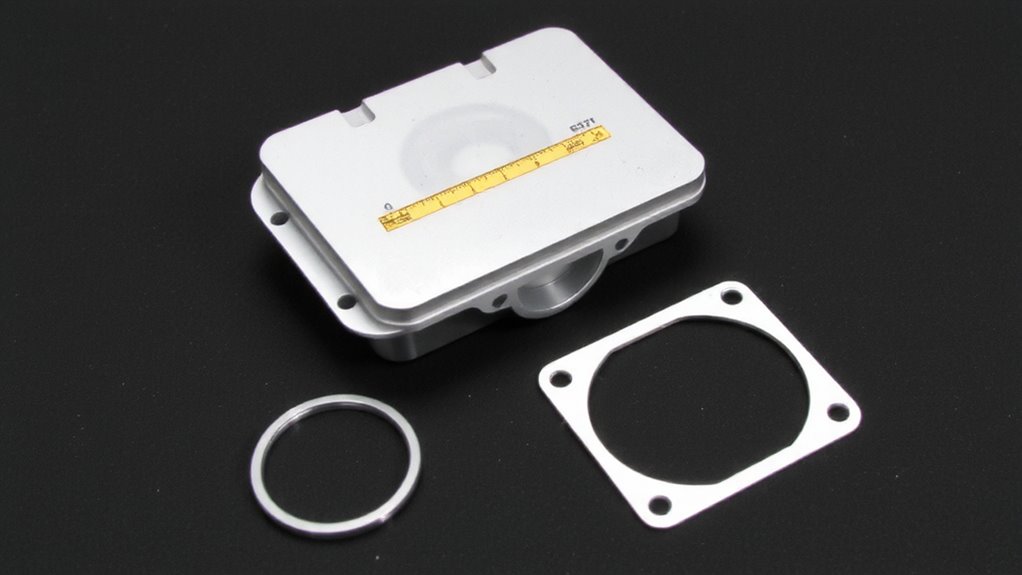
Ever wonder why engine builders obsess over quench distance? It’s because quench distance directly impacts combustion efficiency and detonation control. You need an ideal quench gap-typically between 0.035 and 0.045 inches-for proper cylinder pressure generation. When the piston nears top dead center, the close proximity to the cylinder head rapidly compresses the air-fuel mixture, creating turbulence. This motion improves flame propagation and stabilizes cylinder pressure. Your piston design must account for deck height, compression height, and head gasket thickness to achieve target quench. Too large a gap dulls combustion; too small risks piston-to-head contact. Precision matters. A properly tuned quench distance enhances power, improves thermal efficiency, and reduces reliance on ignition timing. You’re not just assembling parts-you’re engineering controlled chaos. Get the quench right, and the engine responds with smoother operation, better throttle response, and resistance to knock under load.
How Head Gasket Thickness Sets Piston-to-Head Clearance
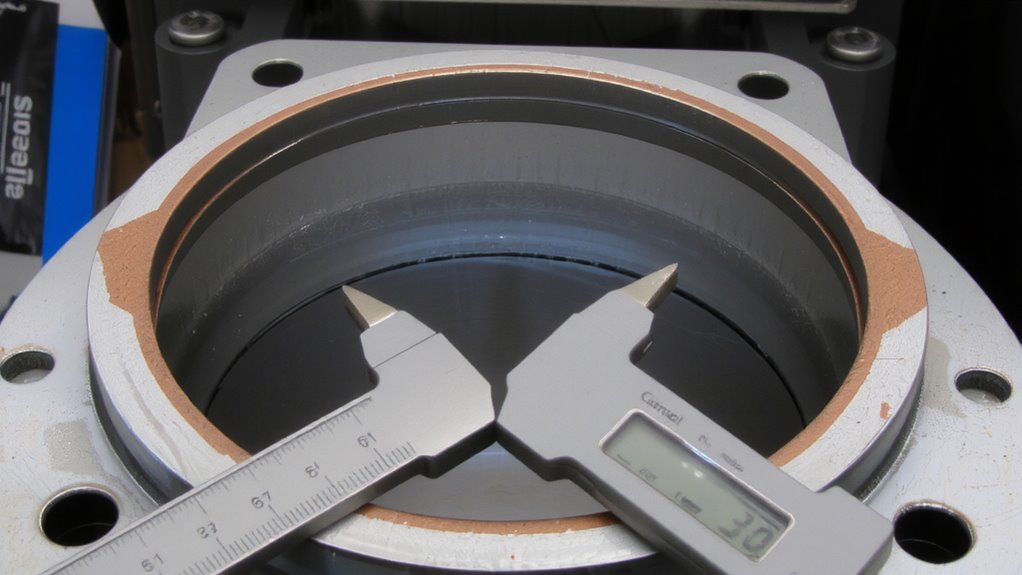
Piston-to-head clearance is set by head gasket thickness, and it’s critical to get it right. You must account for piston protrusion, which is how far the piston extends above the deck at top dead center. This measurement, combined with your chosen head gasket’s compressed thickness, determines the final clearance. For most performance applications, you want between 0.035” and 0.045” piston-to-head clearance to optimize quench. The cylinder bore size affects gasket selection because larger bores require wider sealing rings, influencing gasket design and thickness options. Always verify that the gasket’s combustion seal covers the entire cylinder bore circumference. Using a steel shim or multi-layer steel (MLS) gasket lets you fine-tune clearance with precision. Remember, too little clearance risks piston-to-head contact; too much reduces quench efficiency and combustion effectiveness.
How to Measure Deck Height and Piston Rock
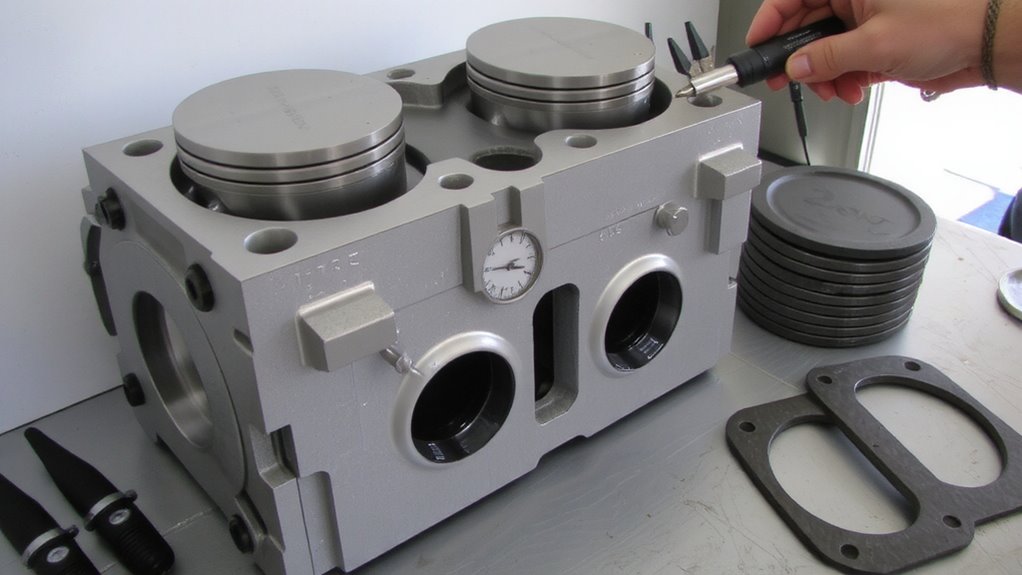
Start by measuring deck height, which is the distance from the centerline of the crankshaft to the cylinder head mating surface on the block. Use a precision depth micrometer or dial bore gauge for accuracy. Record measurements in at least four locations per cylinder to detect deck variance. High deck variance affects compression and quench, leading to inconsistent piston position across cylinders. Piston rock occurs as the piston tilts slightly in the bore at top dead center. Measure it by checking the difference in piston position from front to back with a dial indicator. Zero the indicator at TDC, then rock the piston and note the travel. Typical piston rock ranges from 0.005 to 0.015 inch, depending on skirt design and bore clearance. Accurate deck height and piston rock data help identify true piston position and maintain consistency. These values directly impact deck variance, which must be minimized for maximum engine balance and performance.
Target Quench Gaps by Engine Type and Gasket Choice
Why do high-performance engines demand tighter quench gaps? You need tighter clearances-typically 0.035 to 0.040 inches-to control cylinder pressure and boost combustion efficiency. High cylinder pressure in performance engines increases the risk of detonation, but a tight quench gap promotes faster, more uniform flame travel across the combustion chamber. This reduces hot spots and uncontrolled ignition. In contrast, stock engines often run looser gaps of 0.045 to 0.060 inches, where lower cylinder pressure allows more tolerance. You’ll find that steel or multi-layer steel (MLS) head gaskets maintain stability under extreme heat and pressure, delivering precise quench control. Composite gaskets, while cheaper, compress more and may alter your gap over time. Always match gasket choice to your engine’s operating demands. The goal is consistent quench clearance, so you maximize power and reliability without inviting knock.
Choose Gasket Thickness for Compression and Quench
You control both compression ratio and quench clearance by selecting the right head gasket thickness. Thinner gaskets increase compression and reduce quench distance, enhancing burn efficiency. You must account for piston protrusion, which reduces deck clearance and affects total combustion chamber volume. For example, a piston protruding 0.010″ into the deck requires a thicker gasket to maintain safe quench. Bore diameter also influences the volume added by gasket thickness-larger bores magnify even small thickness changes. A 0.040″ gasket on a 4.000″ bore adds about 5.0 cc, while the same gasket on a 4.125″ bore adds 5.3 cc. Accurately measuring your block deck height, piston protrusion, and bore diameter lets you calculate the ideal gasket thickness to hit both compression and quench targets. Precision matters-use manufacturer specs and verify with mock-ups.
How Boost and Compression Affect Quench Clearance
How do boost and compression interact with quench clearance in high-performance engines? Higher boost pressure increases cylinder pressure and heat, demanding tighter quench clearance to control combustion temps. You need to maintain a quench distance of 0.035–0.045 in for forced-induction setups. This reduces detonation risk under high load. Increased compression ratio also raises combustion pressure, which amplifies the need for precise quench. When clearance is too large, flame propagation slows and becomes unstable. This hurts efficiency and power. But with ideal clearance, the squish effect speeds up flame travel, making combustion faster and more complete. You’re balancing compression, boost pressure, and piston-to-head clearance to achieve this. Ignition timing can be optimized when flame propagation is consistent. Always model your dynamic compression and adjust head gasket thickness accordingly-without compromising piston-to-head clearance. Proper quench enhances durability and power under high boost.
Common Mistakes When Choosing Head Gasket Thickness
A common oversight when selecting head gasket thickness is prioritizing compression ratio adjustments without verifying piston-to-head clearance. You risk piston-to-valve interference or head gasket failure if you ignore physical clearances. Piston domes and valve reliefs greatly affect how close the piston comes to the cylinder head. A thicker gasket increases quench distance, reducing quench effect and potentially hurting combustion efficiency. Too thin, and you may crush the gasket or contact valve reliefs. Always measure actual piston protrusion and valve relief depth. Aim for a minimum 0.040-inch clearance between piston and head across all points. For most performance engines, a 0.039–0.045-inch compressed gasket thickness works well. You can’t assume compatibility-always mock up the short block. Clearance overrides compression goals.
On a final note
You must choose head gasket thickness carefully to achieve best quench distance. A target of 0.035–0.045 inch is ideal for most naturally aspirated engines. Thinner gaskets, like 0.020–0.027 inch, suit boosted applications to prevent detonation. You calculate piston-to-head clearance by combining deck height, piston rock, and gasket thickness. Matching this total to your engine’s compression ratio and duty cycle guarantees efficient combustion and durability.