Adapting Fuel Maps When Switching Between Gasoline and Methanol Fuels
You must recalibrate fuel maps when switching to methanol. Its stoichiometric air-fuel ratio is 6.4:1, nearly half of gasoline’s 14.7:1. Injector pulse width needs to increase 1.5 to 2 times due to methanol’s 19.7 MJ/kg energy density-less than half of gasoline’s. Advance ignition timing by 5–8 degrees to match faster combustion. Use methanol-specific tuning to leverage its 1.17 MJ/kg latent heat for charge cooling. Optimize performance with real-time data and proper calibration. Further adjustments depend on system response and monitoring.
Notable Insights
- Methanol requires a richer air-fuel ratio (~6.4:1) compared to gasoline (14.7:1) due to lower stoichiometric demand and oxygen content.
- Fuel injector pulse width must increase 1.5 to 2 times to compensate for methanol’s lower energy density and higher mass requirement.
- Ignition timing should be advanced by 5 to 8 degrees to align with methanol’s faster combustion and shorter ignition delay.
- Injection timing may need to be advanced 20–30 degrees earlier than gasoline to optimize methanol’s combustion characteristics.
- Enhanced charge cooling from methanol’s high latent heat allows denser intake charges, supporting higher boost or compression tuning.
How Methanol’s Chemistry Demands New Fuel Maps
Chemistry drives the need for new fuel maps when switching from gasoline to methanol. You must account for methanol’s higher chemical reactivity, which increases combustion speed and heat release rates. This reactivity demands precise injection timing adjustments-typically 20–30 degrees earlier than gasoline. Methanol also has lower energy density (19.7 MJ/kg vs. gasoline’s 43.4 MJ/kg), requiring nearly double the fuel mass for stoichiometric combustion. Fuel stability differs notably; methanol absorbs moisture, risking phase separation and corrosion in fuel systems designed for hydrocarbons. It has a higher latent heat of vaporization (1.17 MJ/kg vs. 0.35 MJ/kg), enhancing charge cooling but increasing cold-start challenges. These properties alter air-fuel mixing dynamics and knock resistance, raising effective octane to around 109 MON. Without recalibrated fuel maps, you risk misfires, poor idle quality, or engine damage. Adjustments aren’t optional-they’re chemically mandated for safe, efficient operation.
Set the Correct Air-Fuel Ratio for Methanol
Why does your engine need a richer mixture when running on methanol? Because methanol contains oxygen within its molecular structure, its inherent oxygen content reduces the amount of additional air required for combustion. This means you must supply more fuel to maintain a stoichiometric balance. While gasoline runs best at around 14.7:1, methanol requires roughly 6.4:1. Don’t ignore vapor pressure-methanol’s lower vapor pressure compared to gasoline affects atomization and cold start performance. You’ll need a richer air-fuel ratio not just for chemistry, but also to compensate for slower evaporation. Despite this, methanol’s high latent heat of vaporization improves charge cooling. You’re not just adjusting ratios-you’re recalibrating for a fuel that burns differently from the start. Always verify with wideband O2 readings. Trust the data, not estimates.
Increase Injector Pulse for Methanol’s Fuel Demand
How much longer do you need to keep the injectors open when switching to methanol? You’ll need about 1.5 to 2 times longer pulse width due to methanol’s lower energy density and higher oxygen content. Methanol requires nearly twice the fuel volume compared to gasoline for stoichiometric combustion. This affects flow dynamics markedly, demanding injectors with higher flow rates or extended pulse durations. As fuel demand rises, pressure drop across the injector must remain stable to guarantee accurate delivery. If rail pressure isn’t maintained, inconsistent atomization and poor spray patterns can occur. You must verify that your fuel pump and lines support the increased volume without excessive pressure drop. Running larger injectors or increasing fuel pressure helps compensate. Always recalibrate your ECU to reflect the new pulse width requirements. Proper tuning prevents lean conditions and maintains performance.
Advance Ignition Timing for Methanol’s Burn Speed
Since methanol burns faster than gasoline, you’ll need to advance your ignition timing to optimize combustion. Methanol has a shorter ignition delay, meaning it ignites more quickly under compression. This rapid start requires timing adjustments to align peak pressure with the ideal crankshaft position. You should typically advance timing by 5 to 8 degrees compared to gasoline. Faster flame propagation guarantees more complete burning within the power stroke. This improves efficiency and power output. Because the flame front moves quicker, combustion finishes sooner, reducing the need for late timing. Adjust incrementally and monitor cylinder pressure or exhaust gas readings. Over-advancing risks excessive cylinder pressure, even with methanol’s high octane. Always validate with dyno testing. Properly set, advanced timing leverages methanol’s burn speed for maximum performance without instability.
Exploit Methanol’s Cooling to Avoid Detonation While Tuning
Methanol’s high latent heat of vaporization gives it a powerful cooling effect-up to 30% more intake charge cooling than gasoline-allowing you to run higher compression ratios and more aggressive timing without detonation. This intake cooling reduces combustion temperatures markedly, improving thermal efficiency. As the incoming air charge cools, it becomes denser, increasing charge density by as much as 15–20% under ideal conditions. Higher charge density means more oxygen per cylinder volume, enabling greater fuel burn efficiency and power output. You can exploit this effect during tuning by advancing timing further than gasoline allows, provided fuel delivery keeps up. Unlike gasoline, methanol’s resistance to knock stems largely from this cooling, not just octane rating. Properly managing this allows safer tuning margins even under high load. Always monitor intake air and coolant temperatures to maximize the benefit while avoiding over-cooling the combustion chamber.
Switch ECU to Methanol Fuel Maps
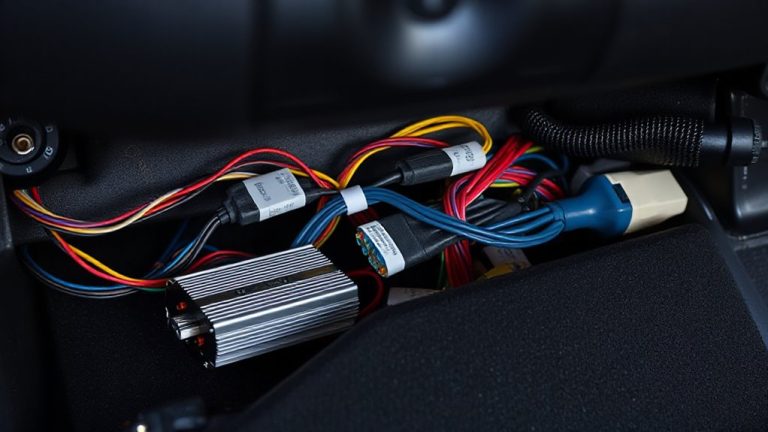
Once you’ve confirmed the engine is mechanically prepared and fuel delivery is sufficient, it’s time to switch your ECU to dedicated methanol fuel maps. Methanol requires roughly 1.5 to 2 times more fuel volume than gasoline, so your ECU must adjust injector pulse widths accordingly. You’ll need to reprogram fuel pressure adjustments to maintain proper rail pressure, typically between 60–85 psi depending on boost levels and injector size. Methanol’s high latent heat of vaporization cools the intake charge, but it also increases the risk of elevated exhaust gas temperatures (EGTs) if the air-fuel ratio runs too lean. Monitor EGTs closely-ideally below 1,600°F under load-to prevent exhaust valve damage. Use wideband O2 sensors to verify stoichiometric combustion, targeting 6.4:1 AFR for full power. The ECU must also recalibrate ignition timing maps, as methanol resists knock and tolerates more advance.
Validate Tuning With Dyno and Real-Time Data
Now that your ECU runs methanol-specific fuel maps with adjusted pulse widths and timing curves, it’s time to verify the tune holds up under real operating conditions. Use a dynamometer to measure power output, air-fuel ratios (AFR), and combustion efficiency across the RPM range. Methanol requires richer mixtures-target 6.4:1 to 6.8:1 AFR under load-so confirm your wideband O2 sensor is recalibrated for methanol’s stoichiometry. Real-time data logging helps detect lean spikes or misfires. Guarantee fuel system compatibility: check for ethanol-rated seals, upgraded pumps, and injectors flowing 30–40% more volume. Sensor recalibration is critical-coolant, intake air, and oxygen sensors must account for methanol’s cooling effect and different exhaust signature. Monitor exhaust gas temperatures (EGT); they should drop 100–200°F versus gasoline. Adjust fuel trims and ignition timing iteratively until power plateaus without knock. Validate stability during throttle transients and sustained load.
On a final note
You must update fuel maps when switching to methanol. Methanol requires a richer air-fuel ratio of 6.4:1, compared to gasoline’s 14.7:1. Injectors need longer pulse widths-roughly 2.5 times longer-to deliver adequate fuel. Ignition timing advances 5–10 degrees due to faster flame speed. Charge cooling lowers intake temps by up to 50°F, reducing knock risk. Use dedicated methanol maps in the ECU. Validate changes on a dyno with wideband O2 and knock sensors.