Why Multi-Link Rear Suspension Is Standard in Modern Luxury Vehicles
You get superior ride comfort and precise handling because multi-link rear suspension uses four to five forged aluminum or high-strength steel links to control wheel motion independently. Each link manages lateral, longitudinal, or vertical forces, maintaining ideal tire contact. High-compliance bushings (80–90 Shore A) reduce vibration, while hydraulic mounts isolate noise. It increases roll stiffness by up to 30% over torsion beams. More advanced tuning awaits.
Notable Insights
- Provides superior ride comfort by isolating road impacts and reducing cabin vibration.
- Enables precise handling with improved body roll control and tire contact during cornering.
- Offers enhanced wheel articulation for consistent road contact on uneven surfaces.
- Reduces noise and vibration through compliant bushings and decoupled suspension linkages.
- Supports fine-tuning of alignment angles, improving stability, comfort, and long-term durability.
What Is Multi-Link Rear Suspension?
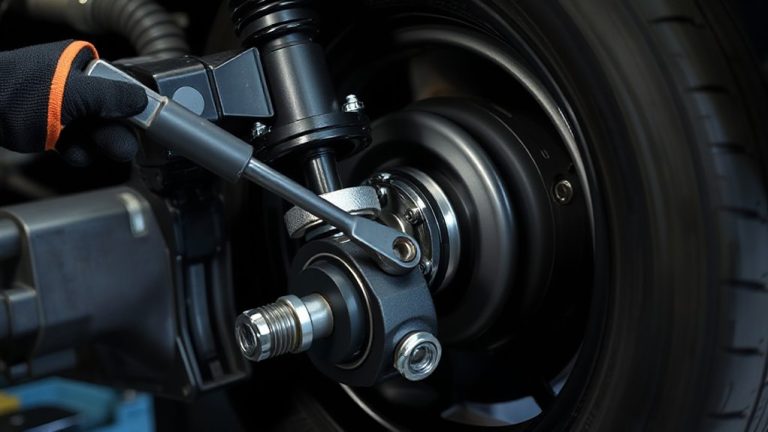
Think of it as the backbone of refined ride quality. Multi-link rear suspension uses three or more lateral and longitudinal arms to precisely control rear geometry. Each link manages a specific force-lateral, longitudinal, or vertical-allowing exact positioning of the wheel. You get superior wheel articulation compared to simpler setups like torsion beams or trailing arms. Independent movement of each wheel maintains contact with the road, even on uneven surfaces. Typical designs use four or five links, crafted from forged aluminum or high-strength steel to reduce unsprung weight. Camber, toe, and caster angles stay optimized throughout suspension travel, enhancing grip and tire wear. Unlike struts or solid axles, multi-link systems decouple ride and handling functions. This means you achieve both comfort and precision. Rear geometry stays consistent under load, improving stability during cornering and braking. It’s engineered for exacting performance-nothing is left to chance.
How Multi-Link Delivers a Smoother Ride on Rough Roads
When you hit a pothole or uneven pavement, the multi-link rear suspension isolates impacts far more effectively than simpler designs. Each wheel moves independently, maintaining tire contact and minimizing cabin vibration. This system enhances tire compliance, allowing the tread to conform to surface irregularities without transferring harshness to the chassis. Superior road contour tracking guarantees the wheel follows bumps and dips smoothly, improving comfort.
| Feature | Benefit | Example Spec |
|---|---|---|
| Multiple control arms | Reduces unwanted wheel motion | 4–5 links per wheel |
| Separate ride and handling tuning | Improves comfort without sacrificing stability | Coil spring + damper isolation |
| Precise geometry control | Enhances road contour tracking | <2° camber change over 2" travel |
| High compliance bushings | Boosts tire compliance | 80–90 Shore A durometer |
Why Multi-Link Improves Handling and Controls Body Roll
Although simpler suspensions often compromise stability during aggressive maneuvers, the multi-link rear setup actively controls body roll through precise wheel alignment and lateral force management. You get superior cornering precision because each link independently manages suspension movement, keeping the tire perpendicular to the road. This design increases roll stiffness by up to 30% compared to torsion beam systems, minimizing lean during hard turns. High-strength aluminum control arms reduce unsprung weight, improving responsiveness. The geometry allows engineers to fine-tune camber and toe angles, maintaining ideal contact patch under lateral loads. Unlike basic setups, where bushings absorb most forces, multi-link systems distribute stress across five or six links, enhancing durability and control. This engineering delivers a flatter, more composed ride through curves. With greater adjustability and structural rigidity, multi-link suspensions guarantee consistent handling dynamics, even under extreme conditions. You stay in command, and the car responds exactly as intended.
How Multi-Link Reduces Noise and Road Vibration
Because the multi-link rear suspension decouples wheel motion from chassis vibrations, you experience considerably less noise and harshness on rough surfaces. Each control arm operates independently, minimizing direct force transfer to the vehicle body. This design enhances vibration isolation by allowing precise bushing tuning-typically with hydraulic or elastomeric mounts-that absorb high-frequency impacts. Acoustic damping improves as these bushings reduce resonance transmission into the cabin. The suspension’s geometry isolates road shocks, limiting how much energy reaches the frame. Components like stabilizer bars and compliant subframes further aid in suppressing unwanted oscillations. Compared to simpler systems, multi-link setups use more joints and mounting points, each contributing to finer control over movement and noise. You’ll notice quieter rides, especially on cracked pavement or expansion joints. This level of refinement is standard in luxury vehicles because it directly improves long-term comfort and perceived quality without sacrificing responsiveness.
Multi-Link vs. Torsion Beam and Solid Axle: Where It Wins
While simpler suspensions rely on rigid connections to maintain alignment, the multi-link rear setup outperforms both torsion beam and solid axle designs through superior articulation and control. You get better wheel motion management, which improves ride comfort and handling precision. Unlike a solid axle that moves as one unit, each wheel in a multi-link system reacts independently to road changes, enhancing off road capability and towing performance.
| Feature | Multi-Link | Solid Axle | Torsion Beam |
|---|---|---|---|
| Wheel Articulation | High | Low | Moderate |
| Ride Comfort | Excellent | Rough | Average |
| Towing Performance | Stable under load | Good stability | Poor compliance |
| Off Road Capability | Strong | Limited | Weak |
This independence allows consistent tire contact, essential when hauling heavy loads or traversing uneven terrain.
Why High-End Vehicles Rely on Multi-Link Suspension
When precision engineering meets real-world performance, luxury automakers consistently choose multi-link rear suspension for a reason. You get independent control over camber, caster, and toe angles, thanks to four or five control arms per wheel. This design minimizes tire scrub and maximizes contact patch stability during cornering. Multi-link setups reduce body roll by up to 30% compared to torsion beams. They deliver superior ride refinement by isolating road imperfections through multiple pivot points and compliant bushings. With precise tuning of spring rates-typically 85–110 N/mm-and dual-valve shock absorbers, these systems guarantee consistent luxury comfort. The suspension’s geometry allows for a lower ride height without sacrificing wheel travel, often maintaining 6.5–8 inches. You experience smoother damping over potholes and expansion joints. That’s not just comfort-it’s engineered perfection in motion.
On a final note
You get superior ride quality because multi-link suspensions use three to five control arms per wheel, allowing precise alignment control. This setup minimizes tire contact loss on uneven surfaces. It reduces body roll by optimizing camber angles during cornering. Compared to torsion beams, multi-link systems cut unsprung weight by up to 15%, enhancing responsiveness. They also isolate road noise more effectively through independent movement and advanced bushing materials.