Why Matte Finishes Require Different Detailing Techniques Than Gloss
You can’t use glossy paint techniques on matte finishes because their 30–40 micron clearcoat lacks self-healing and resists solvent exposure. Gloss sealants and waxes create a shiny film, disrupting the uniform light diffusion that gives matte its texture. Even micro-scratches become visible due to altered light scatter. Use pH-neutral shampoo, <0.5 denier microfiber, and avoid circular motions. Safe correction requires 3–5 µm compounds at ≤1,200 RPM. Discover how to protect and repair without compromising the finish.
Notable Insights
- Gloss products create a shiny film that destroys the uniform light diffusion essential to matte finishes.
- Matte clearcoats are thinner and less chemically resistant, making them vulnerable to solvents in standard polishes.
- Traditional waxes bond and hard”\>en, causing permanent glossy spots and hazing on matte surfaces.
- Surface imperfections become highly visible on matte paint due to its light-diffusing texture, requiring precise correction.
- Safe maintenance demands pH-neutral cleaners and ultra-soft cloths to prevent unintended shine or damage.
Why Glossy Detailing Fails on Matte Paint
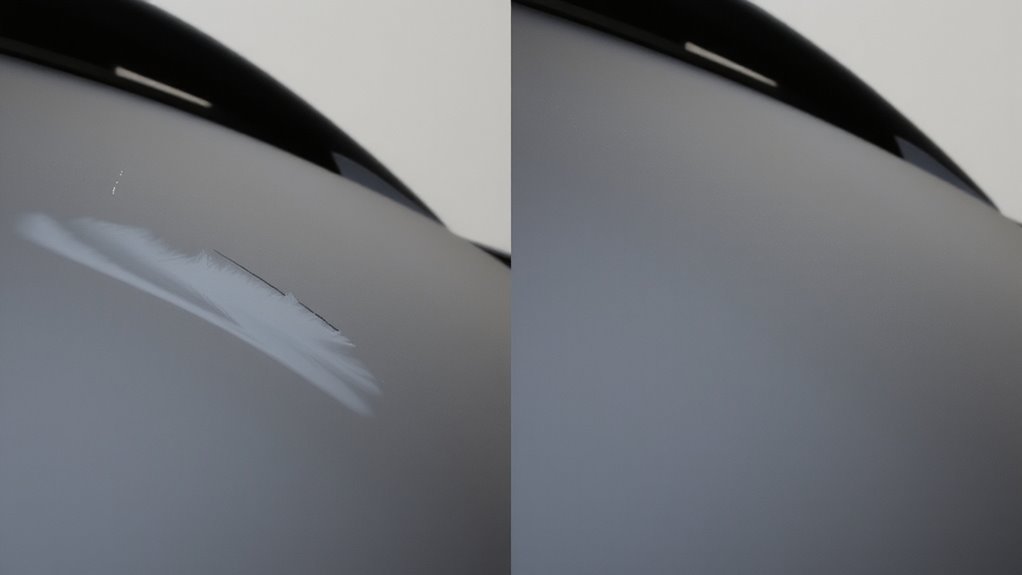
While a glossy finish might seem like the go-to for protection and shine, using gloss products on matte paint disrupts the carefully engineered surface texture designed to scatter light evenly. These gloss coatings create a smooth film that reflects light uniformly, destroying the matte effect. You’re not just altering appearance-you’re inviting chemical degradation. The solvents in traditional gloss sealants penetrate and weaken matte clearcoats, which are formulated with lower cross-link density. This makes them vulnerable to environmental etching from acidic pollutants, bird droppings, and hard water. Unlike gloss surfaces, matte finishes lack self-healing properties due to reduced polymer mobility. Any etching becomes permanent, visibly distorting the flat finish. OEM matte clearcoats are typically 30–40 microns thick-thinner than gloss-offering less buffer against damage. Using gloss products voids protection integrity. You need specialty matte-safe sealants with non-film-forming, hydrophobic additives that preserve texture without compromising defense.
Why Matte Paint Shows Every Flaw
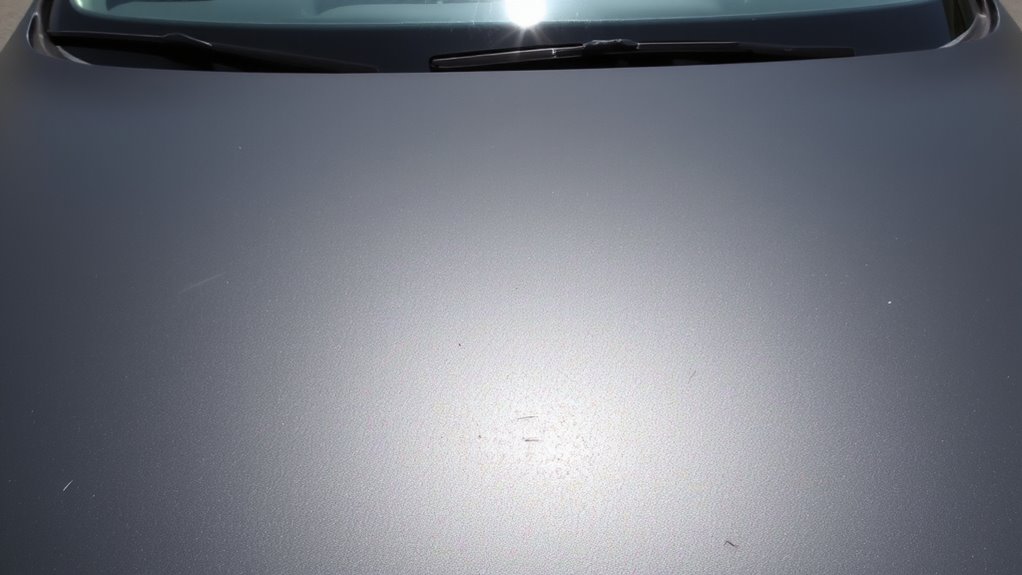
Because matte paint diffuses light instead of reflecting it, even minor surface imperfections become highly visible. Your eye detects flaws not through shine but through disruptions in surface texture. Light diffusion scatters incoming rays evenly, eliminating hotspots but revealing every scratch, swirl, or uneven patch. Unlike glossy finishes that mask defects with reflectivity, matte paint emphasizes topography over luster. A 3-micron scratch invisible on gloss becomes obvious here due to altered diffusion patterns. Surface texture consistency is critical-any contamination or marring changes how light disperses. Feathered edges, buffer trails, or improperly wiped areas create visible shifts. You need precise, flat correction methods to maintain uniform matte appearance. Even minor high spots or low spots in clear coat depth distort diffusion. Clean application and flawless substrate prep are non-negotiable. Imperfections aren’t hidden-they’re mapped in matte.
How Regular Waxes Ruin Matte Finishes
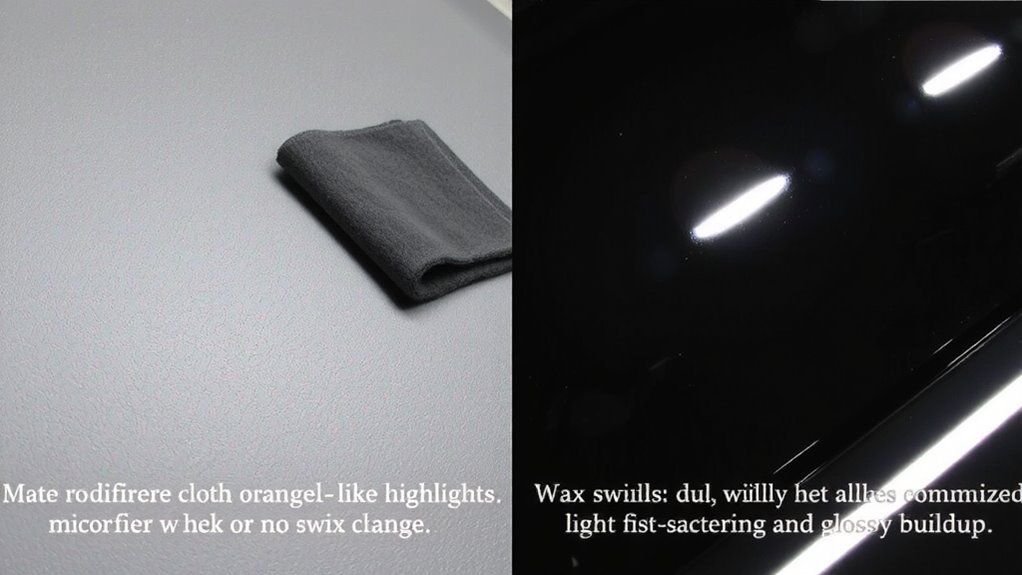
Matte finishes demand specialized care, and using regular wax is one of the fastest ways to ruin their appearance. Standard waxes create glossy highlights through chemical reactions with paint, disrupting the uniform low-luster finish. These products leave behind heavy product residue that fills micro-textures, causing light to reflect unevenly. Unlike gloss surfaces, matte paint relies on a consistent flatness; any buildup results in shiny spots or hazing.
| Product Type | Sheen Change | Residue Level |
|---|---|---|
| Regular Wax | High gloss | Heavy |
| Matte Sealant | None | None |
| All-Purpose Cleaner | Dulling | Moderate |
Avoid waxes containing carnauba or synthetic polymers that bond tightly and harden over time. Their formulation isn’t reversible without aggressive polishing-which damages the matte clearcoat. Always choose solutions engineered specifically for matte finishes to prevent irreversible finish degradation.
Safe Washing Methods for Matte Surfaces
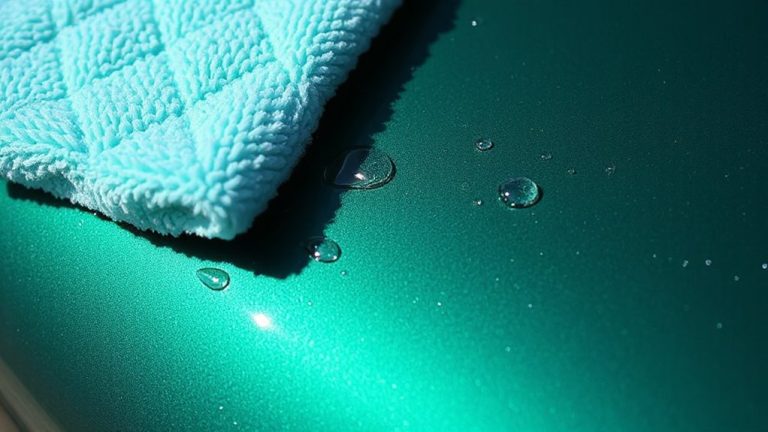
When cleaning a matte surface, using the right technique matters just as much as choosing the correct products. Use lukewarm water only-water temperature above 100°F can soften the clear coat and compromise the matte finish. Always pre-rinse to remove loose debris, minimizing abrasion during washing. Use a pH-neutral car shampoo designed for matte finishes; harsh detergents strip protective layers. Your microfiber selection is critical: choose plush, dual-layer towels with ≤0.5 denier fiber thickness to reduce marring. Fold the towel into quarters to maximize clean surfaces and minimize trapped grit. Use a flat, squeegee-like motion instead of circular buffing to preserve texture uniformity. Avoid high-pressure rinses-keep nozzle pressure below 1,200 psi to prevent delamination at panel edges. Rinse thoroughly and allow to air-dry in shade. Never towel-dry unless using a dedicated, uncontaminated microfiber.
Fixing Scratches Without Adding Shine
How do you repair surface imperfections on a matte finish without altering its signature non-reflective appearance? Start with scratch assessment to determine depth. Surface-level marks disrupt texture; deep scratches expose substrate. Use a 10x loupe and side lighting for accurate evaluation. For light damage, employ buffing alternatives like matte-specific abrasive compounds with micro-fine silica (3–5 µm). These level without polishing. Apply with a low-abrasion foam pad at 1,200 RPM max-exceeding speed generates heat and gloss. Never use rotary buffers or wax-based polishes. Instead, opt for water-based matte correction gels that resuspend matte clearcoat uniformly. For moderate scratches, apply a matte touch-up pen matching the OEM 15–25 gloss unit range. Let dry 10 minutes before feathering edges. Always test on a hidden panel first.
Matte-Safe Sealants That Last
Protection starts where gloss ends-with sealants engineered specifically for low-surface-energy finishes. You need matte-safe formulas that bond without altering surface texture. Traditional sealants fail here; they create shine or peel under stress. Instead, use silicone dioxide (SiO₂) or fluoropolymer-based products designed for flat finishes. These offer superior chemical resistance, shielding against acidic contaminants and alkaline washes. Most last 6–12 months, depending on environmental exposure and washing frequency. Durability factors include film thickness-typically 5–7 microns-and cross-link density, which prevents micro-cracking. Avoid waxes; they degrade unevenly and cause patchiness. Proper application means thin, even layers using a matte-specific applicator. Always verify compatibility with your finish using a discreet test spot. Reapply when water no longer beads or sheets uniformly. With the right product, your matte finish stays protected, consistent, and truly flat-no compromises.
On a final note
You must treat matte finishes differently to preserve their integrity. Matte paint relies on a flat optical structure that glossy products disrupt. Standard waxes add unwanted shine by filling surface pores with polymers. Instead, use pH-neutral cleaners with surfactant levels below 5%. Apply sealants formulated with SiO₂ concentrations of 5–8% for durable, non-reflective protection. Always use microfiber towels rated at 300+ GSM to prevent marring.