How to Apply Rust-Inhibiting Grease to Suspension Components
Apply rust-inhibiting grease every 6,000 miles to ball joints, tie rod ends, and control arm bushings using NLGI #2 lithium-complex or calcium-sulfonate grease with a drip point above 400°F. This grease resists water washout and forms a hydrophobic barrier that prevents corrosion. Use a high-pressure grease gun with a secure coupler to guarantee full lubrication. Clean zerk fittings first with a lint-free cloth and parts cleaner. Wipe off excess grease to avoid attracting dirt. Regular reapplication maintains protection and extends component life under harsh conditions. Further details on identification and maintenance follow.
Notable Insights
- Identify suspension components like ball joints, tie rods, and control arms that have grease fittings and require lubrication.
- Select NLGI grade 2 rust-inhibiting grease with lithium-complex or calcium-sulfonate base for optimal corrosion protection.
- Clean zerk fittings thoroughly with a lint-free cloth and parts cleaner to prevent contamination during greasing.
- Use a high-pressure grease gun with a secure coupler to ensure proper grease delivery to each fitting.
- Apply grease until fresh lubricant emerges from the joint, then wipe off excess and reapply every 6,000 miles.
Apply Rust-Inhibiting Grease to Suspension Components
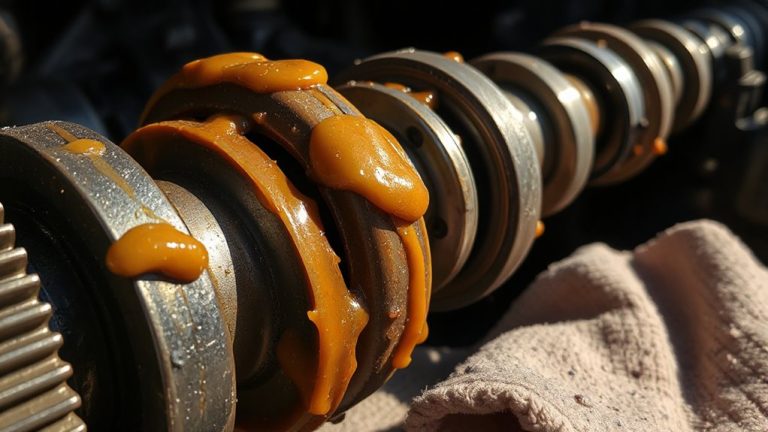
While corrosion can silently degrade suspension performance over time, applying rust-inhibiting grease proactively protects critical components. You must apply it to exposed metal surfaces where moisture and road salts accumulate. Harsh weather conditions, like freezing winters or humid summers, accelerate oxidation and promote rust. The grease forms a hydrophobic barrier, typically with a drip point above 400°F and NLGI grade 2 consistency, to resist washout. It reduces mechanical wear by minimizing friction between moving parts, extending service life. Most formulations contain lithium or calcium sulfonate for enhanced corrosion resistance. Apply using a grease gun or brush, ensuring complete coverage without excess buildup. Reapply every 12 months or 15,000 miles under severe conditions. Proper lubrication prevents pitting, seizing, and premature failure-critical for maintaining alignment and ride stability over time.
Identify Ball Joints, Tie Rods, and Control Arms
Think of your vehicle’s suspension as a network of precision joints and levers working together to keep you safe and in control. Ball joints connect control arms to steering knuckles, allowing smooth pivot motion. They typically use a ball-and-socket design with grease fittings for lubrication. You’ll need to inspect them for play-exceeding 0.05 inches indicates wear. Control arms link the frame to the wheels, absorbing road shocks. Their bushings and grease points require periodic checks. Tie rods transmit steering input, connecting the rack to the wheels. A proper tie rod inspection reveals end wear or looseness, critical for maintaining alignment. Grease fittings on tie rod ends prevent corrosion and reduce friction. Though ball joint removal isn’t always needed for greasing, it’s sometimes necessary if fittings are damaged or seized. Recognizing these components guarantees accurate maintenance and long-term suspension reliability.
Choose the Right Rust-Inhibiting Grease and Grease Gun
Since not all greases offer the same level of protection, picking the right rust-inhibiting grease is essential for maximizing the life of your suspension components. You need grease types formulated with corrosion inhibitors, such as lithium-complex or calcium-sulfonate, which provide superior water resistance and operate effectively between -20°F and 350°F. These greases form a durable barrier that resists washout and prevents oxidation. Always verify gun compatibility before purchasing. Most vehicles use standard NLGI #2 grease, but your grease gun must match the cartridge or bulk supply system-pistol grip guns work best for precise, high-pressure delivery. A flexible hose and rigid tip help reach tight zerk fittings without leaks. Mismatched gun compatibility leads to incomplete lubrication and wasted material. Use a coupler that seals tightly to avoid pressure loss. Choosing the right grease and tool guarantees complete protection and efficient application. For cordless options, consider a cordless grease gun with consistent pressure control for faster, less strenuous lubrication tasks.
Clean and Dry Fittings Before Lubricating
Always clean and dry zerk fittings before applying rust-inhibiting grease. Surface preparation is critical to guarantee proper grease adhesion and penetration. Use a clean, lint-free cloth to wipe away dirt, grime, and old grease from the fitting’s exterior. Any debris can block the grease from entering the component, reducing lubrication efficiency. For heavily soiled fittings, use a parts cleaner and a small brush-avoid water to prevent internal moisture intrusion. Allow the fitting to dry completely; even small amounts of moisture can dilute grease effectiveness. This step supports contamination prevention by stopping foreign particles and liquids from entering the joint. A clean fitting guarantees the grease reaches moving parts, forming a protective barrier. Proper prep extends component life, maintains smooth operation, and maximizes corrosion resistance. Skip shortcuts-effective lubrication starts with a spotless, dry surface.
Use a Grease Gun to Apply Rust-Inhibiting Grease
You’ll need a high-quality grease gun to properly apply rust-inhibiting grease to suspension components. Using the correct tool guarantees consistent pressure and full lubrication of zerk fittings. Grease gun safety is critical-always relieve pressure before detaching and wear safety glasses. Confirm fitting compatibility between your gun’s nozzle and the vehicle’s grease fittings to avoid leaks or damage. Most modern systems use a standard 1/4-inch NPT thread, but always verify.
| Feature | Specification |
|---|---|
| Operating Pressure | Up to 10,000 psi |
| Nozzle Type | Quick-connect, swivel head |
| Grease Type Compatibility | Lithium-based, rust-inhibiting |
| Fitting Compatibility | SAE 00, 0, and 1 fittings |
This guarantees efficient, mess-free application and maximum corrosion protection.
Wipe Off Excess Grease to Prevent Dirt Buildup
After applying rust-inhibiting grease, wipe away any excess with a clean, lint-free cloth to prevent dirt and debris accumulation. Leftover grease attracts contaminants that can grind against suspension parts, accelerating wear. This is especially critical when grease viscosity is high, as thicker formulations hold onto dirt more readily. Wipe gently around zerk fittings and pivot points to maintain a clean seal. The application temperature also affects how the grease behaves during cleanup. If applied in cold conditions-below 40°F (4°C)-the grease may be stiffer, making it harder to spread and remove excess. At ideal application temperatures (60–100°F or 15–38°C), grease flows smoothly, guaranteeing even coverage without overapplication. Always adhere to manufacturer specs for both grease viscosity and thermal range. A clean finish guarantees protection without inviting abrasion.
Reapply Grease Regularly to Prevent Corrosion
Regularly reapplying rust-inhibiting grease is essential to maintaining long-term corrosion resistance in suspension components. You must establish a consistent grease frequency based on vehicle usage and environmental exposure. For most standard applications, grease every 6,000 miles or six months-whichever comes first. Heavy-duty or off-road use demands more frequent service, typically every 3,000 miles. Always pair reapplication with corrosion monitoring, inspecting components for rust, pitting, or coating breakdown. Look especially at ball joints, control arm bushings, and sway bar links. Use a lithium-based grease with a minimum NLGI grade 2 rating and corrosion inhibitors such as zinc or calcium. This grease resists washout from rain and road salts. Skipping maintenance accelerates wear, much like leaving steel exposed to saltwater. Proper reapplication extends component life by up to 50%, ensuring safety and reliability. Stick to a schedule-it’s the simplest defense against mechanical failure.
On a final note
You’ve protected your suspension by applying rust-inhibiting grease correctly. Use lithium-based or calcium-sulfonate greases with a consistency rating of NLGI #2 for best performance. Each fitting needs 3–5 pump strokes from a high-pressure grease gun. Excess grease attracts dirt, so wipe fittings clean. Reapply every 6 months or 6,000 miles. Proper maintenance prevents corrosion and extends component life by up to 50%.