Understanding Tire Blowout Response: What to Do When Disaster Strikes
Stay calm during a blowout-panic slows reaction time by up to 30%. Grip the wheel at 9 and 3 with steady pressure to counter sudden 3,000-pound lateral drag. Don’t brake hard; ease off the accelerator and use aerodynamic drag to slow down. Steer straight, then gradually pull to the shoulder. Turn on hazards-flashing 60–120 times per minute-to alert others. There’s more to optimizing safety after impact.
Notable Insights
- Stay calm and breathe steadily to maintain mental focus and avoid panic after a blowout.
- Grip the steering wheel firmly at 9 and 3 o’clock to counteract sudden pull from the deflated tire.
- Ease off the accelerator instead of braking hard to maintain control during initial deceleration.
- Steer smoothly to the shoulder and turn on hazard lights to warn other drivers safely.
- Inspect tire and vehicle damage only after stopping, and check remaining tires to prevent future blowouts.
Stay Calm During a Tire Blowout
You’re driving at highway speed when suddenly-pop-the sharp bang of a blowout shatters the quiet. Your immediate response can determine safety outcomes. Stay calm. Panic triggers erratic reactions; maintaining mental focus allows rational decision-making. Steady breathing reduces heart rate, which can spike from 70 to over 120 bpm during sudden stress. Controlled breaths-inhale for four counts, exhale for four-anchor your nervous system. This technique, used in aviation and tactical training, sustains cognitive function under pressure. Vehicles traveling at 65 mph cover 95 feet per second; even two seconds of impaired judgment increases risk markedly. Mental focus means ignoring distractions-phone, passengers-and concentrating solely on executing trained responses. Steady breathing supports this focus, preventing hyperventilation, which reduces oxygen flow to the brain. Reaction time improves by up to 30% with regulated respiration. Your survival hinges not on luck, but on disciplined calm, enabling precise next steps.
Keep Control and Grip the Steering Wheel
Maintaining composure sets the foundation for physical control, but the next step demands immediate action at the steering wheel. Grip it firmly with both hands, ideally at the 9 and 3 o’clock positions, to maximize steering stability. A blowout on one side causes sudden drag, pulling the vehicle toward the deflated tire-your input counters this imbalance. Maintain straight-line tracking by resisting the pull, not overcorrecting. Sudden jerks worsen wheel alignment and increase skid risk. The front axle, especially, relies on precise input; even 2 inches of unintended steering can compromise recovery. Vehicle dynamics shift instantly: lateral weight transfer rises, and yaw rate increases. Keep inputs smooth and deliberate, mirroring how a pilot corrects asymmetric thrust. Modern electric power steering systems provide feedback, but don’t rely on assist fully-mechanical connection remains critical. Your hands are the primary control interface. Hold firm, stay neutral, and prioritize directional control above all.
Slow Down Safely Without Braking Hard
When a tire fails, your first instinct might be to hit the brakes, but slamming them can destabilize the vehicle and increase stopping distance. Instead, ease off the accelerator gradually to begin slowing down. Maintaining control relies heavily on proper tire pressure and awareness of current road conditions. Underinflated tires generate excessive heat and increase blowout risk, especially at high speeds. On wet or gravel-covered roads, sudden braking reduces traction and can lead to skidding. The vehicle’s momentum will decrease naturally once power is disengaged, allowing you to maintain directional stability. ABS systems prevent wheel lockup, but they can’t compensate for abrupt inputs after a blowout. Focus on smooth inputs-abrupt steering or braking exceeds the tire’s remaining grip threshold. Let aerodynamic drag and rolling resistance reduce speed before attempting any controlled braking, ensuring safer deceleration under compromised tire conditions.
Pull Over Safely and Turn on Hazards
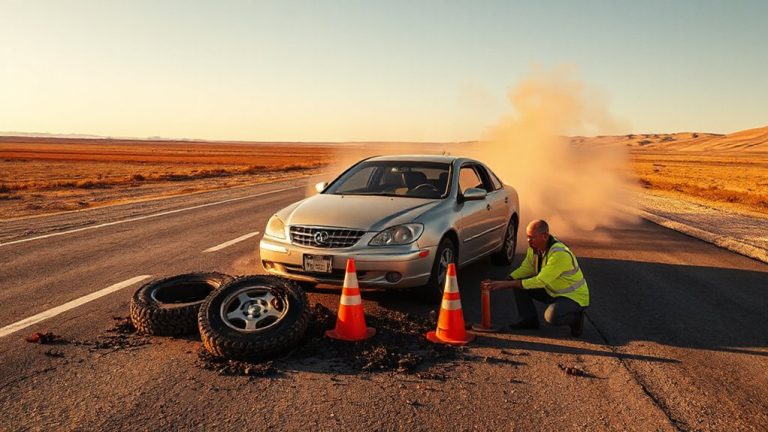
Every second counts after a tire blowout, and pulling over safely is critical to avoid secondary incidents. Immediately ease off the accelerator and maintain a firm grip on the steering wheel. Steer steadily toward the shoulder or nearest area suitable for safe parking. Avoid abrupt maneuvers-gradual deceleration reduces skidding risk. Once stabilized, activate your hazard lights to alert nearby drivers. Hazard lights operate at 60–120 flashes per minute, increasing visibility from up to 500 feet away. Choose a flat, stable surface for stopping; uneven terrain compromises vehicle stability. Remain inside the vehicle if on a high-speed roadway. Safe parking isn’t just about stopping-it’s about positioning your vehicle at a 45-degree angle to traffic if possible, minimizing exposure. Hazard lights should stay on until emergency personnel arrive or the vehicle is safely towed. Keep reflective triangles or LED warning devices ready for low-visibility conditions.
Check Your Car for Damage
Now that you’ve brought the vehicle to a controlled stop and activated your hazard lights, it’s time to assess the damage. Start by visually inspecting the blown tire and the surrounding areas. Look for deep cuts, tread separation, or sidewall bulges, which indicate irreversible damage. Check the tire pressure of the remaining tires using a digital gauge-ideal pressure typically ranges from 32 to 35 PSI, depending on manufacturer specs. Uneven wear or vehicle pulling to one side may signal compromised wheel alignment. Misalignment often exceeds 0.5 degrees from factory settings and can degrade handling. Inspect rims for bends or cracks, as these affect both tire performance and alignment. Damage to suspension components like control arms or struts may also occur. Document all findings before proceeding. This evaluation guarantees safe operation and informs necessary repairs.
Prevent Future Blowouts With These Maintenance Tips
Though you can’t always predict a tire failure, sticking to a strict maintenance routine greatly reduces the risk of another blowout. Tire rotation every 5,000 to 7,500 miles guarantees even wear and extends tread life. Most manufacturers recommend this interval because front and rear tires wear differently due to weight distribution and drivetrain dynamics. Pressure monitoring is equally critical. Check tire pressure monthly using a calibrated gauge; proper inflation typically falls between 32 and 35 psi, as specified on the driver’s side door jamb. Underinflation causes excessive sidewall flexing, generating heat that weakens internal structures. Modern TPMS systems alert you to sudden drops, but manual checks remain essential. Combine tire rotation and pressure monitoring with visual inspections for cracks, bulges, and tread depth below 2/32 of an inch. These practices maintain structural integrity and markedly reduce blowout risk. A reliable tire tread depth gauge helps ensure accurate measurements during routine inspections.
On a final note
Stay sharp and act fast during a blowout. Your vehicle’s stability depends on immediate, controlled input. Grip the wheel firmly-don’t yank it. Let off the accelerator gradually; sudden braking worsens skidding. Most modern cars with tire pressure monitoring systems (TPMS) give early warnings-heed them. Once stopped, inspect tread wear; replace tires below 2/32-inch depth. Balance wheels every 6,000 miles. Use quality radial tires rated for your load and speed. Prevention is engineered, not accidental.