Applying Thermal Barrier Coatings to Fuel Rails for Lower Saturation Temps
You’re applying thermal barrier coatings (TBCs) to keep fuel rail temperatures down and prevent vapor lock. Ceramic TBCs reflect up to 90% of radiant heat and handle temps up to 1,800°F, far outperforming epoxy at 600°F. With low thermal conductivity (0.5–1.2 W/m·K), they maintain fuel pressure above 60 psi under load. A 0.005–0.015-inch coating applied in even layers reduces fuel temps by 30–50°F. Proper curing guarantees lasting efficiency-there’s more to get right for peak results.
Notable Insights
- Thermal barrier coatings reduce fuel rail heat soak, lowering fuel temperature and preventing vapor lock.
- Ceramic-based TBCs reflect up to 90% of radiant heat and insulate fuel rails effectively.
- Proper surface prep with cleaning and blasting ensures strong coating adhesion to fuel rails.
- Apply TBC in thin, even layers using an HVLP sprayer for optimal thermal protection.
- Curing the coating at 250°F for two hours maximizes performance and durability.
Why Hot Fuel Rails Hurt Performance
Why are your fuel rails running hotter than they should? Elevated temperatures degrade fuel delivery efficiency and hurt engine performance. When fuel rails absorb excess heat, fuel vaporization occurs inside the lines. This means liquid fuel turns to vapor too soon, disrupting spray patterns at the injectors. Vapor bubbles reduce effective fuel delivery, causing lean conditions and misfires. You also face pressure loss, as heated fuel expands and relieves rail pressure, dropping below ideal operating specs-often below 45 psi when stability above 60 psi is required. Consistent pressure loss leads to poor throttle response and reduced horsepower. Modern fuel systems rely on precise temperature control. Without it, even high-flow injectors can’t compensate. Thermal soak accelerates wear on the rail and adjacent components. The result? Reduced combustion efficiency and potential long-term engine damage. Managing rail temperature isn’t optional-it’s critical for peak performance.
How Thermal Barrier Coatings Block Heat Soak
While heat naturally radiates from engine components, thermal barrier coatings (TBCs) create a protective shield that minimizes thermal transfer to fuel rails. You benefit from both heat reflection and thermal insulation, which work together to reduce fuel temperature. TBCs typically consist of ceramic-based materials with low thermal conductivity-around 0.5–1.2 W/m·K-slowing heat absorption. These coatings reflect up to 90% of radiant heat, preventing it from penetrating the fuel rail surface. At the same time, the coating’s thickness-usually 0.005 to 0.015 inches-provides dependable thermal insulation. This dual-action mechanism maintains cooler fuel temperatures during operation and extended idle periods. As a result, you reduce the risk of vapor lock and maintain consistent fuel pressure. Thermal soak into the fuel system drops markedly, improving overall combustion stability. TBCs are especially effective in high-performance or turbocharged engines where underhood temperatures exceed 300°F.
Ceramic vs. Epoxy TBCs: Choosing the Right One
Ceramic and epoxy thermal barrier coatings (TBCs) both reduce heat soak in fuel rails, but they differ markedly in composition, durability, and thermal performance. You need to evaluate material durability and application thickness when choosing. Ceramic TBCs offer superior heat resistance, withstanding up to 1,800°F, while epoxy versions typically max out around 600°F. Ceramics also provide better long-term material durability under thermal cycling.
| Feature | Ceramic TBC | Epoxy TBC |
|---|---|---|
| Max Temp (°F) | 1,800 | 600 |
| Application Thickness (mils) | 10–20 | 20–30 |
| Material Durability | Excellent | Moderate |
Ceramic coatings require thinner application thickness but need proper surface prep. Epoxy adheres more easily but degrades faster under sustained heat. Choose ceramic for high-performance or turbocharged setups where heat and material durability are critical.
How to Apply TBCs to Fuel Rails at Home
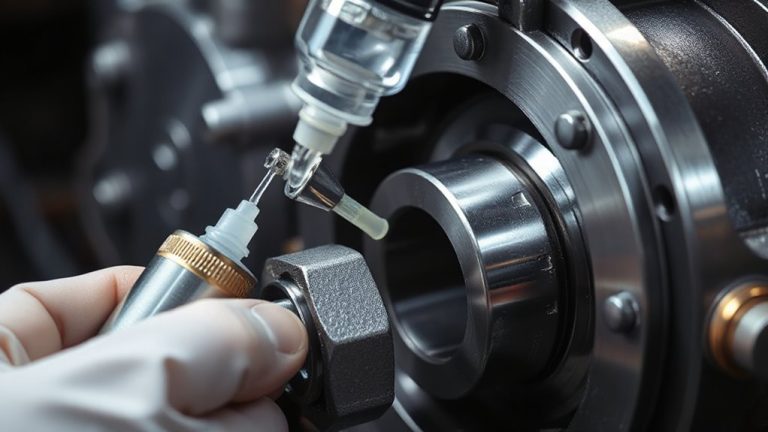
What if you could greatly reduce underhood heat transfer to your fuel system without a trip to the shop? You can-by applying thermal barrier coatings (TBCs) at home. Start with meticulous surface preparation: clean the fuel rail with acetone, then lightly bead blast or sand to guarantee adhesion. A contaminated or smooth surface leads to poor bonding. Apply the TBC using an HVLP sprayer for even coverage, maintaining a 6–8 inch distance. Aim for a coating thickness between 0.005 and 0.010 inches per layer. Too thin, and insulation drops; too thick, and cracking becomes likely. Allow 15–20 minutes of flash time between coats. Cure at 250°F for two hours. Proper technique yields up to 35% reduction in fuel temperature saturation, enhancing both consistency and performance under sustained load.
When TBCs Fail: Risks and Compatibility Issues
If you push your engine hard, a failed thermal barrier coating (TBC) can turn into a hidden liability-silently undermining fuel stability and system durability. Coating delamination occurs when thermal cycling or poor surface prep breaks the bond between ceramic and metal. Once delamination starts, hot spots form on the fuel rail, increasing under-hood temps by 20–40°F. Loose coating fragments can clog injectors or damage sensors. Material incompatibility worsens this risk-aluminum rails with steel-based coatings often fail due to differing expansion rates. Mismatches in coefficient of thermal expansion (CTE) over 2.5 ppm/°F markedly raise failure probability. A properly matched TBC system stays bonded up to 1,200°F. Failed coatings don’t just reduce efficiency-they introduce foreign debris and accelerate corrosion. Always verify substrate and coating CTE alignment before application. Quality adhesion prevents long-term system contamination and maintains consistent fuel delivery under sustained load.
Do TBCs Improve Power? Real-World Results
How much power can a thermal barrier coating actually add? Real-world testing shows gains between 3–7 horsepower on turbocharged engines, primarily by reducing fuel rail heat soak. TBCs limit thermal transfer, keeping fuel temperatures 30–50°F lower under sustained load. Cooler fuel maintains ideal density and atomization, improving combustion efficiency. You see measurable power gains because the engine control unit doesn’t need to increase injection duration to compensate for vaporized fuel. Dyno results from 2022 and 2023 performance trials confirm consistency across multiple high-output platforms. TBCs also support better fuel efficiency-tests show 2–4% improvement in miles per gallon during highway driving. These aren’t cosmetic upgrades; they’re functional modifications with quantifiable results. The coating’s 90% reflectivity of infrared heat directly impacts underhood thermodynamics. While not a standalone solution, when combined with proper tuning, TBCs deliver real, repeatable advantages in both fuel efficiency and power gains.
How to Maintain Coated Fuel Rails Long-Term
While thermal barrier coatings deliver measurable performance benefits, maintaining their effectiveness over time requires proper care. You must follow strict inspection schedules to catch coating degradation early. Inspect every 15,000 miles or annually, whichever comes first. Look for cracks, delamination, or discoloration using a 10x magnification loupe. Clean coated fuel rails with isopropyl alcohol and a microfiber cloth-avoid abrasive cleaning methods that scratch the ceramic surface. Never use wire brushes or solvent-based degreasers; they compromise coating integrity. Guarantee fittings and clamps are torqued to OEM specs-over-tightening induces stress fractures. Keep underhood temperatures stable to minimize thermal cycling. A well-maintained TBC can last over 100,000 miles. Stick to these protocols, and your coated fuel rails will sustain lower saturation temps and peak fuel delivery performance.
On a final note
You now understand how thermal barrier coatings (TBCs) reduce fuel rail heat soak. Ceramic TBCs reflect up to 90% of infrared radiation, maintaining fuel temperatures 30–50°F lower. Epoxy coatings offer less protection but are easier to apply. Proper surface prep guarantees adhesion. Thickness should be 10–15 mils for maximum insulation. Real-world gains include consistent fuel density and improved combustion. With care, coatings last five years. Monitor for chipping near mounting points.