Optimizing Dwell Time: A Key Factor in Successful Car Wax Application
You need to let wax dwell 5–15 minutes for proper polymer cross-linking with the clear coat. Dwell time guarantees strong adhesion, maximum gloss, and water repellency. Paste wax needs 5–10 minutes; spray wax sets in 2–3 due to solvents. Ceramic coatings require 7–10 minutes for covalent bonding. Temperature and humidity shift timing-heat shortens it, cold or high humidity extends it. Apply thin 0.5–1.0 mil layers and buff with a 300–400 GSM microfiber. Check residue at a 45° angle. The ideal climate is 65–75°F and 40–60% RH. You’ll see how surface prep and technique further boost results.
Notable Insights
- Dwell time is the window between wax application and removal, critical for proper bonding and protection.
- Wait 5–15 minutes depending on wax type, with paste wax needing 5–10 minutes and ceramic coatings up to 10.
- High temperatures reduce dwell time, while high humidity or cold conditions extend it significantly.
- Apply wax in thin, even layers to ensure consistent curing and prevent hazing or difficult removal.
- Buff off wax with a clean microfiber towel using straight-line motions to maximize gloss and adhesion.
What Is Dwell Time and Why It Matters
Dwell time-the window between wax application and buffing-determines how well the product bonds to your car’s clear coat. This interval directly impacts wax adhesion and surface bonding. Most manufacturers recommend a dwell time of 5 to 15 minutes, depending on ambient temperature and humidity. If buffed too soon, solvents haven’t evaporated, weakening adhesion. If left too long, the wax cures excessively, making removal difficult and risking residue. Ideal conditions for maximum bonding include temperatures between 60°F and 80°F and low moisture. Proper dwell time allows polymers and resins in the wax to cross-link with the clear coat, forming a durable protective layer. Think of it like paint drying-too little time and it chips easily; just enough, and it lasts. Maximize surface bonding by following product-specific instructions, ensuring lasting wax adhesion and peak performance.
How Dwell Time Affects Wax Protection and Shine
When you let the wax sit for the right amount of time, you’re giving it a chance to form a strong, uniform bond with your car’s clear coat. Proper dwell time maximizes wax adhesion, guaranteeing the protective layer resists wash-off and environmental damage. Insufficient time weakens adhesion, leading to patchy coverage and reduced durability. Over-curing, however, risks hazing and makes removal difficult, compromising surface clarity. Ideal dwell allows solvents to evaporate, leaving behind a resilient, optically clear film. This enhances light reflection, directly improving gloss and depth. The result is a finish with measurable improvement in both gloss units (GU) and contact angle-key indicators of shine and water repellency. Proper timing guarantees full polymer cross-linking in synthetic waxes, boosting longevity. You’re not just adding shine-you’re building a durable shield that maintains surface clarity for months. Every second of dwell affects performance.
Best Dwell Times by Wax Type (Paste, Spray, Ceramic)
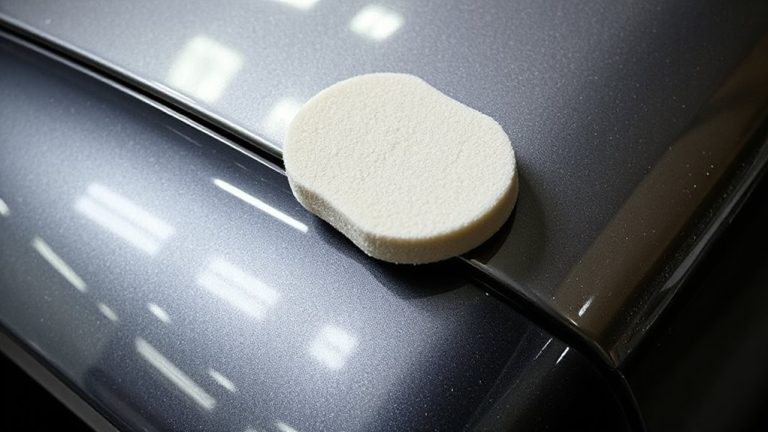
Most paste waxes need 5 to 10 minutes of dwell time before buffing. This allows solvents to evaporate and the wax to form a microscopically uniform layer. You’ll achieve better application consistency when using a foam applicator with light, even pressure. Spray waxes dry faster-usually 2 to 3 minutes-due to lower solids content and higher solvent ratios. Their convenience suits quick detailing, but they offer less durability. You must monitor surface compatibility, especially on matte or textured finishes, where residue can remain visible. Ceramic coatings require 7 to 10 minutes of dwell time for covalent bonding to initiate. They demand precise application consistency to prevent high spots or streaking. Surface compatibility is broad, but proper decontamination is non-negotiable. Each wax type performs best within its ideal dwell window. Respect these times to maximize protection and finish quality. For optimal results, consider choosing from the best car wax picks based on performance and ease of application.
How Temperature and Humidity Change Dwell Time
A few degrees can make a big difference in how long your wax needs to cure. Temperature and humidity directly affect surface tension and evaporation rate, altering dwell time. High heat increases evaporation rate, causing wax to dry too fast, while cold slows curing. Humidity impacts surface tension, changing how wax adheres and spreads.
| Condition | Dwell Time Change |
|---|---|
| 75°F / 24°C, 50% RH | Baseline (15–20 min) |
| 90°F / 32°C, 40% RH | Decreases by ~40% |
| 60°F / 15°C, 60% RH | Increases by ~50% |
| 80°F / 27°C, 80% RH | Increases by ~30% |
| 50°F / 10°C, 50% RH | Increases by ~70% |
You must adjust application timing accordingly. High evaporation rate reduces working time; high surface tension in humid conditions delays film formation. For precision, apply wax in stable climates-ideally between 65–75°F and 40–60% humidity.
Pro Tips for Perfect Wax Drying and Removal
Now that you’ve accounted for temperature and humidity’s effect on dwell time, focus shifts to the final stage-drying and removal. Apply wax in thin, even layers; ideal wax thickness is 0.5–1.0 mils to prevent hazing and guarantee uniform curing. Thicker applications prolong drying and complicate removal, especially on textured surfaces. Surface texture directly influences wax adhesion and drying consistency-painted flat areas dry faster than roughened or ribbed panels. Allow 5–10 minutes of dwell time before wiping, using a microfiber towel with a 300–400 GSM weave for safe, lint-free removal. Buff in straight-line motions to avoid swirls. Check for residue by viewing the surface at a 45-degree angle. Proper technique guarantees a clear, reflective finish without staining or marring, preserving the paint’s optical clarity and protective performance.
On a final note
You must respect dwell time to achieve ideal wax performance. It directly impacts bonding strength and finish clarity. Paste waxes typically need 10–15 minutes; spray waxes dry in 2–5. Ceramic coatings require 5–10 minutes but offer 6–12 months of protection. High temperatures reduce open time by up to 40%. Humidity above 60% slows evaporation. Apply in 60–80°F (15–27°C), low-wind conditions for consistent results.