How to Lubricate Steering Column Support Bearing on a 2015 Toyota Sienna
You’ll need to disconnect the battery and remove the lower dash panels using a T25 Torx and 10mm socket to access the steering column support bearing behind the firewall. The bearing has an 18 mm inner diameter and must be lubricated with 0.3–0.5 grams of high-temperature, water-resistant grease applied evenly to the races. Avoid over-greasing-never exceed 12 grams-to prevent contamination. Rotate the column while applying to guarantee full coverage. Check for axial play over 2 mm or binding, which could indicate internal wear. If play exists or the bearing feels rough, replacement is likely needed. Proper torque on mounting bolts is 18–22 Nm. Use nitrile gloves and a lint-free cloth to wipe excess. A precision grease gun with a needle tip gives the best control. This process restores smooth steering feedback and prevents long-term damage. Further inspection steps reveal what to do if lubrication doesn’t resolve the symptoms.
Notable Insights
- Disconnect the battery and remove the lower steering column cover to access the support bearing on the firewall.
- Inspect the bearing for wear, corrosion, or axial play exceeding 2 mm before lubrication.
- Use a precision grease gun with a needle applicator to apply 0.3–0.5 grams of high-temperature, water-resistant grease.
- Rotate the steering column while applying grease to ensure even distribution across inner and outer races.
- Avoid over-greasing and reassemble components, torquing bolts to 18–22 Nm to prevent spline damage.
What the Steering Column Support Bearing Does
The steering column support bearing keeps the steering shaft stable and aligned as it transfers motion from the steering wheel to the steering gear. This bearing function guarantees smooth, precise steering input with minimal play or vibration. The column support houses the bearing and mounts to the vehicle’s firewall, maintaining shaft alignment under load. It typically uses a sealed sleeve or ball bearing designed to last the life of the vehicle under normal conditions. The assembly reduces friction and wear on the steering shaft, which rotates at a 1:1 ratio with the steering wheel. On a 2015 Toyota Sienna, the bearing’s inner diameter measures approximately 18 mm, accommodating the steel steering shaft. Proper column support alignment prevents premature U-joint wear and steering effort increase. You rely on this component every time you turn the wheel, even if you never notice it. Its job is quiet, but critical.
Signs Your Bearing Needs Lubrication
Why does your steering wheel suddenly feel gritty or develop a rhythmic shudder when turning? You may have a dry or worn steering column support bearing. This component, located beneath the dashboard along the steering shaft, reduces friction between moving parts. When it lacks lubrication, resistance increases, leading to squeaky steering and a stiff, inconsistent response. You might also notice a slight play or vibration in the steering wheel, indicating a loose column. These symptoms worsen over time, especially during low-speed maneuvers or tight turns. A properly lubricated bearing guarantees smooth rotational movement with minimal backlash-typically less than 2mm of axial play. Ignoring early signs can accelerate wear on the intermediate shaft and U-joints. Squeaky steering isn’t just annoying-it’s a mechanical warning. Addressing lubrication early maintains steering precision and prevents premature component failure.
Tools and Grease You’ll Need
A successful bearing lubrication starts with the right tools and materials-no exceptions. You’ll need a high-temperature, water-resistant grease type like lithium-based or molybdenum disulfide (moly), rated for at least 400°F. This guarantees longevity under under-hood heat cycles. A precision grease gun with a flexible extension lets you apply lubricant evenly without disassembling surrounding components. Needle applicators work well for tight spaces. Use a 10mm socket, trim panel tool, and Phillips screwdriver for access points near the column. Wipe away old grease with a lint-free cloth saturated in brake cleaner. Consider Tool alternatives: a small syringe replaces a grease gun in confined areas, while a flatpick can substitute for a panel tool if you’re gentle. Always wear nitrile gloves. Proper prep prevents contamination and extends bearing life.
Accessing the Bearing Under the Dash
Where do you start when the steering column’s support bearing is buried behind dash panels? You begin with careful dashboard removal to expose the steering column support area. Start by disconnecting the negative battery terminal to prevent electrical shorts. Then, remove the lower steering column cover and knee bolster panel using a T25 Torx driver. Exercise caution around electrical connectors-label each with tape before disconnecting. Use a wiring harness sleeve to protect connectors during panel removal. Full access requires removing the instrument panel support bracket bolts (10mm). Once panels are out, the bearing mount is visible near the firewall.
| Component | Tool Required | Torque Spec (ft-lbs) |
|---|---|---|
| Knee bolster | T25 Torx | Hand-tight |
| Instrument bracket | 10mm socket | 8.9 |
| Steering cover | Phillips #2 | N/A |
| Dash screws | T20 Torx | 5.1 |
| Electrical fasteners | Push-pin tool | N/A |
Step-by-Step Lubrication
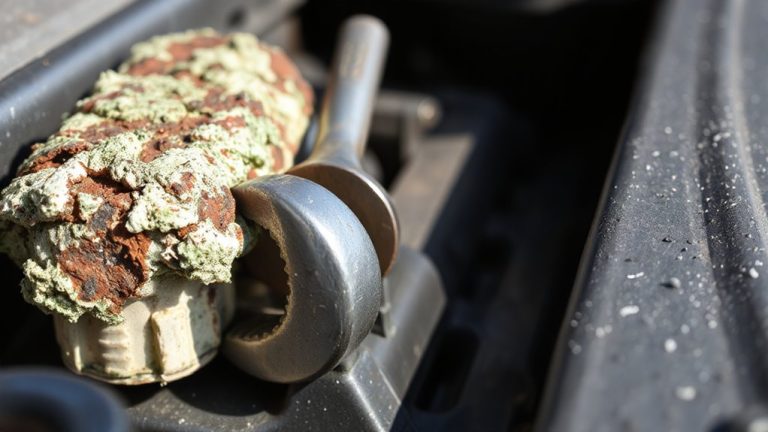
Start by inspecting the exposed support bearing for signs of wear, corrosion, or binding movement before applying lubricant. If you notice roughness or stiffness, it’s likely contributing to steering resistance. Use a high-quality, silicone-based grease rated for automotive steering components-never petroleum-based, as they degrade rubber seals. Apply a thin, even layer around the bearing’s inner and outer races using a precision lubrication tip. Rotate the steering column slowly while applying to guarantee full coverage. Proper lubrication reduces friction, directly aiding noise reduction by eliminating metal-on-metal contact. You should feel smoother turning effort and hear less squeaking or grinding. Recheck movement post-lubrication; the bearing should turn freely with minimal drag. Over-greasing can attract dirt, so use only 0.3 to 0.5 grams of lubricant. This precise amount guarantees longevity and peak performance.
Common DIY Mistakes to Avoid
Overconfidence can lead to costly oversights when servicing the steering column support bearing. Improper alignment during reassembly misroutes steering torque, accelerating wear. Always align the bearing’s index mark with the column shaft groove-0.5 mm tolerance guarantees smooth operation. Forcing misaligned parts damages the splines, degrading steering response. Over greasing displaces factory-specified molybdenum disulfide grease (Toyota part 00295-00102), trapping excess. Excess grease escapes into the cabin during operation, contaminating air ducts. Apply only 10–12 grams to the central race. Use a precision grease gun with graduated output. Never mix grease types-NLGI #2 is required. Skipping alignment checks risks binding under load. Maintain strict torque specs: 18–22 Nm on mounting bolts. Even slight deviations impair tilt and telescoping functions. Prevent damage with measured, deliberate work.
When It’s Not a DIY Fix
If the steering column support bearing shows signs of advanced internal pitting or race deformation, it’s time to stop the DIY repair and call a professional. These defects compromise rotational smoothness and can lead to steering bind or excessive play. A worn bearing may produce grinding or clicking noises when turning, especially at low speeds. Once the bearing cage or inner/outer races are damaged, lubrication won’t restore function-bearing replacement is required. The 2015 Toyota Sienna’s steering column uses a sealed NSK or NTN sleeve bearing with a 25mm inner diameter and static load rating of 4.2 kN. Improper removal or installation risks damaging the column shaft or clockspring. A professional repair guarantees correct alignment, torque specifications (12–15 lb-ft), and use of OEM-spec parts. Mechanics also inspect related components like U-joints and intermediate shafts. Skip the guesswork-trust certified technicians for safe, lasting results.
On a final note
You’ve completed the lubrication process correctly when the steering feels smooth and silent. The support bearing, located beneath the dashboard near the firewall, requires NLGI #2 lithium-based grease-approximately 5 to 7 grams applied evenly. Over-greasing causes boot damage; under-greasing leads to persistent noise. Use a precision grease gun with a needle tip for accurate delivery. Confirm proper function by turning the wheel lock-to-lock with the engine off.