Developing a High-Octane Specific Tune With Adjusted Ignition and Fuel Maps
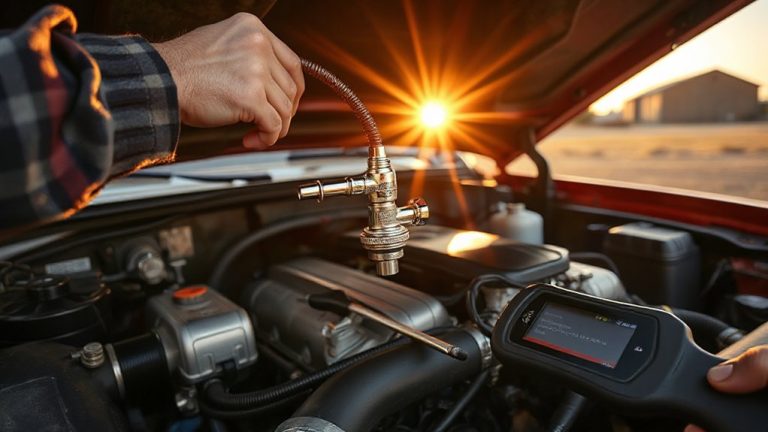
You need a custom tune to access the benefits of high-octane fuel, as factory ECUs are calibrated for 87 AKI and conservative timing. High-octane gas (91–100+ AKI) resists knock, letting you safely advance ignition timing by 5–10 degrees and optimize fuel maps. You’ll run a stoichiometric 12.8:1 air-fuel ratio under load, not waste fuel on unnecessary enrichment. Advanced timing increases cylinder pressure for more power, while real-time knock control adjusts within 20 ms if detonation occurs. Proper tuning uses wideband O2 data and MAF scaling to maintain accuracy across temperatures and elevations. You’ll see 5–10 horsepower gains and sharper throttle response. There’s more to how dynamic spark control and boost tuning work together for peak efficiency.
Notable Insights
- High-octane fuel resists knock, enabling safer ignition timing advances for increased power output.
- Custom tuning adjusts spark timing to optimize cylinder pressure without inducing detonation.
- Fuel maps are refined to reduce unnecessary enrichment, matching the slower burn rate of high-octane fuel.
- Stoichiometric ratios are targeted near 12.8:1 under wide-open throttle for efficient combustion.
- Real-time knock detection and wideband O2 feedback ensure safe, adaptive tuning under load.
Why High-Octane Fuel Requires a Custom Tune
While your engine might run on high-octane fuel right out of the pump, it won’t take full advantage of that fuel unless it’s tuned for it. High-octane fuel has a greater resistance to knock due to its fuel chemistry, allowing for more aggressive tuning. The octane rating measures this knock resistance-regular pump gas is typically 87, while high-octane fuels range from 91 to 100+. Without adjusting the air-fuel ratio and ignition timing, your ECU sticks to conservative factory maps designed for lower octane. That means you’re paying for performance you’re not using. A custom tune recalibrates fuel and spark maps to exploit the stability of high-octane fuel. You gain optimized combustion efficiency, increased power output, and improved throttle response. The engine runs cooler and cleaner, reducing stress on components. Without tuning, high-octane fuel’s benefits remain unrealized-like using a race tire on a stock suspension.
How Advanced Ignition Timing Adds Power Safely
Since ignition timing directly affects combustion efficiency, adjusting it properly releases more power without risking engine damage. You can safely increase ignition advance because high-octane fuel resists knock, allowing the spark to fire earlier in the compression stroke. This early ignition promotes complete combustion, maximizing cylinder pressure at the most favorable piston position. Proper timing safety prevents detonation by ensuring spark advance stays within safe limits. Engines with dynamic knock control systems adjust timing in real time, maintaining peak performance under load. Too much advance causes pre-ignition, but calibrated tuning avoids this risk. You’ll typically see gains of 5–10 horsepower from optimized advance curves alone. Advanced ignition timing improves throttle response and engine efficiency. The key is balancing ignition advance with fuel stability and cooling capacity. When done correctly, you achieve higher output while preserving reliability-critical in high-performance or forced-induction setups where timing safety is non-negotiable.
Optimizing Fuel Maps for High-Octane Fuel
What changes when you switch to high-octane fuel? You gain resistance to knock, allowing more aggressive tuning. But your fuel maps must adapt. High-octane fuel burns slower, so you don’t need as much fuel enrichment under load. Excess fuel wastes power and cools combustion. Adjust stoichiometry to stay near 12.8:1 under wide-open throttle. Air density still dictates oxygen availability, so your tune must respond to changes in temperature and elevation. Use MAF scaling and fuel tables to maintain precision.
| Condition | Fuel Adjustment |
|---|---|
| High Load | Reduce enrichment |
| Low Air Density | Lean slightly, monitor AFR |
| Stable Cooling | Maintain ideal AFR |
You rely on real-time feedback. Data logging guarantees consistency. Enhance for combustion efficiency-not just power.
Tuning Forced Induction Engines for Maximum Output
How do you access peak power from a forced induction engine without compromising reliability? You start by precisely managing the boost threshold to guarantee timely spool and consistent pressure. Modern turbo engines respond best when the boost threshold is set just before peak torque RPM, maximizing efficiency. You must also account for air density, as it directly affects oxygen volume and fuel requirements. Higher air density means more oxygen, allowing for increased fuel delivery and power-assuming ignition timing is optimized. Use a wideband O2 sensor to monitor AFR and adjust fuel trims accordingly. Pair this with precise spark control and a stable boost curve. You’re not just chasing power; you’re balancing thermodynamic load, volumetric efficiency, and long-term component safety. Calibrate with real-world data, not guesswork.
Preventing Knock With Real-Time Tuning Adjustments
A single detonation event can compromise engine integrity, so you need real-time knock control to protect against destructive combustion. Modern ECUs use knock detection to monitor high-frequency vibrations indicating pre-ignition. Proper sensor calibration guarantees accurate readings across RPM and load ranges. Without it, false positives or missed events can damage your build.
| Parameter | Value |
|---|---|
| Detection Frequency Range | 5–15 kHz |
| Response Time | <20 ms |
| Calibration Tolerance | ±0.1 volts |
You adjust ignition timing and fuel delivery within milliseconds when knock is detected. Retarding timing by 2–4 degrees typically suppresses knock without major power loss. Real-time tuning relies on precise input-sensor calibration directly impacts knock detection reliability. Use factory-referenced sensors and validate with wideband AFR and oscilloscope monitoring. This closed-loop strategy lets high-octane engines run aggressive maps safely.
On a final note
You must tune your engine when using high-octane fuel. Advanced ignition timing increases thermal efficiency and power output. Properly adjusted fuel maps prevent over-fueling and maintain ideal air-fuel ratios near 12.8:1 under wide-open throttle. Real-time knock detection allows millisecond-level timing corrections. For forced induction setups, boost pressure up to 20 psi requires precise manifold pressure control and intercooling. A custom tune maximizes horsepower and engine longevity.