Developing a Custom Tune for a Turbocharged Honda K24 With Big Cam
You need a custom tune because your big cam and turbocharged K24 demand precise control that stock ECU settings can’t provide. Aggressive cam timing increases overlap, disrupting idle vacuum and airflow. Without proper fueling and spark adjustments, you risk detonation or valve float past 6,500 RPM. A standalone ECU like Hondata S300 offers full tuning authority. You’ll optimize AFR to 11.8:1–12.2:1 under boost and fine-tune cam timing to restore turbo spool-details that guarantee your build runs safely and performs predictably. Mastering these variables reveals your engine’s real potential.
Notable Insights
- A custom tune is essential to address disrupted idle vacuum and airflow from aggressive cam timing on a turbocharged K24.
- Use a standalone ECU like Hondata S300 or AEM EMS for full control over fuel, spark, and cam timing.
- Optimize ignition dwell to ensure coil saturation at high RPM and prevent misfires with big cam profiles.
- Tune fuel maps to manage increased low-RPM airflow and maintain AFR between 11.8:1 and 12.2:1 under boost.
- Test with wideband O2 and digital knock detection, logging data at 10 Hz to safely refine the tune.
Why a Big Cam Turbo K24 Can’t Run Without a Custom Tune
While stock engine management settings are designed for factory cam profiles and naturally aspirated operation, your big cam turbocharged K24 operates under completely different conditions-making a custom tune not just beneficial but essential. The aggressive cam timing increases overlap, disrupting idle vacuum and altering airflow dynamics. Without recalibration, the ECU can’t compensate, leading to hesitation or stalling. High-lift cams extend valve train load, raising the risk of valve float above 6,500 RPM if spring pressure isn’t matched with precise timing adjustments. Ignition dwell must be optimized to guarantee full coil saturation at high RPM, especially with modified cam profiles affecting crank trigger signals. Too little dwell causes misfires; too much overheats coils. A custom tune adjusts fuel, spark, and cam timing across all load and RPM points. It prevents detonation under boost and maintains cylinder pressure control. You’re not just adding power-you’re managing interdependent variables no stock map can handle.
OBD1 or Standalone: Best ECU for Turbo K24 Big Cam
If you’re running a big cam turbocharged K24, choosing the right ECU isn’t about preference-it’s about control. OBD1 Honda ECUs are limited in tuning flexibility and can’t properly manage aggressive cam timing or high boost. A standalone ECU like Hondata S300 or AEM EMS gives full authority over fuel, spark, and idle. You’ll need precise MAP sensor calibration to accurately read vacuum and boost, especially with high-duration cams that alter intake pressure. Incorrect readings lead to poor air/fuel ratios and detonation. Standalone systems support aftermarket ignition coil selection, including direct-fire coils for stronger spark under pressure. They allow individual coil dwell tuning, critical for cylinder stability at high RPM. OBD1 can’t adjust for coil variances or provide full boost control. For reliability and performance, a standalone is the only real choice. It adapts to your engine’s demands-no compromises.
How Big Cams Break Turbo Spool (and How to Fix It)
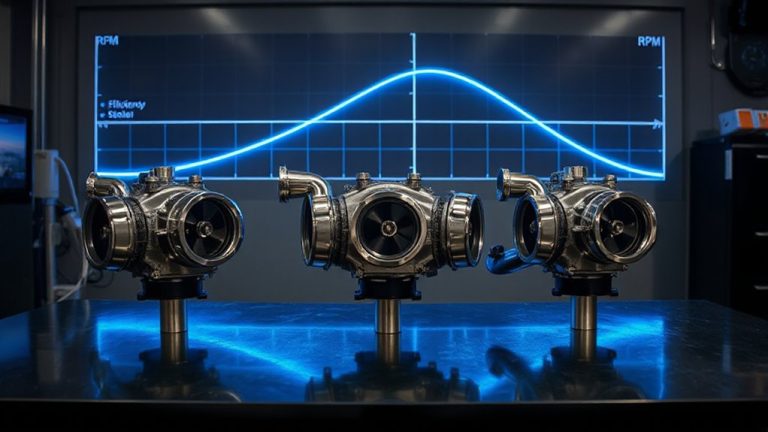
Because big cam profiles increase valve overlap and duration, they can severely disrupt turbo spool on a K24, especially in the low-to-mid RPM range. Excessive cam duration reduces exhaust gas pressure by allowing intake and exhaust valves to be open simultaneously, weakening turbo response. You lose exhaust scavenging efficiency when timing mismatches the turbo’s operating window. This hurts low-end torque and delays boost onset. Properly managing overlap restores spool. Use the table below to match cam specs with turbo behavior.
| Cam Duration (°) | Overlap (°) | Spool Impact |
|---|---|---|
| 252 | 52 | Moderate delay |
| 264 | 68 | Significant delay |
| 272 | 82 | Severe spool loss |
| 256 (adjustable) | 44–60 | Tunable, ideal |
Adjust cam timing or use variable cam control to balance exhaust scavenging and turbo efficiency.
Tuning Fuel and Timing on a Turbo Big Cam K24
You’ve optimized cam timing to preserve turbo spool, but now you need to adjust fuel and ignition timing to match the new airflow dynamics. You must revise fuel maps to account for increased airflow at low RPM and residual exhaust gases from extended cam overlap. Without correction, you’ll run lean off-boost and risk detonation. Adjust fuel tables using load and RPM zones, targeting 11.8:1 to 12.2:1 AFR under boost. Spark curves require equal attention-reduce timing near peak torque to prevent knock while advancing it in shift phases for response. Use a knock-limited strategy: pull 0.5–1 degree per occurrence until stable. Proper spark curves improve efficiency and control exhaust gas temperatures. You’re not just compensating; you’re synchronizing combustion events with intake pulses. This balance maximizes power without sacrificing reliability. A well-synchronized tune guarantees fuel maps and spark curves respond cohesively to throttle and load changes.
How to Test AFR and Knock Safely Under Boost?
How do you verify your fuel and ignition tuning under real boost conditions without risking engine damage? Use wideband AFR and knock detection tools to monitor combustion in real time. Maintain AFR between 11.5:1 and 12.2:1 under full boost for ideal turbocharged performance and boost safety. Even slight deviations increase knock risk. Modern ECU systems use digital knock detection with adjustable sensitivity, often based on decibel threshold and frequency filtering (typically 5–15 kHz). Log data at minimum 10 Hz to catch transient events.
| Parameter | Safe Target |
|---|---|
| AFR (boost) | 11.5:1 – 12.2:1 |
| Knock Threshold | < 2 degrees retarded |
| Boost Stability | ±1 psi consistency |
| EGT (max) | < 1650°F |
| Duty Cycle | < 85% injectors |
Always tune in small load and RPM increments.
On a final note
You need a custom tune to access your turbocharged K24’s potential with a big cam. Without proper tuning, poor spool and timing issues hurt performance. OBD1 or standalone ECUs offer precise control over fuel and ignition. Proper AFR should stay between 11.0:1 and 11.3:1 under boost. Use real-time knock monitoring. Accurate wideband O2 data guarantees safety.