Adding External Oil Coolers to Prevent Thermal Degradation in Sequential Transaxles
You need an external oil cooler to protect your sequential transaxle from thermal breakdown. Fluid degrades above 250°F, losing viscosity and lubricity. A 24-row stacked-plate cooler rated for 25,000–35,000 GVW lowers temps by 20–30°F. Mount it in front of the radiator for maximum airflow. Use -10 AN PTFE-lined hoses and match flow rates to your pump’s 3–6 GPM output. Proper installation keeps oil in the ideal 175°F–225°F range. There’s more to optimizing cooling performance.
Notable Insights
- External oil coolers reduce transmission fluid temperatures by 20–30°F, preventing thermal breakdown above 250°F.
- Install 24-row stacked-plate coolers rated for 25,000–35,000 GVW to match sequential transaxle cooling demands.
- Mount the cooler vertically in front of the radiator for maximum airflow and to avoid air pockets.
- Use PTFE-lined or reinforced silicone hoses rated for 300 psi and 300°F to withstand heat and pressure.
- Match cooler flow rate to pump output (3–6 GPM) to maintain pressure and optimize heat dissipation.
How Heat Damages Sequential Transaxles
While your sequential transaxle delivers lightning-fast shifts and race-ready performance, it’s also generating intense heat with every gear change. Prolonged exposure to temperatures above 250°F degrades transmission fluid, reducing its lubricity and viscosity. This thermal breakdown accelerates bearing wear, compromising shaft alignment and increasing friction. Damaged bearings create metal particles that circulate through the system, further contaminating the oil. As lubrication fails, components experience higher stress, leading to gear slippage under load. Slippage generates even more heat, creating a destructive feedback loop. Surface temperatures on gear teeth can exceed 300°F during aggressive shifts, warping metallurgy and reducing fatigue life. OEM fluid coolers often can’t dissipate heat fast enough during track use. Without proper thermal management, you’re risking costly internal damage that affects shift precision and transmission longevity. Preventive cooling isn’t optional-it’s essential for sustained performance.
How External Oil Coolers Protect Your Transmission
When temperatures climb, your transmission depends on consistent oil cooling to maintain peak operation, and that’s where an external oil cooler makes all the difference. It enhances oil flow and stabilizes pressure balance, preventing thermal breakdown. By routing hot fluid through an auxiliary radiator, the cooler efficiently dissipates heat before returning conditioned oil to the transaxle. This cycle maintains viscosity and lubrication quality.
| Function | Benefit |
|---|---|
| Improved oil flow | Reduces channel restriction |
| Stable pressure balance | Prevents aeration and cavitation |
| Faster heat dissipation | Lowers peak temps by 20–30°F |
| Consistent viscosity | Preserves clutch response |
You extend component life by minimizing thermal stress. The cooler integrates inline with factory lines, requiring no modifications. Proper installation guarantees uninterrupted oil flow and reliable pressure balance under load, keeping your sequential transaxle operating within ideal thermal ranges.
Choosing the Right External Oil Cooler Size
A properly sized external oil cooler makes or breaks your transmission’s thermal management. If the cooler’s too small, it can’t dissipate enough heat, causing oil viscosity to drop and protective film strength to fail. Most sequential transaxles need coolers rated for at least 25,000–35,000 GVW (Gross Vehicle Weight) to handle sustained loads. Cooler efficiency depends on surface area, fin density, and airflow-turbulators inside the tubes enhance heat transfer by disrupting laminar flow. A 24-row stacked-plate cooler offers better efficiency than an 8-row tube-fin unit under high-stress conditions. Match the cooler’s flow rate to your pump’s output, typically 3–6 GPM, to avoid pressure drops. Undersized coolers cause fluid temperatures to exceed 250°F, accelerating oxidation. Oversized units maintain ideal viscosity, staying within the 175°F–225°F ideal range. Choose size based on duty cycle, ambient temperature, and horsepower-your transmission’s longevity depends on it.
Best Places to Mount an Oil Cooler
If you want maximum cooling efficiency, mounting location matters just as much as cooler size. The ideal spot maximizes airflow efficiency and minimizes oil line length. Mount the cooler directly in front of the radiator or A/C condenser where it receives unobstructed ram air. This position guarantees consistent airflow efficiency at highway speeds. Use OEM mounting points or a custom bracket to secure the cooler at least 1/2 inch away from adjacent components for clearance. Avoid placing it behind the bumper or inside wheel wells-these areas trap heat and restrict airflow. Keep the cooler vertical to prevent air pockets and promote full oil circulation. A tilted or horizontal position reduces effective surface contact and cooling capacity. Proper mounting location directly affects thermal performance-position matters.
Oil Cooler Hoses, Fittings, and Installation Tips
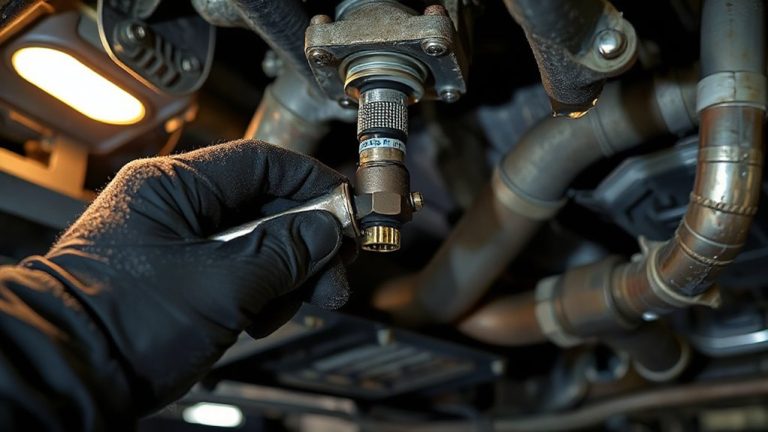
Choose high-quality oil cooler hoses and fittings designed for sustained high-temperature and high-pressure operation. Hose material selection is critical-use reinforced silicone or PTFE-lined hoses rated for at least 300 psi and 300°F to resist cracking and internal delamination. Avoid standard rubber lines; they degrade quickly under sustained heat. Fitting thread compatibility prevents leaks and system failure-verify thread type (e.g., -10 AN, M16x1.5) matches both transaxle ports and cooler inlets. Use crush washers or O-ring seals where specified. Double-flare or ISO-compliant fittings guarantee metal-to-metal seals under vibration. Keep hose routing as straight as possible, minimizing bends to reduce flow restriction. Secure lines with clamps every 18 inches to prevent chafing. Always pressure-test the system before operation. Proper installation guarantees reliable thermal management and protects your transaxle from oil breakdown.
Use a Thermostatic Valve to Regulate Oil Cooling
Why let your oil run too hot-or too cold? A thermostatic valve gives you precise temperature regulation, ensuring your sequential transaxle stays in the ideal range. You’re not just adding cooling-you’re adding smart control. Thermostatic control activates cooling only when oil exceeds preset thresholds, typically between 180°F and 220°F (82°C–104°C). Below that, the valve bypasses the cooler, letting oil warm up faster and stay stable. This prevents overcooling in cold climates and undercooling during track use. Most valves use wax-element actuators with ±5°F accuracy. They handle up to 90 psi and fit 3/8″-16 ORB or M16x1.5 ports. Installing one protects against thermal degradation and maintains viscosity. You get consistent performance, longer fluid life, and reduced wear. It’s not just a valve-it’s precision temperature management built into your cooling loop.
On a final note
You must control heat to protect your sequential transaxle. Excessive temperatures above 260°F degrade oil viscosity and accelerate wear. An external cooler maintains ideal range of 180–220°F. Use a cooler with 20+ cooling fins per inch and 3/8″ or 1/2″ ports. Mount it in front of the radiator with unrestricted airflow. Install -10 AN braided hoses and a thermostatic valve set to 180°F. This setup guarantees consistent lubrication and extends transmission life by up to 50%.