Enhancing Vehicle Appearance With Correct Polishing Motion Techniques
You achieve a high-gloss, streak-free finish by using controlled polishing motions that optimize pad contact and heat distribution. Apply straight-line passes with 50% overlap and 3–5 pounds of pressure for even correction. Use crosshatch patterns to guarantee uniform coverage and reduce marring on large panels. Operate dual-action polishers at 1,200–1,800 OPM with a 6.5mm–9mm orbit and 5-inch foam pads to minimize vibration. Proper motion enhances light reflection and surface clarity-further refinements await.
Notable Insights
- Use straight-line passes with 50% overlap to ensure uniform coverage and prevent hazing on flat or contoured panels.
- Apply crosshatch patterns to large surfaces for balanced abrasion, reduced heat, and improved defect visibility during polishing.
- Maintain 1,200–1,800 OPM with light pressure (2–3 lbs) to prevent swirls and pad deformation.
- Choose dual-action polishers with 5–9mm orbit and quality foam pads to enhance control and minimize buffer trails.
- Overlap polishing strokes by 2–3 inches and use consistent motion to achieve even correction and maximum gloss.
Why Polishing Motion Matters for Shine
While the type of polish and pad matters, the motion you use during polishing plays a decisive role in achieving a flawless shine. Your hand movement directly alters surface texture, which affects light reflection across the paint. Circular motions can generate heat buildup, leading to holograms-micro-ripples visible under direct light. A randomized orbital motion, between 4,000–6,000 OPM (oscillations per minute), evenly distributes abrasive particles. This reduces marring and enhances gloss. Straight-line movements align microscopic peaks on the paint, creating a smoother topology. A smoother surface means more uniform light reflection, increasing perceived depth and clarity. Polishing at 1,500–2,500 RPM with consistent overlap (2–3 inches) guarantees even correction. You maintain control while minimizing swirl patterns. Proper motion doesn’t just remove defects-it shapes how light interacts with the surface. That’s where true shine comes from. Choosing the right tools, such as a high-quality car buffing kit, can significantly improve the effectiveness of your technique.
How Straight-Line Passes Prevent Streaks
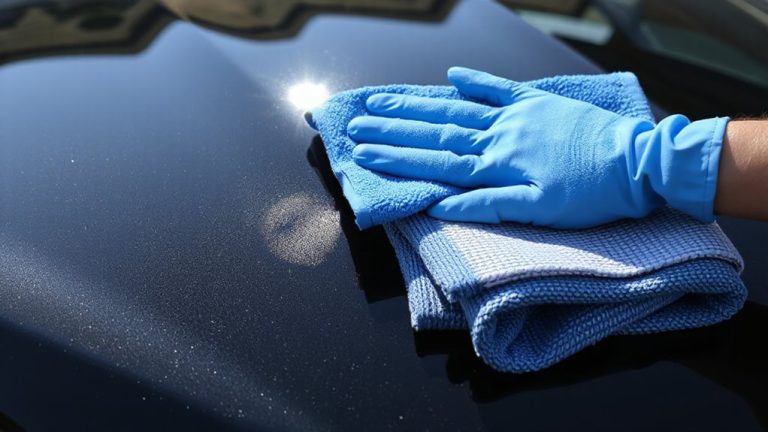
Straight-line passes give you control over how polish interacts with the paint, reducing the risk of uneven finishes. Using linear strokes guarantees each section receives consistent treatment without overlapping too much. You maintain even pressure across the panel, which prevents excessive abrasion in any one spot. Think of it like mowing a lawn-straight, parallel lines cover ground uniformly. Deviating into curves or random patterns risks pooling polish and creating hazy trails. Linear strokes let the pad shear polish cleanly, especially with dual-action polishers operating at 1,200–1,800 orbits per minute. At this speed, straight motions enhance cut efficiency while minimizing heat buildup. You’ll notice fewer buffer marks and improved clarity. Maintaining 3–5 pounds of even pressure optimizes pad-to-surface contact. This technique works best on flat or mildly contoured panels, where tracking is predictable. Overlap each pass by 50% to guarantee full coverage without skipping areas. With disciplined execution, straight-line polishing delivers a streak-free, uniform finish every time.
Circular or Crosshatch: Which Polishing Pattern Wins?
Why do so many detailers default to circular motions when crosshatching might deliver better results? The persistence of circular myths leads many to believe that rotating pads in tight circles guarantee even polishing. In reality, circular patterns often cause uneven material removal, especially on flat panels. Crosshatch benefits include consistent coverage and minimized pooling of polish. You should apply polish in overlapping passes, first horizontally, then vertically, guaranteeing uniform dwell time across the surface. This method reduces heat buildup and prevents pad glazing, which occurs at rotational speeds over 1,200 RPM in circular applications. Crosshatching also improves defect visibility mid-process. Unlike circular techniques, the grid-like approach guarantees each zone receives equal abrasion. You maintain better control, especially on larger panels like hoods and doors. For precision and repeatability, crosshatching outperforms outdated circular routines. It’s not about tradition-it’s about results. Choosing the right best polishing compounds for beginners ensures optimal cutting and finishing when using proper crosshatch techniques.
How Polishing Motion Causes Swirls (And How to Stop Them)
Polishing motion directly influences whether you eliminate defects or leave behind a network of fine scratches known as swirl marks. Applying incorrect pressure causes the polisher to overheat the paint, breaking down the polish prematurely and increasing marring. Too much downward force distorts pad contact, creating uneven abrasion patterns. Pad deformation occurs when excessive pressure flattens the foam, reducing its ability to absorb motion and distributing shear forces unevenly across the surface. This concentrates abrasives in streaking lines-visible under direct light. To prevent swirls, use consistent, light hand pressure-no more than 2 to 3 pounds per square inch. Let the machine do the work. Maintain a steady speed of 1,200 to 1,800 orbital movements per minute. Overlap each pass by 50% to guarantee uniform correction without stacking heat. Choosing the right auto buffing compounds can significantly improve defect removal while minimizing the risk of introducing new marring.
Polisher and Pad Choices That Support Smooth Motion
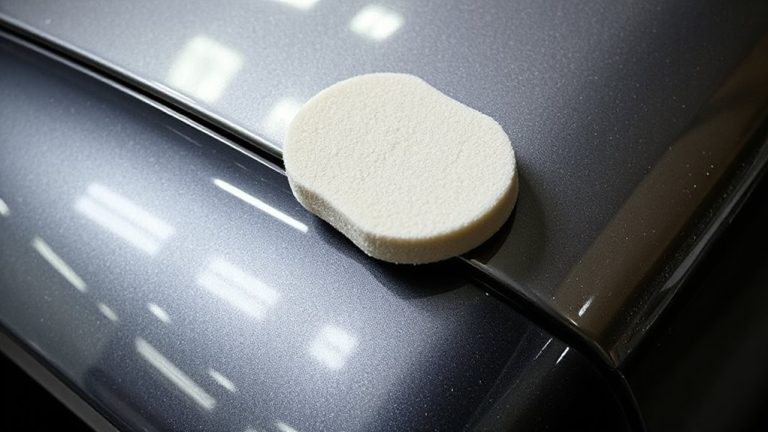
When it comes to achieving a flawless finish, the right combination of polisher and pad plays a critical role in maintaining smooth, consistent motion across the paint. You need motion control to prevent vibrations that lead to buffer trails. Dual-action polishers with a 5mm to 9mm orbit offer safer, more predictable movement than forced rotation models. For moderate correction, use a 6.5mm or 8mm orbit polisher with medium firmness foam pads. Pad selection directly affects cut performance and heat buildup. Choose foam pads between 14mm and 20mm thick-thicker pads dampen vibration better. Lambswool pads are ideal for finishing, but foam delivers superior motion control. Match pad diameter to polisher size: 5-inch pads on 6-inch machines reduce edge runout. High-quality backing plates with rubber dampeners further improve stability. Your tools must work together to support uniform, gliding motion-anything less risks uneven results and added correction work.
Final Passes: How Motion Boosts Gloss
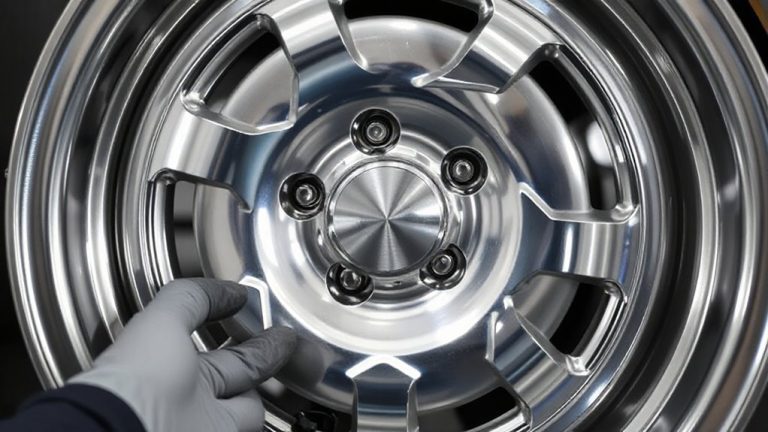
Because surface refinement peaks during the final passes, your motion directly influences the level of gloss achieved. Use slow, overlapping passes at 1,200–1,800 RPM to maximize shine without inducing swirls. Maintain consistent, light buffing pressure-ideally 3 to 5 pounds of force-to prevent pad loading and surface distortion. Excessive pressure generates unnecessary friction, compromising finish clarity. Heat control is critical; sustained high temperatures can haze the paint or soften clear coat. Work in 2×2-foot sections, monitoring surface temperature with an infrared thermometer; stay under 100°F. Employ a water-based finishing polish with micro-abrasives under 3 microns for optical smoothness. Use a plush foam pad, 3 to 4 inches thick, to distribute motion evenly. Your motion-straight lines or gentle arcs-must remain deliberate, enhancing reflectivity. Proper technique yields a glossy, defect-free surface.
On a final note
Your polishing motion directly impacts finish quality. Straight-line passes at 1,200–1,800 OPM prevent holograms and guarantee even correction. Circular patterns risk swirl accumulation on flat panels, while crosshatch motions improve compound breakdown. Use a dual-action polisher with a 6mm or 9mm orbit; pair with foam pads graded by density (e.g., firm for cutting, soft for finishing). Final passes with low speed and overlapping strokes increase gloss by 20–30%.