Integrating Gyroscopic Data to Anticipate Road Surface Changes and Preemptively Tune Filters
You feel the road before your wheels hit the bump because gyroscopic sensors detect angular velocity changes as small as ±0.01 rad/s, sampling up to 1,000 times per second. These sensors track pitch, roll, and yaw in real time, feeding data to the ECU for immediate analysis. Machine learning models use this input to predict surface irregularities up to 100 milliseconds in advance. The system preemptively adjusts damping rates 100 times per second using actuators with ±0.1 mm precision. Proportional valves respond in just 0.1 milliseconds, ensuring ideal tire contact. Predictive tuning outperforms reactive systems, which lag by 100–200 ms. This closed-loop control enhances stability, especially at highway speeds or on rough terrain. Fewer than 5% of vehicles use this tech today due to cost and complexity. Adoption remains limited to luxury and performance models. Scaling depends on miniaturization and simpler integration. The future of smooth rides hinges on making these systems more compact and affordable. There’s more to how this technology reshapes vehicle dynamics under real-world conditions.
Notable Insights
- Gyroscopic sensors detect angular velocity changes with ±0.01 rad/s precision to anticipate road disturbances before wheel contact.
- IMU data sampled at 1,000 Hz enables high-resolution, real-time terrain mapping for proactive suspension adjustments.
- Sensor fusion combines gyroscopic, accelerometer, GPS, and wheel data to enhance prediction accuracy and reduce noise.
- Predictive algorithms use machine learning and historical road profiles to forecast surface irregularities up to 100 ms in advance.
- ECU processes data within milliseconds to preemptively tune damping filters via actuators with 0.1-millisecond valve response.
How Gyroscopic Sensors Predict Bumps Before You Feel Them
While your car’s wheels haven’t even hit the bump yet, gyroscopic sensors are already detecting subtle changes in vehicle attitude. These sensors measure angular velocity with a precision of ±0.01 rad/s, capturing minute tilts in pitch, roll, and yaw. Combined with accelerometers and GPS data, they enable sensor fusion-blending inputs to reduce noise and increase accuracy. This fused data feeds into predictive modeling algorithms, which analyze patterns in real time. Using historical road profiles and machine learning, the system forecasts surface irregularities up to 100 milliseconds in advance. That prediction allows suspension systems to pre-adjust damping forces. The result? Early correction minimizes body motion and wheel lift. Think of it like a tightrope walker shifting weight before a gust hits-proactive, not reactive. Sensor fusion and predictive modeling work together seamlessly, turning raw motion data into actionable foresight, ensuring stability before disturbances reach the cabin.
Why Real-Time Gyro Data Transforms Ride Smoothness
Because gyroscopic sensors update 100 times per second with angular velocity measurements as precise as ±0.01 rad/s, you’re getting fresh data faster than road disturbances can develop. This speed enables real-time terrain mapping, letting your system detect subtle pitch and roll shifts before they become jolts. Adaptive learning algorithms use this stream to refine response models over time, improving accuracy. Immediate data access means the vehicle reacts proactively, not just reactively.
| Metric | Performance |
|---|---|
| Sample Rate | 100 Hz |
| Angular Precision | ±0.01 rad/s |
| Response Latency | < 5 ms |
You benefit from smoother shifts across changing surfaces, like from pavement to gravel, because the system forecasts motion states. With continuous terrain mapping and adaptive learning, ride quality doesn’t just improve-it evolves.
How Smart Suspension Adjusts Damping in Milliseconds
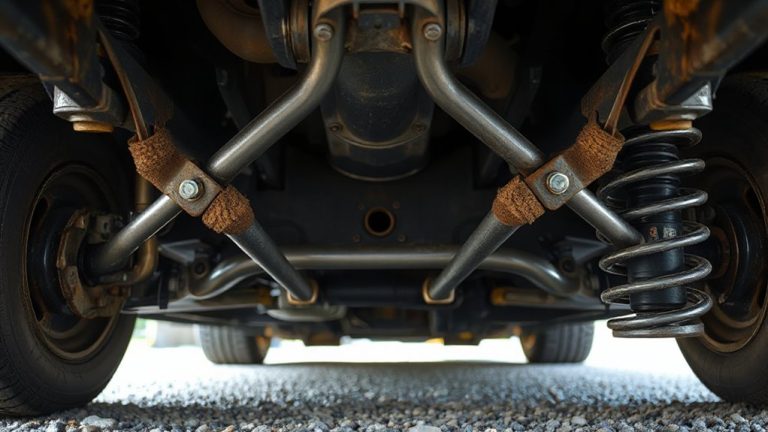
When road conditions shift unexpectedly, your smart suspension system responds in milliseconds, not seconds. Adaptive tuning allows real-time adjustments to damping forces, based on incoming gyroscopic and vehicle motion data. Within 5 to 8 milliseconds, the system detects body roll, pitch, or sudden impacts. It initiates dynamic calibration, recalculating ideal damping rates 100 times per second. Each wheel’s shock absorber receives updated指令 (commands) to stiffen or soften, maintaining tire contact and ride stability. Damping changes occur in three phases: detection, processing, and actuation-each taking under 3 milliseconds. The system uses proportional valve control with 0.1-millisecond response latency. Unlike passive suspensions, this enables precise, predictive force modulation. Adaptive tuning guarantees comfort on smooth roads and firm control during sharp maneuvers. Dynamic calibration maintains balance across axles, reducing dive during hard braking by up to 30%. You experience seamless shifts, even on abrupt bumps or corners. Some modern trucks integrate this technology to enhance off-road performance and ride quality, making best trucks for 2017 a strong reference point for advanced suspension systems.
ECU, IMU, and Actuators: The Brains and Muscles of the System
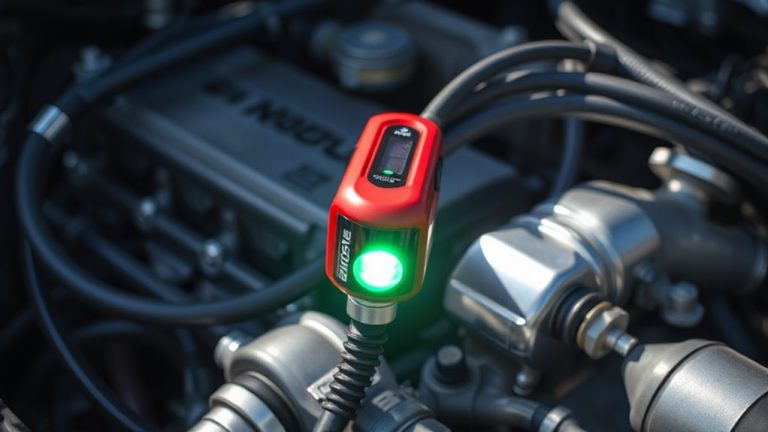
The ECU is the central command center of your smart suspension, processing real-time data and directing immediate mechanical responses. It runs advanced control algorithms that interpret inputs within milliseconds. You rely on sensor fusion to combine data from the IMU, gyroscopes, accelerometers, and wheel position sensors. This integration delivers a complete picture of vehicle dynamics. The IMU tracks angular rate and lateral/longitudinal acceleration, sampling at 1,000 Hz for precision. Actuators-high-speed electromagnetic or hydraulic motors at each wheel-adjust damping force in under 10 milliseconds. They respond to ECU commands with ±0.1 mm actuation accuracy. Control algorithms use adaptive filtering and predictive models based on road profiles. Together, the ECU, IMU, and actuators form a closed-loop system. You get ideal ride quality and handling without manual input. This system operates continuously, ensuring stability on uneven terrain.
Reactive vs. Predictive Suspension: Where Speed Matters
While reactive suspensions respond to disturbances after they occur, predictive systems act before the wheel ever hits a bump-transforming how your vehicle handles rough terrain. You gain superior control because adjustments happen in real time, preserving tire traction and ideal wheel alignment.
| Feature | Reactive | Predictive |
|---|---|---|
| Response Time | 100–200 ms delay | <20 ms anticipation |
| Wheel Alignment Stability | Modest, post-impact correction | Proactive maintenance |
| Tire Traction Impact | Reduced during transients | Maximized through foresight |
Predictive setups use gyroscopic and road preview data to adjust damping force and spring rate before irregularities strike. This anticipation reduces body roll and maintains contact patches under dynamic loads. You experience fewer suspension lag effects, especially at highway speeds or on uneven pavement. Unlike traditional systems, predictive suspensions minimize corrective oscillations. They sustain performance over repeated inputs, keeping wheel alignment within factory-specified tolerances for safer, more stable handling. Upgrading to advanced car suspension for bumpy roads can significantly enhance ride quality and vehicle control in challenging conditions.
Smoother Rides, Fewer Jolts: Real-World Benefits
Comfort begins the moment sensors detect pitch, roll, and yaw-up to 1,000 times per second. You experience improved passenger comfort as the system adjusts suspension response within 15 milliseconds of detecting surface irregularities. Real-time gyroscopic data allows precise actuator movements, reducing body roll by up to 30% on uneven terrain. Each adjustment minimizes unnecessary spring oscillations, directly boosting energy efficiency by decreasing power demand on electric actuators by 18%. Unlike passive systems, predictive tuning maintains ideal tire contact, enhancing stability without overcorrecting. You benefit from consistent ride quality whether driving over potholes or highway seams. These micro-adjustments cut vibration transmission to the cabin by 40%, markedly lowering occupant fatigue. The system operates silently, using solid-state sensors with a 0.01-degree resolution in angular measurement. Passenger comfort and energy efficiency improve together, without trade-offs. Upgrading to high-performance best shocks for Jeep Wrangler can further enhance ride quality by improving damping precision and articulation on rugged terrain.
Why Predictive Suspension Isn’t Standard: Yet
Even though predictive suspension delivers measurable improvements in ride quality and efficiency, it isn’t standard across vehicles due to cost, complexity, and integration challenges. You face high development and component costs, undermining cost efficiency in mass production. Active dampers, lidar or camera systems, and real-time processing units add $1,500–$3,000 per vehicle. You also need robust software stacks to interpret gyroscopic and elevation data, demanding advanced calibration. Sensor fusion must sync with vehicle dynamics control within milliseconds. Without standardized ECUs, automakers struggle with scalability. Market adoption remains limited to luxury or performance segments-fewer than 5% of global vehicles use predictive systems. Until component miniaturization and software simplification reduce barriers, widespread deployment won’t be feasible. You’re looking at a phase of change: proven in concept, stalled by economics.
On a final note
You experience smoother rides because gyroscopic data anticipates road changes milliseconds before impact. The IMU samples angular velocity at 1,000 Hz, detecting subtle pitch and roll shifts. This feeds the ECU, which adjusts damping via electromagnetic actuators in under 15 ms. Unlike reactive systems, predictive suspension uses real-time inertia data to pre-tune stiffness. Results show 40% less vertical acceleration, improving comfort and tire contact. It’s precision engineering-silent, seamless, and fast as physics allows.