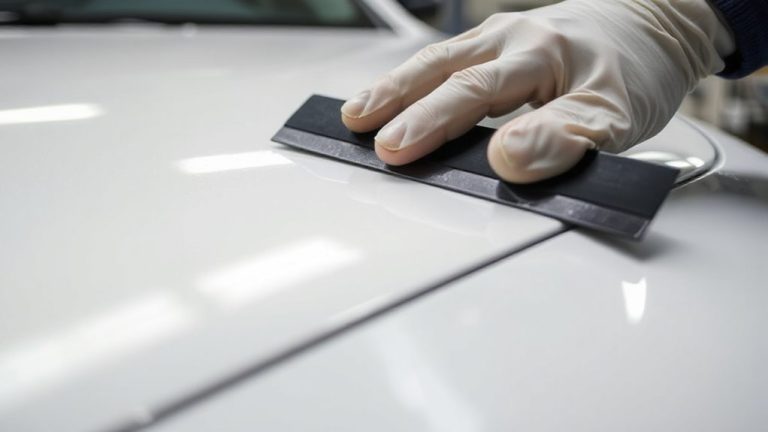
How to Choose the Perfect Applicator Pads Based on Product Type
Choose the right applicator pad by matching material and density to your product. Use closed-cell foam with 45–55 IFD for waxes and sealants-it resists saturation and spreads evenly. Opt for microfiber pads with 0.1 denier fibers for polishing; they’re lint-free and durable. Pick wool pads with 18–22 oz/ft³ density for heavy cutting. Avoid cross-contamination and replace pads every 3–5 uses. The correct pad guarantees flawless results-details on each type follow.
Notable Insights
- Match pad material to product type: use polyester blends for solvent-based dressings to prevent degradation.
- Select foam density between 45–55 IFD for even wax and sealant application without oversaturation.
- Choose microfiber pads with ultra-fine fibers (≤0.1 denier) for lint-free polishing and detailing.
- Use high-density wool pads (18–22 oz/ft³) at 1,200–1,800 RPM for effective heavy cutting.
- Avoid cross-contamination and replace pads every 3–5 uses to maintain finish quality.
Why Matching Applicator Pads to Products Matters
While it might seem like a small detail, choosing the right applicator pad for your product can make or break the finish. Product compatibility guarantees the pad’s material doesn’t react with your product’s chemical composition. For example, polyester blends resist breakdown from solvent-based dressings, while natural lambswool can degrade. Using the wrong pad risks streaking, residue buildup, or product waste. Application efficiency depends on the pad’s density and surface texture. Pads with a Shore A hardness of 18–22 distribute liquids evenly without soaking too much. A standard 3.5” x 3.5” pad at 0.75” thickness offers ideal grip and coverage. Closed-cell foam maintains shape after 15+ uses if cleaned properly. Choosing correctly improves spread rate, reduces effort, and guarantees uniform results. Always match pad specs to product type-doing so sharpens precision and extends pad life.
Foam Pads for Waxes and Sealants
When applying waxes or sealants, foam pads offer unmatched control and consistency for achieving a flawless finish. You need precision, and foam delivers it. Foam density determines product absorption and spreadability-medium density (45–55 IFD) works best, balancing softness and structure. Too soft, and the pad deforms; too firm, and it won’t evenly distribute the product. Pad thickness typically ranges from 1.5 to 2 inches. Thinner pads (1.5”) suit flat surfaces, providing direct control. Thicker pads (2”) conform slightly to curves without sacrificing precision. Closed-cell foam resists saturation, preventing product waste. Choose pads with beveled edges to avoid edge marking on panel shifts. The pad’s foam density and pad thickness directly impact application efficiency and finish quality. A well-designed foam pad guarantees uniform layer deposition, essential for maximizing protection and shine. Stick to these specs, and your results will be consistently smooth and streak-free.
Microfiber Pads for Polishing and Detailing
Microfiber pads bring a different set of advantages to your polishing and detailing workflow compared to foam. They’re densely woven with ultra-fine fibers, typically 0.1 denier or less, making them ideal for light to medium correction and final finishing. You’ll appreciate their excellent color fastness-dyes resist fading even after repeated washings at 30–40°C. Unlike cheaper cloths, they leave no lint residue on glass or clear coats, ensuring a pristine finish. Most microfiber pads measure 12–15 cm in diameter with a 15–20 mm thickness, balancing flexibility and durability. The dual-layer construction separates the absorbent base from the soft face, improving product pickup and release. Use them at 1,200–1,800 orbital RPM to prevent overheating. They work well with fine polishes and glazes, delivering high clarity without marring. Microfiber pads offer consistent performance across multiple uses when cleaned properly with pH-neutral detergents. When maintaining your vehicle, having reliable off-road capability can enhance access to remote detailing locations, making a best budget off-road vehicle a smart investment for mobile detailers.
Wool Applicator Pads for Heavy Cutting
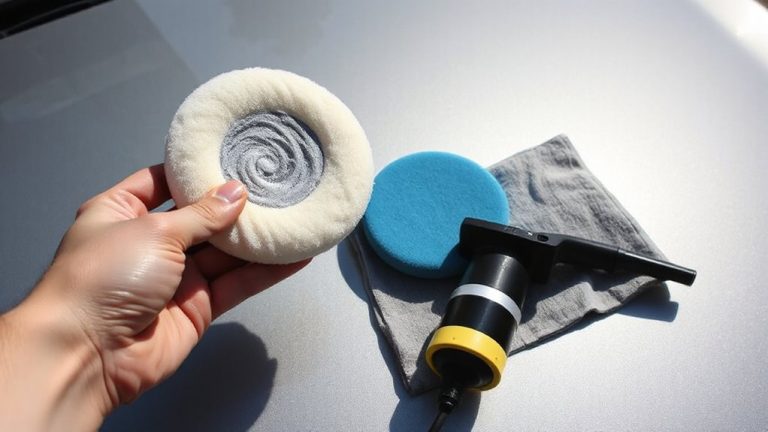
You’ll reach for wool applicator pads when the job demands serious cutting power. These pads excel in removing deep scratches, heavy oxidation, and thick compounding products. Wool density directly affects performance-higher density means more material contact and consistent cutting aggression. A typical wool pad has a density of 18–22 ounces per cubic foot, providing durability under high-speed operation. Cutting aggression is further influenced by fiber length; longer fibers generate more heat and friction, accelerating material removal. Wool pads work best at speeds between 1,200 and 1,800 RPM. Exceeding this range risks overheating and surface marring. Unlike foam, wool doesn’t cushion well, so use them with a dual-action or rotary polisher that maintains stability. Their open fiber structure sheds debris efficiently, sustaining aggression over time. Choose tightly woven wool for moderate cut, looser weaves for maximum cutting aggression. Properly maintained, they deliver repeatable, industrial-grade results.
5 Applicator Pad Mistakes to Avoid
Improper pad selection is the most common misstep in paint correction and finishing. Using the wrong density or material leads to inefficient cutting, swirls, or overheating. Always match pad hardness to the product: firm pads for aggressive compounds, soft for finishing. Pad contamination ruins finishes-don’t use a pad exposed to coarse residue on a delicate glaze. Cross-contamination spreads abrasives where they don’t belong, marring surfaces. Improper storage degrades foam integrity; pads collapse or absorb moisture if left uncompressed or in humid areas.
| Pad Type | Risk of Misuse |
|---|---|
| Wool | Over-cutting, fiber shedding |
| Foam (Hard) | Swirl marks, heat buildup |
| Foam (Soft) | Poor compound activation |
| Microfiber | Pad contamination from oils |
| Applicator (Dual-Action) | Improper storage deformation |
Replace pads every 3–5 uses or when surface texture changes.
On a final note
Choosing the right applicator pad guarantees ideal product performance and surface finish. Foam pads, with a density of 80–120 PPI, work best for waxes and sealants, providing even spreadability. Microfiber pads offer fine, consistent results for polishing due to their split-fiber structure. Wool pads, at 14–18 mm thickness, excel in heavy cutting. Match pad type to product for precision and durability.