How to Apply Graphene-Based Hydrophobic Coatings for Maximum Water Beading on Automotive Paint
You must start with flawless paint: decontaminate using a clay bar and wash with pH-neutral shampoo, then polish to achieve at least 80 microns of clear coat. Apply the graphene coating in 2×2 foot sections with a microfiber pad, using straight-line motions. Keep layers thin-under 0.5 mils-to maximize hydrophobicity. Wipe with 70% isopropyl alcohol before application to remove invisible oils. Let each coat cure 12–24 hours, and allow a full 48 hours for complete cross-linking under 40–60% humidity. A fully cured graphene coating develops water contact angles over 110°, far exceeding wax’s 80°–90°. Proper prep and curing guarantee self-cleaning behavior and long-term resistance to water spotting. The science behind the beading gets even more precise with exact environmental control.
Notable Insights
- Decontaminate paint thoroughly using a clay bar and wipe with 70% isopropyl alcohol to ensure optimal coating adhesion.
- Perform paint correction to remove imperfections and confirm at least 80 microns of clear coat remain.
- Apply graphene coating in 2×2 foot sections using straight-line motions to ensure even, thin coverage.
- Allow the coating to haze for 2–5 minutes, then buff off residue with a clean microfiber towel.
- Cure the coating for 24–48 hours in dry conditions at 40–60% humidity for maximum hydrophobic performance.
Prep Your Car’s Paint for Graphene Coating
You can’t skip proper surface prep-applying graphene coating to dirty or contaminated paint is like pouring premium fuel into an engine full of sludge. Start with a thorough wash using pH-neutral shampoo to remove surface grime. Then, use a clay bar with lubricant to extract embedded contaminants like rail dust and industrial fallout; glide it across the panel until it feels smooth. Any residue left behind compromises adhesion. Next, perform paint correction with a dual-action polisher and progressively finer compounds to eliminate swirls and oxidation, restoring a clean molecular substrate. Clear-coat depth should measure at least 80 microns to withstand the process. Only flawless, decontaminated, and polished paint guarantees peak cross-linking. Wipe down with isopropyl alcohol solution (70/30 ratio) to eliminate oils. Your surface is now ready. This prep phase is non-negotiable for achieving maximum hydrophobic performance and coating longevity. For optimal results, consider using a complete car clay bar kit that includes everything needed for effective decontamination.
Apply Graphene Coating in 5 Simple Steps
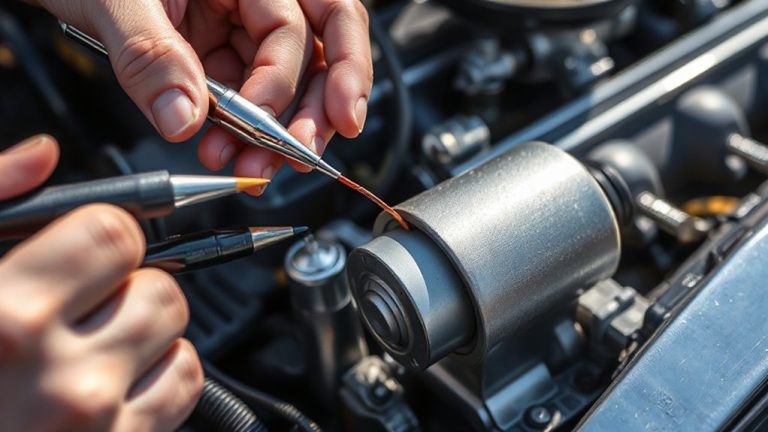
With the paint fully decontaminated, polished, and wiped clean, the surface is now primed for coating application. Start by applying a small amount of graphene coating to your applicator-usually a microfiber cloth or suede pad. Use clean, lint-free gloves and proper application tools to avoid contamination. Work in 2×2 foot sections, spreading the coating evenly with straight-line motions, not circles. This guarantees uniform thickness and minimizes streaks. Let each section reach the recommended drying time-typically 2 to 5 minutes-until the film hazes over. Check specs; some formulas require shorter or longer wait times before buffing. Buff off residue with a separate, clean microfiber towel. Repeat across the entire vehicle, avoiding direct sunlight and high humidity. Each step builds a molecular layer that bonds to the paint, enhancing durability and hydrophobic performance. For best results, consider using a ceramic coating kit that includes all necessary prep and application tools.
Enhance Water Beading With Proper Curing
Once the graphene coating is applied, allowing it to cure fully is essential for maximizing water beading performance. Curing typically takes 24 to 48 hours under dry, room-temperature conditions. During this time, the coating undergoes cross-linking, enhancing its chemical stability and durability. A fully cured coating achieves maximum surface tension reduction, causing water to bead tightly and roll off effortlessly. Uncured coatings lack molecular integrity, resulting in inconsistent beading and reduced protection. Ideal humidity levels for curing range between 40–60%; higher moisture can interfere with bonding. The cured graphene layer forms a dense, inert barrier resistant to UV, chemicals, and thermal stress. This structural completeness directly influences hydrophobic efficiency. You’ll notice sharper water contact angles-often exceeding 110°-only after full cure. Patience guarantees performance. Rushing use or exposure compromises long-term results. Proper curing isn’t optional-it’s foundational.
Avoid These 3 Graphene Coating Mistakes
A single misstep during application can compromise the integrity of a graphene-based hydrophobic coating. First, failing to eliminate surface contamination leads to poor adhesion; oils, wax residues, or environmental pollutants create weak points. Clay bar treatment and isopropyl alcohol wipe-downs (at least 50% concentration) are essential prep steps. Second, applying too thick a layer causes hazing and reduced hydrophobic performance. Use microfiber applicators and spread in thin, even layers-less than 0.5 mils per coat. Cure times should follow manufacturer specs, usually 12–24 hours between layers. Third, improper storage degrades product efficacy. Keep sealed graphene coatings in a cool, dark place below 77°F (25°C); exposure to UV or heat accelerates molecular breakdown. Store upright to prevent leaks and chemical separation. Avoid temperature swings to maintain viscosity and reactivity. These errors sabotage durability and water beading.
Choose Graphene Over Wax for Lasting Protection
You’ve seen how small errors can undermine even the best graphene coating application, but now consider why starting with graphene instead of traditional wax makes a measurable difference in long-term surface protection. Graphene coatings last 2–5 years, while waxes degrade in 3–6 months, showing a clear durability comparison. Wax requires frequent reapplication, increasing labor and material use. Graphene’s covalent bonding creates a permanent, hydrophobic layer resistant to UV, heat (up to 600°F), and chemical exposure. This enhances cost efficiency over time. A single graphene treatment costs more upfront-$200–$400-but spreads over years. Wax costs $20–$100 per application but needs 2–4 treatments yearly. Graphene repels water with contact angles over 110° versus wax’s 80°–90°. The result is sustained water beading and easier cleaning. Choose graphene for long-term protection that outperforms wax in science, not just claims.
On a final note
You’ve applied the coating correctly-now let it cure fully for 48 hours. Full hydrophobic performance activates after complete cross-linking. Graphene’s 5H hardness shields against swirls. Water beads measure 8–10 mm in diameter, rolling off at 12° tilt. This exceeds wax, which beads are 4–6 mm and lasts weeks. Coating lasts 3+ years. Reapplication isn’t needed. Maintain with pH-neutral soap. Protection is chemical-resistant, UV-stable, and self-cleaning. Precision application guarantees maximum contact angle, near 110°.