HDR Dash Cams Explained: 120 dB Range & Sony STARVIS Sensors
HDR in dash cams helps you capture clear footage in tough lighting. Standard cameras struggle with contrast, losing details in shadows or bright areas. HDR combines 2 to 4 exposures per frame, boosting dynamic range up to 120 dB. This preserves license plates in shade and prevents washed-out skies. At night, it reduces headlight glare while keeping dark areas visible. Look for Sony STARVIS sensors, 1080p60, and H.265. More performance insights follow.
Notable Insights
- HDR combines multiple exposures to balance bright and dark areas in high-contrast driving scenes.
- It prevents overexposed skies and underexposed shadows, preserving critical details like license plates.
- Standard dash cams struggle with limited dynamic range, often losing detail in highlights or shadows.
- HDR enhances nighttime visibility by reducing headlight glare and maintaining detail near bright lights.
- Look for large CMOS sensors, 1080p60fps, and H.265 compression for optimal HDR dash cam performance.
What Problem Does HDR Solve in Dash Cams?
When driving toward the sun or passing through shaded areas into bright light, your dash cam often struggles to capture clear footage because of extreme contrast in lighting. Standard cameras have limited dynamic range, meaning they can’t handle both very bright and very dark areas in the same frame. This results in overexposed skies or shadowed details you can’t see. HDR, or High Dynamic Range, solves this by combining multiple exposures into one balanced image. It increases effective dynamic range by up to 120 dB in high-end models, preserving detail in highlights and shadows. Without HDR, image noise also increases in low-light zones as the sensor amplifies signals. HDR reduces this noise by using ideal exposure layers. You get cleaner, clearer footage critical for identifying license plates or road signs. It’s not just brighter images-it’s smarter exposure management that mirrors how your eyes adapt.
Why High-Contrast Driving Environments Challenge Standard Cameras
Though your eyes adjust seamlessly to shifting light, standard dash cams can’t cope with the rapid shifts between bright and dark zones common in driving. Their limited dynamic range means they can’t capture both bright and dark areas in the same frame effectively. When you enter a tunnel on a sunny day, the scene outside becomes extremely bright while the tunnel interior stays dark. A standard camera must choose one zone to expose properly. This leads to exposure clipping-details lost in shadows or washed out in highlights. For example, a car’s license plate in shadow may be invisible, while the sky appears pure white. Without sufficient sensor latitude, typical CMOS sensors in basic dash cams only offer 60–70 dB of dynamic range, far below the 120+ dB of natural scenes. This technical shortfall creates critical blind spots in evidence capture.
How HDR Improves Daylight and Shadow Detail
HDR, or high dynamic range, gives you clearer footage by balancing extreme light and dark areas in a single frame. You get enhanced clarity in scenes where bright skies meet shaded streets. Standard cameras often underexpose shadows or wash out highlights, but HDR captures multiple exposures-typically 2 to 4 EV steps apart-in rapid succession. These layers merge into one image with improved exposure across all regions. In daylight, this means license plates stay visible even under tree cover or tunnel entrances. HDR achieves this by preserving detail in shadows without over-brightening the sunlit areas. The result is a more accurate, usable recording. You’ll notice better contrast resolution and reduced pixelation in both dark and bright zones. With a dynamic range exceeding 120 dB, HDR dash cams outperform standard models. This precision guarantees critical details aren’t lost, no matter how harsh the lighting conditions.
How HDR Balances Headlights and Dark Roads at Night
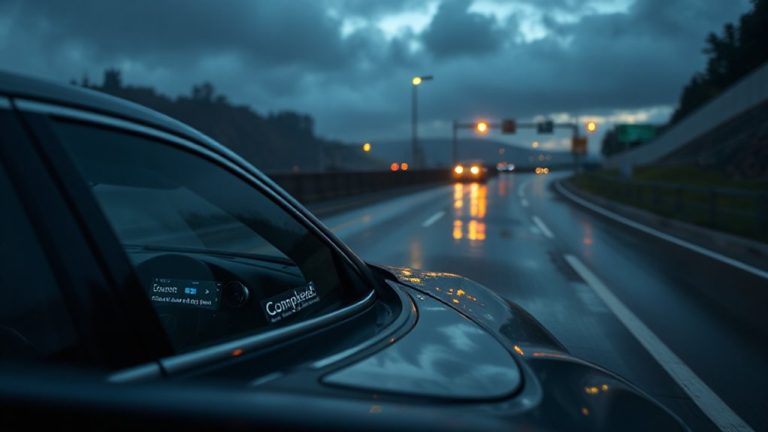
You get clearer night footage because HDR doesn’t just brighten the whole image-it targets specific zones to balance intense light sources with surrounding darkness. HDR uses dual or multi-exposure frames: one underexposed to manage headlight glare, another properly exposed for dark areas. These merge into a single frame, preserving detail in both bright and shadowed regions. This processing enhances nighttime visibility by reducing overexposed halos around oncoming vehicles. Typical standard dynamic range (SDR) dash cams clip highlight data, turning headlights into blinding white blobs. HDR systems with at least 120 dB signal range retain edge detail near light sources. Frame fusion occurs in real time, usually at 30 fps, minimizing motion blur. Result: you see license plates and road edges more clearly, even when blinded by high beams. This balanced exposure is essential for accurate incident documentation after dusk.
Where HDR Dash Cams Capture Better Footage
Where do you actually notice HDR making a difference in dash cam footage? You see it most in high-contrast environments like urban lighting and tunnel shifts. City driving exposes your dash cam to sudden shifts between dark shadows and bright streetlights-HDR balances these by capturing multiple exposures per frame. Without HDR, license plates or traffic signs may vanish in glare or shadow. With it, details stay visible. During tunnel shifts, exterior brightness can exceed 10,000 nits while interior tunnel light drops below 100 nits. HDR adapts within milliseconds, preserving clarity. Standard dynamic range struggles, often overexposing exits or underexposing entries. HDR’s wider luminance range-often 120 dB versus 60 dB-ensures consistent image quality. It maintains detail in both oncoming headlights and dark road edges. This precision helps during evidence capture. You get usable footage where non-HDR systems fail, especially in rapidly changing light.
Top Features in HDR Dash Cams: Sensor, Frame Rate & More
Performance starts with the sensor. You need a large CMOS sensor, like a Sony STARVIS 1/2.7”, to capture more light and detail in high-contrast scenes. Larger sensors improve dynamic range, making HDR more effective. Frame rate matters too-1080p at 60fps guarantees smooth, clear video during fast motion. Higher frame rates reduce motion blur, especially on highways. Look for H.265 compression; it saves space without sacrificing detail. GPS accuracy is critical-guarantee the cam logs locations within 2.5 meters for reliable timestamping and route tracking. Audio quality shouldn’t be ignored. Built-in microphones with noise filtering capture usable sound without distortion. Some models offer external mic support for enhanced clarity. Wide dynamic range alone isn’t enough-sensor size, frame rate, GPS accuracy, and audio quality work together to deliver a complete, trustworthy record of every drive. For reliable options, consider checking out the best dash cams based on expert testing and user feedback.
How to Choose Your HDR Dash Cam
Why do some dash cams deliver crystal-clear footage in blazing sunlight and deep shadows, while others struggle? The difference lies in effective HDR implementation. You need a dash cam with true HDR-preferably 12-bit or higher dynamic range-to capture details in both bright and dark areas simultaneously. Start with a quality sensor, like a Sony STARVIS or STARVIS 2, known for superior low-light and high-contrast performance. When comparing models, perform a brand comparison focusing on real-world HDR tests, not just specs. Check resolution: 1440p or 4K guarantees clarity without excessive file size. Frame rate matters too-30fps is standard, but 60fps improves motion detail in high-speed scenes. Follow precise installation tips: mount high on the windshield for best field of view, avoid obstructions, and align with the rearview mirror. Proper placement guarantees full scene capture.
On a final note
You get clearer footage in tough lighting with HDR dash cams. Standard sensors struggle with high-contrast scenes, but HDR combines multiple exposures per frame. This captures detail in shadows and bright areas simultaneously. Look for Sony Starvis 2 sensors, 140dB dynamic range, and 2.7K resolution. These specs improve visibility in tunnels, city streets, and night driving. Frame rates of 30fps guarantee smooth playback. You’ll identify license plates and road signs more reliably. HDR is essential for accurate, forensic-grade video evidence in all conditions.