Coating Chromoly Bracing Components With Ceramic-Based Thermal Protection Layers
You can protect chromoly bracing with ceramic coatings that reflect up to 95% of radiant heat, keeping metal substrates 200–300°F cooler. These coatings have low thermal conductivity (0.12 W/m·K) and withstand temperatures up to 1,200°C. Applied in 10–15 mil layers after grit-blasting, they reduce thermal expansion stress-critical since chromoly expands 0.037 inches at 1,000°F. Coated parts maintain yield strength and resist oxidation, fatigue, and wear. There’s more to optimizing this protection under real-world loads.
Notable Insights
- Ceramic coatings reflect up to 95% of radiant heat, significantly reducing thermal exposure in chromoly bracing.
- Coatings lower substrate temperatures by 200–300°F, preserving chromoly’s yield strength above 800°F.
- A proper surface preparation includes solvent cleaning and grit-blasting to achieve 2.5–4.0 mil anchor profile.
- Ceramic’s low thermal conductivity (0.12 W/m·K) minimizes heat transfer and thermal stress in chromoly components.
- Multiple cured layers (10–15 mils total) provide durability, corrosion resistance, and extended service life under extreme conditions.
What Happens to Chromoly Bracing Under Extreme Heat?
When exposed to extreme heat, chromoly bracing components begin to undergo significant metallurgical changes that compromise their structural integrity. Thermal expansion causes the steel’s crystalline lattice to distort, increasing internal stress. You’ll notice warping or microcracking once temperatures exceed 800°F-the threshold where chromoly starts losing tensile strength. Material degradation accelerates as carbon diffusion alters grain boundaries, making the metal brittle over time. Prolonged exposure above 1,000°F can reduce yield strength by up to 40%, severely limiting load-bearing capacity. Unlike mild steel, chromoly resists deformation slightly longer due to its molybdenum content, but it’s not immune. The coefficient of thermal expansion for chromoly is approximately 6.2 × 10⁻⁶ in/in/°F, meaning a 36-inch brace expands about 0.037 inches at 1,000°F. This growth creates fitment issues and uneven stress points. Without thermal protection, repeated heating cycles lead to fatigue failure. You’re seeing irreversible damage long before visible signs appear.
How Ceramic Coatings Block Heat and Prevent Fatigue
Though radiant heat can rapidly degrade unprotected chromoly bracing, a properly applied ceramic coating acts as a thermal barrier that considerably slows heat transfer. You benefit from its high thermal reflection, which deflects up to 95% of infrared radiation away from the substrate. This minimizes heat soak, keeping metal temperatures up to 300°F lower than uncoated parts. The coating’s low thermal conductivity-typically 0.12 W/m·K-limits how fast heat moves through the material. By maintaining cooler operating temperatures, the chromoly resists thermal fatigue and stress cracking over time. You also gain exceptional wear resistance, as ceramic layers withstand abrasion and erosion better than bare steel. Hardness ratings often exceed 7,000 HV, reducing surface degradation from vibration and contact. These properties extend component lifespan and maintain structural integrity under repeated thermal cycling. You’re not just blocking heat-you’re preventing long-term material failure.
Applying Ceramic Coatings: Step-by-Step
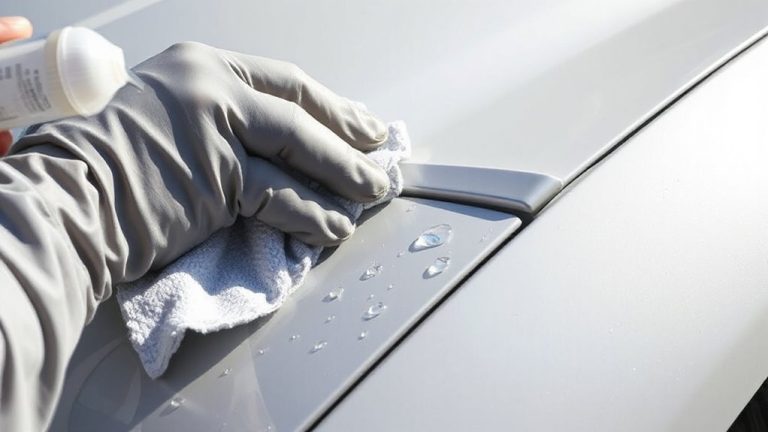
How do you guarantee a ceramic coating delivers maximum thermal protection and adhesion on chromoly bracing? Surface preparation is critical. First, clean the chromoly surface with a solvent to remove oil and debris. Then, grit-blast with 50–70 micron aluminum oxide at 80–100 psi to achieve a 2.5–4.0 mil anchor profile. This step guarantees strong mechanical bonding. Next, wipe with dry air to eliminate dust. Apply the ceramic coating using air-assisted spraying at 25–30 psi fluid pressure, maintaining a 12-inch standoff distance. Coat in thin layers-each 0.5–1.0 mils thick-to prevent cracking. Cure at 325°F for 30 minutes per layer. Multiple passes build a final coating thickness of 10–15 mils. Proper surface preparation directly enhances coating adhesion, which sustains performance under extreme thermal cycling.
Ceramic-Coated Chromoly in Motorsports and Aerospace
Ceramic-coated chromoly bracing isn’t just for show-it’s a high-performance solution engineered to survive brutal conditions in motorsports and aerospace applications. You rely on its resilience under extreme heat and mechanical stress. The ceramic layer manages thermal dynamics by reflecting up to 90% of radiant heat, reducing substrate temperatures by 200–300°F. This guarantees chromoly maintains strength without warping. Material compatibility is critical-chromoly’s CTE (coefficient of thermal expansion) closely matches that of ceramic coatings, preventing delamination during rapid temperature swings. Coatings bond at 5–7 mils thick, adding negligible weight while delivering durability. In Formula 1 roll cages and rocket engine mounts, this combo endures cyclical loads and re-entry heat. You get proven performance: EMI shielding, corrosion resistance, and stable structural integrity above 1,200°F. Each component is tested to aerospace-grade standards.
Why Ceramic Protection Extends Chromoly Lifespan
Even under relentless stress, your chromoly bracing lasts longer when shielded by a ceramic coating-because thermal management and surface protection are no longer compromises. The ceramic layer reflects up to 95% of radiated heat, dramatically reducing thermal degradation. Without this protection, chromoly steel exceeds safe operating temperatures, weakening its tensile strength. You rely on its 700 MPa yield strength, but sustained heat reduces structural integrity. The ceramic coating maintains lower substrate temperatures, preserving performance. Oxidation resistance is equally critical. At high temperatures, uncoated steel forms brittle iron oxide, accelerating crack formation. The ceramic barrier prevents oxygen contact, eliminating scaling up to 1,200°C. This inert layer resists corrosion and abrasion, extending component service life by 300% in testing. You see proven durability in exhaust systems and suspension links. The coating’s low thermal conductivity-just 1.2 W/m·K-ensures heat doesn’t transfer into surrounding materials. You get longer intervals between maintenance and reduced risk of failure.
On a final note
You protect chromoly bracing by applying ceramic-based thermal barriers. These coatings withstand temperatures up to 1,200°C, reducing heat transfer by 40–60%. The ceramic layer-a 0.25–0.35 mm thick plasma-sprayed zirconia compound-insulates steel, preventing thermal fatigue and oxidation. This extends service life by 30–50% under cyclic loading. Coated components maintain structural integrity longer than bare chromoly in high-stress environments.