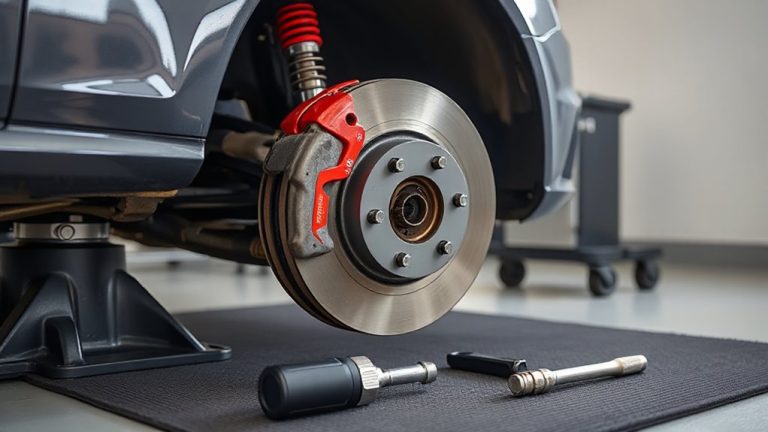
Achieving Proper Weight Transfer Balance With Independent Front and Rear Coilover Tuning
You balance weight transfer by tuning front and rear coilovers independently to match your vehicle’s dynamics. Set front springs around 550 lbs/in with compression damping at 3/5 for sharp turn-in. Use 250–350 lbs/in rear springs to maintain traction and control squat. Adjust preload to set ride height without changing spring rate. Maintain 50% front-rear load transfer at 3.5 inches ride height. Proper damping harmony keeps weight shifts controlled and predictable-there’s more to optimizing each setting than meets the eye.
Notable Insights
- Balance front and rear spring rates to prevent understeer or oversteer during dynamic weight transfer.
- Adjust front coilovers for responsive turn-in using appropriate spring rates and damping settings.
- Tune rear coilovers to maintain traction by controlling squat and optimizing camber under acceleration.
- Match damping ratios within 10–15% front to rear for harmonious weight transfer control.
- Set ride height via preload to maintain balanced load distribution without altering spring rates.
Why Coilover Tuning Balances Weight Transfer
When you hit the brakes or accelerate hard, weight shifts forward or rearward, altering how much load each tire carries-and that’s where properly tuned coilovers make all the difference. You rely on balanced weight transfer to maintain grip and control. Coilover preload adjusts spring tension, influencing ride height and initial load distribution without changing spring rates. This affects how quickly the front or rear responds to dynamic inputs. Suspension geometry determines the angles and motion paths of your control arms and knuckles. Correct geometry preserves tire contact under load, improving traction during shifts. Misadjusted coilovers distort this geometry, leading to unpredictable handling. You need precise tuning front and rear to match your vehicle’s weight distribution and driving demands. Independent tuning lets you fine-tune each corner, ensuring even weight transfer and ideal tire loading. Proper setup maximizes responsiveness and stability. For daily drivers, choosing the right setup involves balancing comfort and performance, with best coilovers for daily driving offering an optimal blend of adjustability and ride quality.
Tune Front Coilovers for Sharper Turn-In
Why does your car feel slow to respond when you first turn the wheel? Poor front coilover tuning kills turn in responsiveness. You need proper spring rates and damping to sharpen steering precision. Stiffening the front increases initial grip, reducing delay. But go too stiff and the tire skips, losing traction. Find balance. Front roll center and camber settings also affect how quickly your car bites into corners. Adjust in small increments. Track your changes to isolate what improves response. Below are common front-end tuning combos and their effects:
| Spring Rate (lbs/in) | Compression Damping | Effect on Turn-In |
|---|---|---|
| 400 | Soft | Lazy, understeer |
| 500 | Medium | Balanced response |
| 600 | Medium-High | Sharp, precise |
| 700 | High | Nervous, jumpy |
| 550 | Adjustable (3/5) | Ideal for most |
Optimize Rear Coilovers for Exit Traction
How does your car behave when you hit the throttle mid-exit? If the rear tires break loose, you’re losing rear grip due to poor suspension geometry. Properly tuned rear coilovers keep the tire in ideal contact with the road. Set your rear ride height to maintain consistent camber under acceleration-typically –1.5 to –2.0 degrees for most RWD platforms. This range maximizes contact patch under load. Adjust rebound damping to control axle movement; too soft and the rear squats excessively, too stiff and it skips, reducing grip. Use a linear spring rate between 250–350 lb/in for balanced response. This setup keeps weight transfer predictable, improving rear grip. Fine-tune preload to eliminate sag without over-compressing the suspension. Correct geometry guarantees the lower control arm stays level, minimizing unwanted toe changes. That’s how you maintain drive traction.
Balance Front and Rear Spring and Damping Rates
Though spring and damping rates are often tuned in isolation, balancing front and rear settings is critical for achieving neutral handling under dynamic loads. You need spring symmetry to guarantee load transfer occurs evenly during cornering, braking, and acceleration. Mismatched spring rates induce either understeer or oversteer, disrupting chassis balance. For example, a stiffer front with soft rear causes excessive front grip loss. Damping harmony complements this by controlling the speed of weight transfer. Your compression and rebound settings must match the spring rates-too much damping causes harsh shifts; too little allows excessive body roll. Aim for balanced front-to-rear damping ratios, typically within 10–15% of each other. Proper tuning uses data like damper shaft velocity (0.3–0.5 m/s typical) and wheel acceleration to refine response. This integration delivers predictable, stable handling.
Set Ride Height to Control Load Transfer
Setting ride height properly shapes how load transfers across the chassis during dynamic maneuvers, building directly on the balance you’ve established between front and rear spring and damping rates. You control ride height primarily through spring preload adjustments, which compress the coilover spring without changing its rate. Proper shock mounting guarantees alignment and prevents binding during suspension travel. Too low, and you risk bottoming out or compromising camber; too high, and center of gravity reduces stability.
| Ride Height (in) | Front Load Transfer (%) | Rear Load Transfer (%) |
|---|---|---|
| 2.0 | 58 | 42 |
| 2.5 | 55 | 45 |
| 3.0 | 52 | 48 |
| 3.5 | 50 | 50 |
| 4.0 | 48 | 52 |
Adjust spring preload evenly per corner. Confirm shock mounting hardware is torqued to spec-usually 25–30 ft-lbs.
On a final note
You achieve balanced weight transfer by tuning front and rear coilovers independently. Stiffer front springs, around 8–10 kg/mm, sharpen turn-in response. Softer rear springs, 6–8 kg/mm, improve traction on corner exit. Match damping rates to spring stiffness-typically 10–14 clicks rebound front, 8–12 rear. Set ride height to lower center of gravity, reducing lateral load transfer. Proper setup guarantees predictable handling.