Assessing Rotor Edge Chipping From Stone Impacts Common in Gravel Roads
You’re at risk of chipped brake rotors when driving on gravel roads, as stones can hit rotors at over 80 mph. Impacts at 30°–60° cause the most damage, especially to rotor edges with minimal structural support. Chips deeper than 1/8 inch or wider than 1 inch compromise safety. Cast iron rotors can’t resist repeated strikes, leading to microfractures and pulsation. If thickness nears the stamped minimum-often 28–32 mm-replacement is required. There’s more to evaluate before deciding your next move.
Notable Insights
- Stone impacts at 80+ mph on gravel roads commonly chip rotor edges, especially at 30°–60° angles.
- Cast iron rotors are vulnerable to chipping due to low impact resistance despite adequate hardness.
- Edge damage over 1/8 inch deep or 1 inch long compromises structural integrity and safety.
- Brake pulsation and thickness variation beyond 0.05 mm signal significant rotor damage.
- Replacement is preferred over turning when chipping nears friction surface or thickness is near minimum.
How Gravel Roads Cause Chipped Brake Rotors
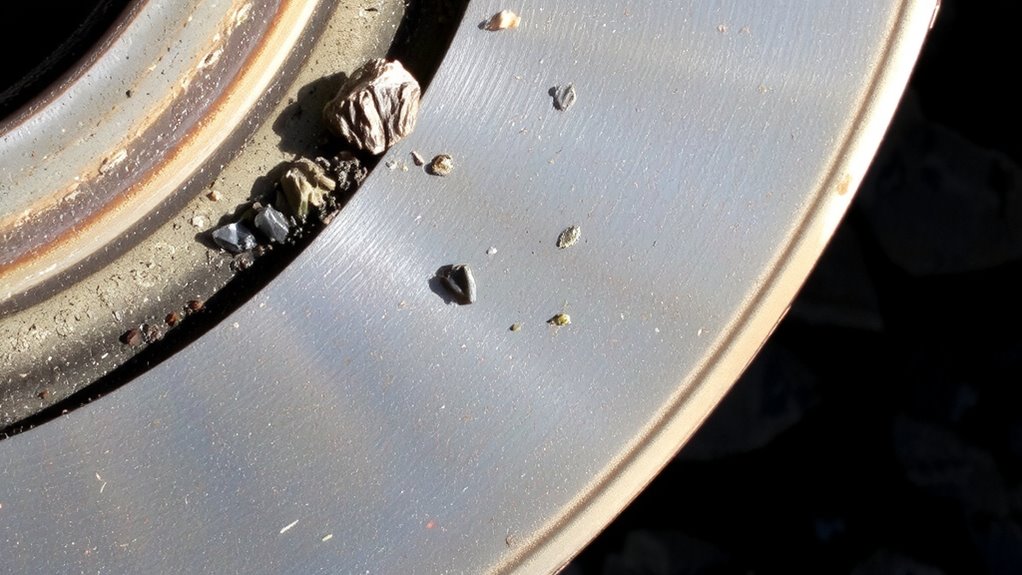
Every time you hit a gravel road, tiny rocks become高速 projectiles. Their stone velocity can exceed 80 mph when kicked up by tires, striking rotors with enough force to chip the edge. The impact angle determines how much material is displaced-shallow angles cause glancing blows, while near-perpendicular strikes remove more metal. Most damage occurs between 30° and 60° impact angles, where force concentrates on a small surface area. Rotors, typically made of cast iron with a Brinell hardness of 170–220, still can’t resist repeated high-speed impacts. Edges are especially vulnerable because they lack structural support beyond the friction surface. Even pea-sized stones, traveling at highway speeds, deliver localized stress exceeding 100,000 psi. Over time, microfractures develop, leading to edge chipping. These chips are usually less than 2 mm deep but compromise edge integrity. Constant exposure accelerates wear, especially on vehicles frequently driven on unpaved terrain. Upgrading to high-quality best brake rotors can improve durability and resistance to impact damage.
Visible and Mechanical Signs of Rotor Damage
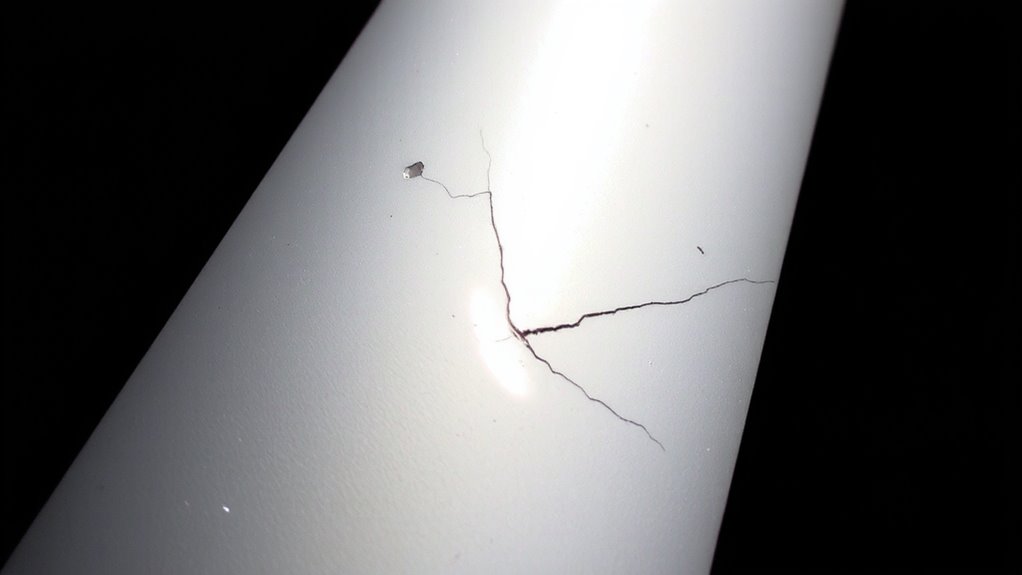
Chips, cracks, and irregular wear patterns are your first clues to rotor damage. You’ll notice these flaws along the rotor’s edge, often from stone impacts on gravel roads. These surface defects can compromise structural integrity and affect braking performance. If you feel brake pulsation during stops, it’s likely due to uneven rotor thickness or warping. Brake pulsation presents as a rhythmic vibration in the pedal, typically when slowing from highway speeds. Measure rotor thickness with a micrometer at multiple points; manufacturers specify a minimum thickness-often between 28mm and 32mm, stamped on the rotor hub. Variations beyond 0.05mm in thickness indicate excessive runout. Even slight deviations disrupt clamp force and pad contact. Visible scoring or heat tinting further signals stress. These mechanical symptoms mean your rotor isn’t wearing uniformly. Monitor wear patterns closely-they reveal early signs of imbalance or alignment issues needing correction.
When Chipped Rotors Become a Safety Risk
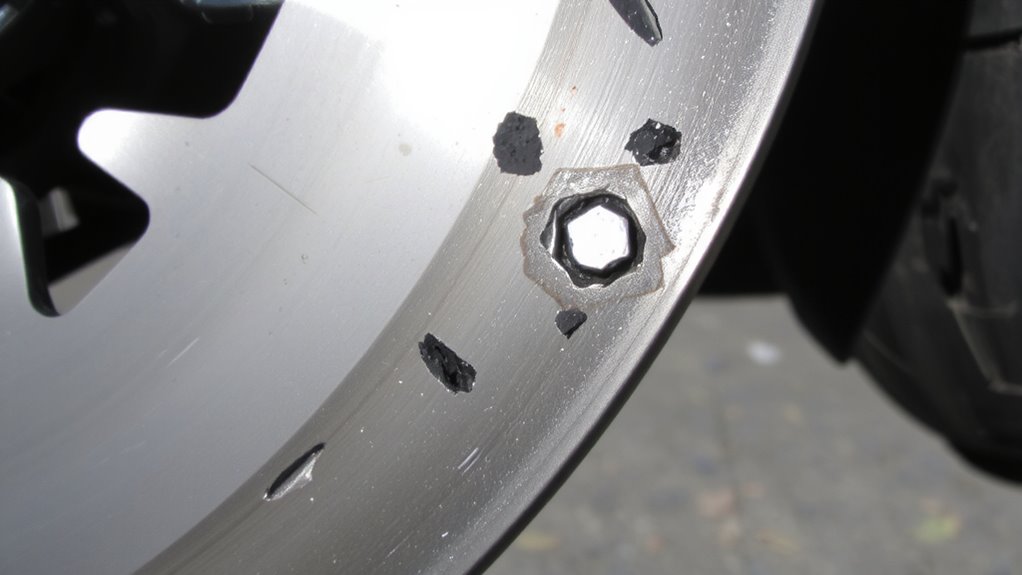
How much damage is too much when it comes to chipped rotors? Once chips exceed 1/8 inch in depth or span more than an inch along the edge, structural integrity is compromised. At that point, you’re not just risking surface wear-you’re inviting serious safety issues. Deep chips create uneven surfaces that lead to brake fade under sustained use, especially during downhill driving or heavy braking. The inconsistent contact between pad and rotor reduces friction efficiency, increasing stopping distances. You’ll also start noticing persistent vibration issues through the pedal, a sign of rotor imbalance. These vibrations aren’t just annoying-they indicate compromised performance. If the damage nears the edge mounting band or alters the rotor’s thickness beyond manufacturer tolerances (typically 0.001–0.003 inch lateral runout), failure risk rises sharply. Ignoring these signs puts you one hard stop away from potential loss of control.
Is It Safe to Drive With Chipped Brake Rotors?
What happens when those small edge chips in your brake rotors start to spread? You risk compromising both rotor thickness and heat dissipation, which are critical to braking performance. Most modern rotors have a minimum thickness spec-usually stamped on the hub-like 22mm front and 10.5mm rear. Once wear reaches that limit, structural integrity drops sharply. Chipped edges can initiate cracks, especially under thermal stress. Uneven surfaces degrade heat dissipation, leading to hot spots and reduced friction. That means longer stopping distances, especially during repeated braking. While minor chipping may not immediately endanger you, spreading damage increases the chance of sudden rotor failure. You shouldn’t ignore groaning noises or pedal vibration-they’re warning signs. Driving with severely chipped rotors isn’t safe, particularly in wet or mountainous conditions where consistent braking matters most.
How to Prevent Rotor Damage on Gravel Roads
When driving on gravel roads, your brake rotors face a constant barrage of loose stones and debris that can lead to edge chipping and surface damage-so taking preventive steps is essential. Maintaining proper tire pressure reduces stone ejection; underinflated tires increase the risk by allowing debris to dislodge more easily. Keep tire pressure at the manufacturer’s recommended PSI-typically 32–35 PSI for passenger vehicles-to minimize debris projection toward brake components. Reduce driving speed on gravel; at 45 mph, stones are flung with substantially more force than at 25 mph, increasing impact energy on rotors. Slower speeds reduce the kinetic energy of airborne gravel by up to 75%, decreasing chipping likelihood. Use protective splash shields if available, and make certain wheel alignment reduces side-to-side stone scatter. Rotor edge damage accumulates over time, so proactive adjustments in tire pressure and driving speed are the most effective defenses against premature wear and material loss.
Should You Repair or Replace Chipped Brake Rotors?
You’ve taken steps to minimize stone impacts by adjusting tire pressure and slowing down on gravel, but if your rotors already show signs of edge chipping, the next decision matters just as much. Minor chipping usually doesn’t affect braking performance and may not require immediate action. However, you must check for progressive damage. Inspect brake pad wear-uneven or accelerated wear can signal rotor surface irregularities. Measure rotor thickness at multiple points using a micrometer; compare results to the manufacturer’s minimum thickness stamped on the rotor. If thickness variation exceeds 0.001 inches or you’re near the minimum spec, replacement is necessary. Turning rotors is rarely recommended for edge damage, as it reduces structural integrity. Chipped edges can propagate cracks, especially under thermal stress. For safety and performance, replace rather than repair when chipping is deep or near the friction surface. Upgrading to high-quality brake pads and rotors can improve durability and resistance to impact damage.
On a final note
You must assess chipped rotors promptly to maintain braking efficiency. Even minor edge damage can disrupt heat dissipation across the 25 mm thick cast iron surface. Cracks may develop under repeated thermal cycling above 500°C. If chips exceed 3 mm in depth or span more than 10% of the rotor’s edge circumference, replace them. Driving with compromised rotors reduces stopping power and risks catastrophic failure during emergency braking.