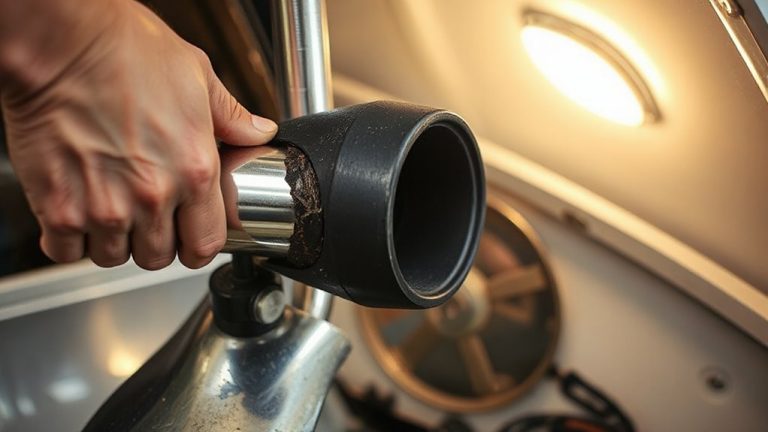
Catalytic Converter Efficiency Testing Methods Beyond Just OBD-II Codes
You can test catalytic converter efficiency without OBD-II by analyzing exhaust gases directly. Use a 5-gas analyzer to check reductions in CO, HC, and NOx. A healthy converter reduces hydrocarbons over 90%. Monitor pre- and post-cat oxygen sensors-one should fluctuate, the other stay stable. Infrared spectroscopy at 3.4 μm (HC) confirms conversion rates. Measure temperature differences: expect a 100–200°F rise across a working unit. High backpressure or minimal ΔT signals failure. Further performance insights follow.
Notable Insights
- Visually inspect the converter for dents, cracks, corrosion, discoloration, or rattling to identify physical damage or overheating.
- Use a 5-gas analyzer to measure reductions in CO, HC, and NOx, confirming catalytic activity beyond OBD-II sensor data.
- Compare inlet and outlet temperatures with an infrared thermometer; a healthy converter shows a 100–200°F increase.
- Perform backpressure testing at the pre-cat O2 sensor port; readings above 1.25 psi at 2,500 rpm indicate clogging.
- Conduct infrared spectral analysis to quantify hydrocarbon reduction efficiency by comparing pre- and post-converter gas composition.
How to Test Catalytic Converter Efficiency Without OBD-II
How do you know if your catalytic converter is failing when you don’t have access to an OBD-II scanner? Start with a visual inspection. Look underneath the vehicle for signs of physical damage like dents, cracks, or corrosion on the converter’s casing. A compromised housing often impairs internal substrate function. Check for discolored metal-blue or dark spots indicate overheating. The converter should feel solid; if it rattles when tapped gently, the ceramic honeycomb inside may be broken. Most units measure 8–12 inches long and connect directly to the exhaust manifold. Damage there disrupts emissions flow. Even without electronic diagnostics, these clues reveal inefficiency. A damaged or sagging exhaust pipe can also stress the converter. You’re evaluating structural integrity as a proxy for performance. Visual inspection won’t confirm chemical efficiency, but physical damage often correlates with failure. Address issues before emissions or engine performance degrade further.
Check Exhaust Gases for Real-Time Efficiency Clues
What if you could detect catalytic converter inefficiency just by analyzing the exhaust stream? You can-by monitoring gas composition with a 5-gas analyzer. Efficient catalysts drastically reduce CO, HC, and NOx; deviations signal problems. Oxygen sensors upstream and downstream play a vital role. The pre-cat sensor reacts quickly to engine mixture changes, while the post-cat sensor should show stable readings-little fluctuation means the converter is storing oxygen and working properly. If the rear O2 sensor mimics the front’s erratic behavior, conversion efficiency is compromised. Normal post-cat O2 voltage stays below 0.5V under steady conditions. Real-time exhaust analysis gives immediate feedback. Unlike OBD-II, which relies on delayed code generation, gas composition reveals active performance. This method offers precise, on-the-spot insight into catalyst health without waiting for fault codes.
Compare Inlet and Outlet Temperatures
While the catalytic converter operates efficiently, you’ll typically see a noticeable rise in temperature from the inlet to the outlet. This increase indicates active catalysis, where exothermic reactions generate thermal gradients essential for peak performance. Healthy converters show a 100–200°F rise, confirming proper heat retention and reaction efficiency.
| Condition | Inlet Temp (°F) | Outlet Temp (°F) |
|---|---|---|
| New Converter | 800 | 950 |
| Moderately Used | 780 | 900 |
| Failing Converter | 820 | 840 |
| Severely Clogged | 850 | 830 |
Minimal temperature change suggests weak catalysis and disrupted thermal gradients. A cooler outlet implies poor heat retention due to internal damage or substrate degradation. Monitoring these differentials gives immediate insight into converter function without relying on OBD-II codes. You can measure these with infrared thermometers or thermal probes at both ends during operation.
Find Failed Catalysis With Infrared Analysis
Can you really see a failing catalytic converter before it kills performance or triggers a check engine light? Yes, and infrared analysis gives you the proof. You’re not just guessing-you’re reading infrared spectra to detect incomplete catalysis. When the converter works, exhaust gases like CO, HC, and NOx drop sharply. A failed unit won’t alter the chemical composition as it should. With an infrared spectrometer, you measure exhaust pre- and post-converter. Healthy catalysts show over 90% reduction in hydrocarbons; failed ones barely crack 40%. Infrared spectra reveal exact molecular absorption bands at 3.4 μm for HC, 4.6 μm for NO, and 4.7 μm for CO. You compare peak intensities. No guesswork. You see in real time whether the catalyst is converting pollutants. Infrared analysis is lab-grade accuracy in the real world.
Test for Clogs: Measure Flow and Backpressure
You’ve confirmed catalytic efficiency with infrared analysis, but a converter can pass emissions and still restrict exhaust flow. Test for clogs by measuring exhaust backpressure. A healthy system should show less than 1.25 psi at 2,500 rpm. Higher readings suggest a blockage. Use a pressure gauge connected to the pre-cat oxygen sensor port. Restricted flow increases backpressure, reducing engine performance and fuel economy. Check exhaust color; black or gray smoke may indicate incomplete combustion due to poor flow. Listen to noise levels-rattling can mean broken substrate material. A sudden drop in engine power with no OBD-II codes often points to flow restriction. Flow testing with a smoke machine or flow bench verifies obstruction. These physical tests reveal issues invisible to sensors. Combine pressure readings with visual and auditory checks for accurate diagnosis.
Combine Gas, Temp, and Flow Tests for Accuracy
Since no single test reveals every flaw, combining gas analysis, temperature readings, and flow measurements gives the most complete picture of catalytic converter health. You need to assess gas composition, thermal dynamics, and exhaust flow together for accurate diagnostics. Relying on just one metric can miss critical inefficiencies.
| Test Type | Key Measurement |
|---|---|
| Gas Analysis | Upstream vs downstream O₂ and HC |
| Temperature | Inlet vs outlet ΔT (min 20°C rise) |
| Flow/Backpressure | Max 1.25 psi at 2,500 RPM |
Abnormal gas composition downstream indicates poor conversion efficiency. Proper thermal dynamics guarantee the catalyst reaches light-off temperature quickly. Flow tests confirm no blockages. When all three tests align, you confirm not just function, but sustained performance. This integrated method eliminates guesswork and delivers repeatable, verifiable results-critical for precise, reliable diagnostics.
On a final note
You confirm catalytic converter efficiency by combining multiple test methods. Relying solely on OBD-II codes risks missing early or partial failures. Analyze exhaust gases with a 4-gas analyzer; a healthy converter reduces HC and CO below 100 ppm and 0.5%, respectively. Inlet temperatures should exceed outlet by 20–50°C during active catalysis. Infrared thermography reveals thermal gradients indicating catalyst activity. Backpressure above 3 psi at 2,500 rpm suggests clogging. Flow tests validate structural integrity.