Dry Sump Oiling Systems Explained – Advantages for Road Racing and Drifting
You gain superior engine reliability with a dry sump system by storing 8–12 quarts of oil in an external tank. It prevents oil starvation during hard cornering, maintaining over 5 psi of pressure under 2G loads. Scavenge pumps remove oil fast, reducing windage and boosting power. The shallow 2–3 inch pan lets you mount the engine lower, improving handling. Remote reservoirs and baffled tanks manage aeration and cooling. Critical for drift and race cars, this system sustains performance at extreme angles-discover how each component contributes to its effectiveness.
Notable Insights
- Dry sump systems prevent oil starvation during high lateral loads by storing oil in a remote tank.
- Scavenge pumps rapidly remove oil from the crankcase, maintaining negative pressure and reducing windage.
- External oil cooling and foam separation improve lubrication efficiency and engine reliability.
- A shallower oil pan allows lower engine placement, lowering the center of gravity for better handling.
- Dry sumps sustain oil pressure during extreme angles and sustained cornering, critical for drifting and road racing.
What Is a Dry Sump Oiling System?
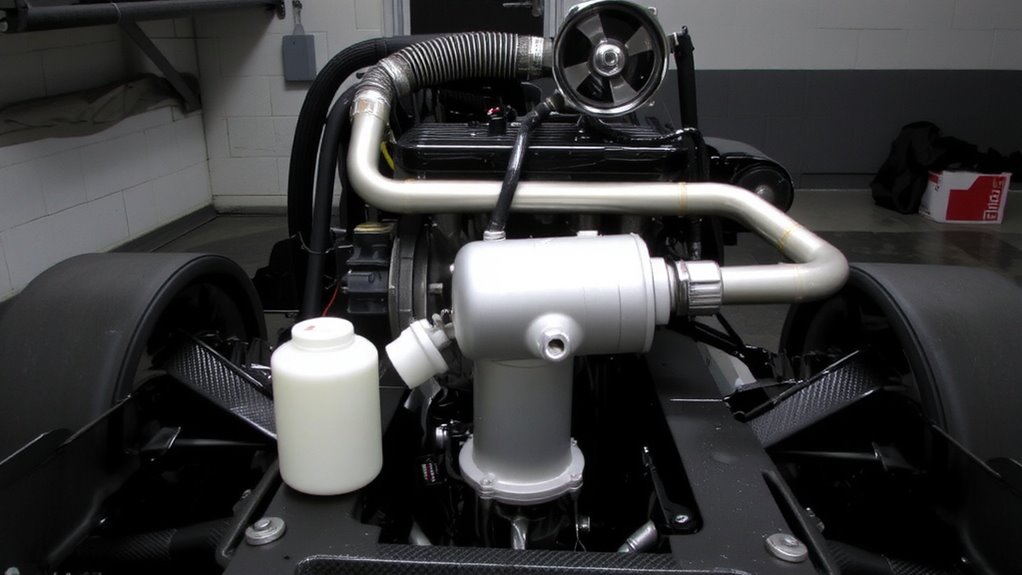
A dry sump oiling system keeps your engine’s lubrication separate from the crankcase. You store oil externally in a tank, not in the oil pan. This setup increases usable oil capacity without raising the engine’s center of gravity. Typical systems hold 4 to 8 quarts, depending on application. An external pump pulls oil from the pan and returns it to the tank, where foam dissipates before recirculation. This design reduces windage and improves lubrication efficiency. However, system complexity is higher than in wet sump setups. You’re adding components: multiple pump stages, plumbing lines, a reservoir, and oil coolers. More parts mean more potential failure points and tighter packaging demands. Despite this, the trade-off favors performance applications. The increased oil capacity enhances thermal stability and engine longevity under sustained high RPM. You gain reliability without redesigning internal engine components. It’s precision engineering tailored for extreme conditions.
How Dry Sump Prevents Oil Starvation
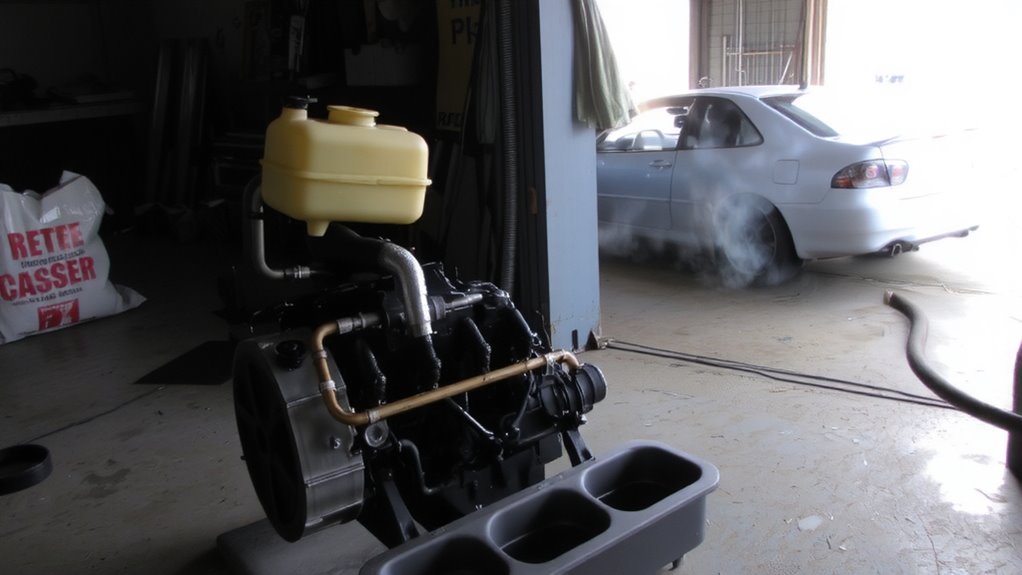
You don’t want your engine running dry when cornering hard or accelerating aggressively-oil starvation can destroy performance parts in seconds. A dry sump system eliminates this risk by relocating oil to an external tank, ensuring consistent supply under extreme conditions. Unlike wet sump systems, where oil pools in the pan, dry sumps use scavenge pumps to remove oil rapidly, preventing oil surge during rapid directional changes. Cornering forces can push oil to one side of the pan in a wet system, uncovering the pickup and starving the engine. With a dry sump, multiple-stage scavenge pumps maintain negative pressure in the crankcase, pulling oil out faster than it accumulates. This design maintains oil pressure above 5 psi even under 2G lateral loads. The remote reservoir also allows greater oil volume-typically 8–12 quarts-improving cooling and aeration control, which sustains lubrication during prolonged track use.
Lower Engine Mounting for Better Handling
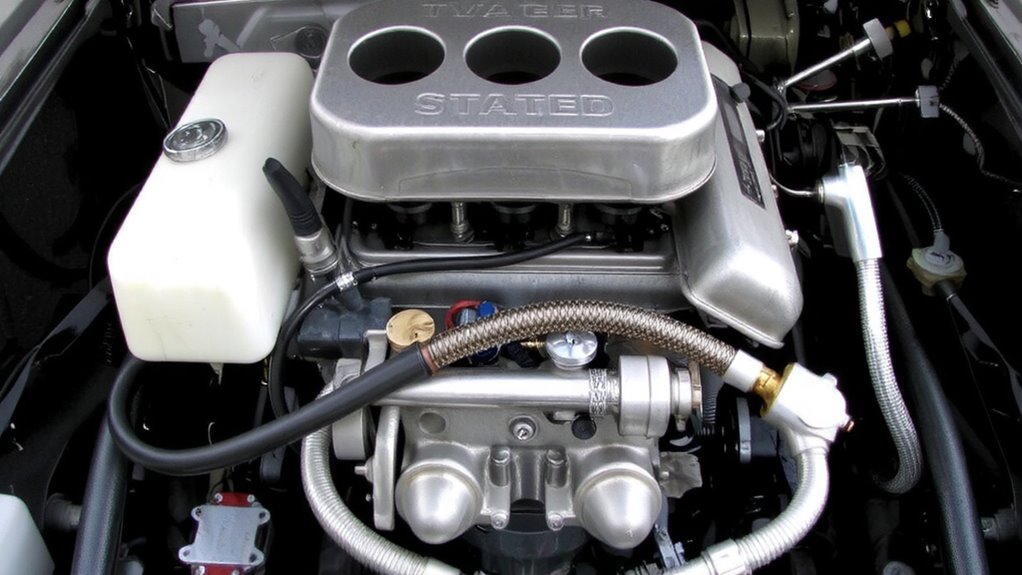
While reducing your vehicle’s center of gravity, a dry sump system lets the engine sit lower in the chassis-improving handling and stability. With no deep oil pan to restrict space, you gain critical engine clearance. This enables tighter chassis integration and improved weight distribution. Lowering the engine just 1.5 to 2 inches reduces body roll and enhances cornering responsiveness. The result is sharper turn-in and better front-end grip.
| Design Factor | Wet Sump | Dry Sump |
|---|---|---|
| Oil Pan Depth | 8–10 inches | 2–3 inches |
| Engine Mount Height | Higher | Up to 2” lower |
| Chassis Integration | Limited | Optimized |
You benefit from improved aerodynamics and suspension geometry. Engine clearance allows for custom fabrication, while chassis integration guarantees structural rigidity. These gains matter most in high-G driving where balance defines performance. Every millimeter of vertical drop translates to measurable lap-time reduction.
Why Drift Cars Rely on Dry Sump Systems
Don’t think engine position is the only reason dry sump systems dominate high-performance builds-drift cars depend on them for survival under extreme conditions. During sustained sideways action, lateral g-forces can cause oil surge in a wet sump, starving the pump inlet. Without constant oil delivery, bearing wear accelerates and catastrophic engine failure follows. A dry sump eliminates this by scavenging oil rapidly from the pan and storing it remotely. This prevents oil surge and maintains stable oil pressure at all angles. You also avoid horsepower loss-typical wet sump systems create windage and drag, robbing 10–15 hp at high RPM. Dry sumps reduce drag by keeping the crankcase nearly empty. The engine runs cleaner, cooler, and more efficiently. In drifting, where throttle control and engine response are critical, avoiding oil surge and minimizing horsepower loss isn’t optional-it’s fundamental to survival.
Pumps, Tanks, and Lines: Dry Sump System Parts
A dry sump system’s reliability hinges on three core components: the pump, the tank, and the oil lines-each engineered to perform under stress. Your system uses a multi-stage pump-typically four to six stages-split into pressure and scavenge sections. The pressure side guarantees consistent oil delivery to bearings and journals, maintaining pressure regulation even at high RPM. The remaining stages handle oil scavenging, pulling oil from the pan and sending it to the remote tank. Your tank isn’t just storage-it allows foam to separate, regulates temperature, and includes internal baffles to prevent sloshing. Stainless steel or reinforced polymer lines connect components securely, designed to withstand constant pressure cycles. Lines typically range from -10 to -16 AN fittings, minimizing flow restriction. Every part works together-precisely tuned for maximum lubrication efficiency under extreme cornering, acceleration, or sustained drift.
Dry Sump vs. Wet Sump: Track-Ready Differences
You’re already familiar with the components that keep a dry sump system running under stress-pumps with multiple stages, remote tanks with baffles, and high-flow oil lines. Unlike wet sump systems, dry sumps store oil externally, eliminating oil surge under hard cornering or braking. Wet sumps rely on a deep oil pan, where g-forces can starve the pickup, risking lubrication loss. Dry sumps actively scavenge oil, maintaining consistent supply and reducing crankcase pressure. Lower crankcase pressure decreases windage, freeing up 10–15 horsepower in high-RPM engines. Scavenge stages pull oil from the pan within 0.2 seconds of movement, far faster than wet sump drains. Dry sumps also allow lower engine mounting, improving center of gravity. Wet sumps are simpler and cheaper but can’t handle sustained lateral loads above 1.5g. For track or drifting use, oil surge control and crankcase pressure management make dry sumps the clear performance choice.
On a final note
You gain critical performance advantages with a dry sump system. It eliminates oil starvation during high-g cornering by scavenging oil from the pan and storing it in a remote tank. The pump typically runs at 20–30 psi feed pressure and pulls a vacuum of 5–10 inches Hg in the crankcase. This setup allows a lower engine placement, reducing center of gravity by up to 2 inches. Dry sumps hold 4–8 quarts in external reservoirs, ensuring stable lubrication.