Designing Custom Halfshafts for Lifted Trucks Running Wide Tires at Highway Speeds
You need custom halfshafts when lifting your truck over 6 inches and running 35-inch tires at highway speeds. Stock units exceed 15-degree CV angles, causing harmonic vibrations and joint failure. Use chromoly steel-it handles 180,000 psi, twice the strength of mild steel. Match joints to use: CV for highway, double cardan for off-road. Precision alignment and laser-adjusted geometry prevent imbalance. Ideal length and torsional rigidity reduce wear. Discover how material, angle, and joint choice determine long-term performance.
Notable Insights
- Use chromoly steel for increased tensile strength and torsional rigidity under heavy loads from wide tires.
- Maintain CV joint angles under 15 degrees to prevent harmonic vibrations at highway speeds.
- Select hybrid CV joints to handle misalignment from lift kits and varying terrain.
- Match halfshaft length precisely to ensure correct driveline geometry and balance.
- Employ laser alignment tools and adjustable components to optimize pinion and driveline angles.
Why Stock Halfshafts Fail on Lifted Trucks
When you lift your truck, the suspension angles change, and that puts extra stress on the stock halfshafts. The increased angle exceeds the OEM design limits, usually beyond 15 degrees, causing premature wear. Vibration imbalance occurs because the joints no longer operate in sync, disturbing rotational harmony. This imbalance intensifies at highway speeds, generating harmonics that weaken components. Material fatigue sets in as the constant flexing exceeds the metal’s endurance limit. Stock halfshafts use lower-grade alloys, typically SAE 1045 steel, which lack the韧性 for extended articulation. The weakened CV joints and inner slides wear faster, leading to clicking noises and slop. Over time, microscopic cracks form at stress points, especially near the splines. These cracks grow with each drive cycle, increasing the risk of catastrophic failure. Aftermarket halfshafts use chromoly steel and precision-balanced assemblies to counter these issues.
Match Halfshaft Design to Your Driving Needs
How far do you plan to push your lifted truck-daily driving over rough terrain or crawling through rock-strewn trails? Your driving needs dictate halfshaft design. Improper axle alignment leads to accelerated wear and compromised drive dynamics. For highway use, precision CV joints and balanced shafts guarantee smooth operation. Rock crawlers need stronger u-joints and flexible joints to handle extreme angles.
| Driving Use | Joint Type | Axle Alignment Tolerance |
|---|---|---|
| Daily Commuting | CV Joint | ±0.5° |
| Off-Road Trails | Double Cardan | ±1.0° |
| Rock Crawling | U-Joint | ±2.5° |
| High-Speed 4×4 | CV with Guard | ±0.75° |
| Mixed Terrain | Hybrid CV | ±1.25° |
Custom halfshafts must match your vehicle’s lift, tire size, and intended drive dynamics. Proper alignment preserves driveline integrity.
How Lift Height and Tire Size Stress Halfshafts
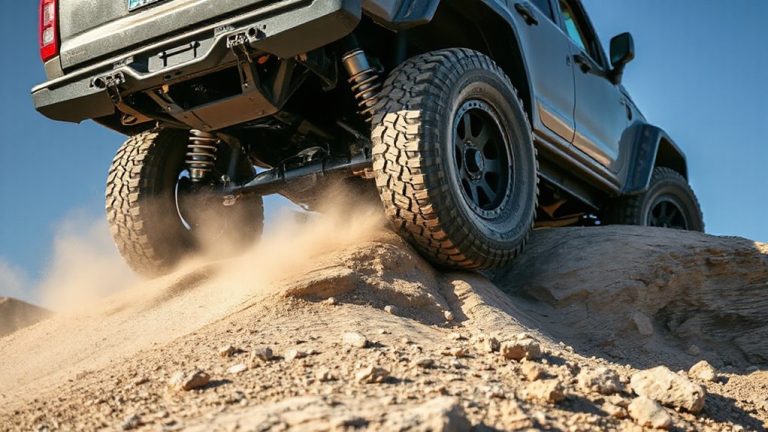
You’re asking more from your halfshafts the moment you increase lift height or install larger tires. Lift kits alter driveline angles, pushing CV joints beyond design limits. This causes increased driveline vibration, especially at highway speeds. Larger tires add rotational mass, amplifying stress on the shaft during acceleration and cornering. The extra weight and diameter also create uneven power distribution between wheels. This strains differential components and accelerates wear. Extended halfshafts needed for lift kits reduce torsional rigidity, lowering resistance to twisting under load. Reduced shaft stiffness contributes to harmonic resonance, worsening vibration. At 6+ inches of lift, driveline angles exceed 15 degrees, exceeding safe operating range for stock shafts. Wide tires increase lateral forces, transferring side-load stress to the inner and outer joints. These combined factors degrade performance, reduce component life, and compromise safety. Properly engineered custom halfshafts counteract these effects with optimized geometry and stronger materials.
Upgrade Axles and Joints for High Torque
A stronger driveline demands axles and joints built to handle amplified torque and stress. You need components with higher torque capacity to avoid premature failure. Stock axles often lack the strength for lifted trucks with wide tires, especially under hard acceleration. Upgraded chromoly axleshafts offer 30–40% more torque capacity than OEM carbon steel. Pair them with heavy-duty CV joints that maintain smooth power delivery under load. Joint articulation must remain sufficient to accommodate suspension travel without binding. High-angle CV joints allow up to 50° of articulation while maintaining full torque transfer. These joints use larger cage windows and reinforced boots to resist wear. Proper heat treatment and precision grinding guarantee durability. Together, robust axles and advanced joints handle the increased demands of off-road torque and highway performance. Never overlook torque capacity and joint articulation-they’re critical for reliability. For off-road enthusiasts pushing their vehicles to the limit, choosing best off-road axles can make a significant difference in performance and longevity.
Optimize CV Angles for Highway Smoothness
When your truck’s suspension is lifted, the increased ride height changes the angle at which your CV joints operate, and that can cause vibrations at highway speeds if not corrected. Ideal CV angles should stay under 15 degrees to maintain smooth operation. Exceeding this leads to poor cv alignment, accelerating wear and inducing harmonic vibrations. You need precise halfshaft length and joint positioning to restore proper geometry. Misaligned CVs disrupt drive balance, creating oscillations that transfer through the drivetrain. A balanced halfshaft with correct insertion depth and angle guarantees even power delivery. Use laser alignment tools or professional measuring systems to verify joint angles under loaded conditions. Aftermarket CV carriers or adjustable control arms help fine-tune the pinion and differential height. Correcting these angles isn’t just about comfort-it preserves joint life and maintains driveline integrity at sustained speeds.
Choose Chromoly or Steel for Strength and Life
Properly aligned CV joints mean nothing if the halfshaft itself can’t handle the stress of off-road abuse and increased torque loads. You need material that resists material fatigue under repeated strain. Chromoly steel offers 40% higher tensile strength than standard 1045 steel, making it ideal for heavy-duty applications. Its enhanced torsional rigidity reduces twist under load-critical when running wide tires that demand more from your drivetrain. Chromoly withstands 180,000 psi versus 90,000 psi for mild steel, doubling resistance to deformation. But chromoly costs more and requires precise heat treatment. Mild steel, while less expensive, wears faster and is prone to failure over time. For lifted trucks carrying added weight and power, chromoly’s durability guarantees longer service life. Torsional rigidity directly affects power delivery and handling response. Choose chromoly for high-torque builds; stick with steel for light-duty, budget-conscious setups.
On a final note
Your lifted truck demands stronger halfshafts. Stock units fail under extreme CV angles and increased torque from wide tires. Upgraded chromoly axles handle 1,200-plus lb-ft, outlasting standard 1045 steel. Proper CV joint angles-under 15 degrees-ensure smooth highway operation. Match spline count and shaft diameter to your lift height and tire size. Precision-balanced shafts prevent vibration. These specs aren’t optional. They’re essential for reliability, performance, and driveline integrity at speed.