DIY Undercarriage Wash to Remove Road Salt After Winter Storms
You should wash road salt off your undercarriage within 24 to 48 hours after exposure. Salt attracts moisture and speeds up corrosion, especially in high humidity. Begin with a pre-rinse using 1,200 to 2,000 PSI water pressure. Spray upward from 12 to 18 inches away, focusing on frame rails and suspension while avoiding electrical connectors. Use water between 120–140°F to dissolve salt effectively. Details on rust prevention treatments follow.
Notable Insights
- Wash your undercarriage within 24 to 48 hours after salt exposure to prevent rapid corrosion.
- Use 1,200 to 2,000 PSI pressure to effectively remove packed salt and debris from hidden areas.
- Pre-rinse with hot water (120–140°F) to dissolve salt and improve cleaning efficiency.
- Avoid spraying electrical parts and bearings directly to prevent damage during the rinse.
- Apply a wool wax-based rust inhibitor immediately after washing for lasting undercarriage protection.
Why Road Salt Ruins Your Car’s Undercarriage
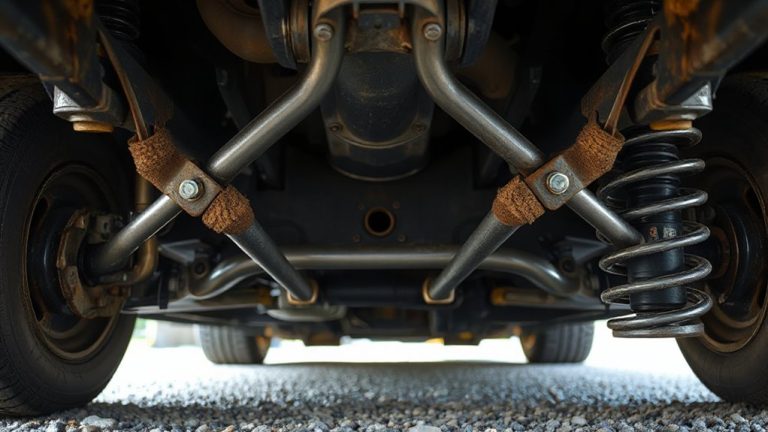
Underneath your car, the metal components face constant exposure to corrosive elements, especially in winter. Road salt accelerates metal degradation by attracting and holding moisture against exposed steel and iron parts. This electrolytic reaction begins almost immediately, compromising structural integrity over time. Without consistent corrosion prevention, critical components like control arms, brake lines, and exhaust systems are at risk. Salt lowers the electrical resistance of water, increasing ion flow and speeding up oxidation-essentially turning your undercarriage into a battery cell slowly eating itself. Factory-applied coatings degrade, leaving bare metal vulnerable. Studies show vehicles in salt-heavy regions experience up to 50% faster rust development. Corrosion isn’t just cosmetic; it weakens load-bearing parts. Preventing this requires proactive cleaning before irreversible damage occurs. You’re not just removing grime-you’re halting an electrochemical process. Routine attention stops progressive deterioration where it starts: out of sight, beneath the chassis. Regular cleaning with effective undercarriage cleaners can significantly reduce salt buildup and slow corrosion.
When to Wash Off Salt (And Why Timing Matters)
You can’t wait until spring to deal with winter’s aftermath-salt buildup demands immediate action. The best time to wash off salt is within 24 to 48 hours after exposure, especially after snow melts or road brine application. Salt accelerates corrosion, with studies showing steel degradation begins in as little as 90 minutes under high humidity. Immediate action prevents chloride ions from penetrating metal substrates. Undercarriage corrosion occurs unseen, often reaching critical levels before visible surface rust appears. Washing weekly during active winter conditions reduces corrosive residue by up to 85%. Use water at 120–140°F (49–60°C) for maximum salt solubility. High-pressure sprayers set to 1,200–1,800 psi effectively dislodge packed debris without damaging components. Timing isn’t just convenient-it’s a critical factor in preserving structural integrity and extending vehicle lifespan. Delay increases repair costs exponentially.
Prepare Your Car for an Undercarriage Rinse
Get your vehicle ready for an undercarriage rinse by parking on a flat, well-drained surface like a concrete driveway or gravel pad. This assures stability and prevents water pooling. Allow the engine to cool for at least 20 minutes to avoid thermal shock on hot components. Engage the parking brake and place wheel chocks for added safety. Remove loose debris using a brush or compressed air, focusing on wheel wells and suspension parts. Conduct a quick undercarriage inspection-look for cracks, rust, or damaged rubber bushings. Check for intact seams and weld points. Assure any existing protective coating, such as wax-based sealants or factory-applied rubberized undercoating, hasn’t peeled or degraded. A compromised coating reduces corrosion resistance. Verify that exhaust, brake, and fuel lines aren’t exposed or frayed. Clear obstructions around splash shields. Proper prep improves rinse effectiveness and extends undercarriage lifespan.
Wash Your Undercarriage at Home – Step by Step
A thorough undercarriage wash removes built-up grime, salt, and debris that accelerate corrosion and compromise critical components. Position your vehicle on a flat, well-drained surface. Begin with a pre-rinse using high water pressure-ideally 1,200 to 2,000 PSI-to dislodge packed mud and salt. Use a pressure washer with an adjustable nozzle to control spray techniques effectively. Start from the front axle and work rearward, angling the spray upward at frame rails, suspension parts, and wheel wells. Maintain a consistent distance of 12 to 18 inches from surfaces to avoid damage. Focus extra attention on seams, brackets, and enclosed sections where salt accumulates. Apply steady, overlapping passes to guarantee complete coverage. Avoid directing water at sensitive electrical connectors or bearings. Let gravity assist in flushing contaminants from hidden crevices. This method guarantees efficient, uniform cleaning without component risk.
Stop Rust After a Salt Wash
Once the undercarriage is free of salt and debris, the next step is immediate protection against corrosion. Applying a rust prevention treatment within hours of washing maximizes corrosion protection. Use a fluid film product with minimum 80% wool wax content for long-lasting coverage. Penetration depth should reach at least 0.5 mm into seams and joints where moisture hides. Reapply every 3–4 months or after heavy rain exposure.
| Treatment Type | Protection Duration |
|---|---|
| Fluid Film Spray | 90 days |
| Oil-Based Coating | 120 days |
| Wax-Gel Hybrid | 180 days |
| Epoxy Sealant | 365 days |
Each provides varying levels of rust prevention. Epoxy sealants require professional application but offer superior durability. For most drivers, a wax-gel hybrid balances ease and performance. Guarantee even coverage across frame rails, suspension components, and wheel wells.
On a final note
You’ve protected your car’s undercarriage. Delaying salt removal accelerates corrosion, especially on steel components below 0.12-inch thickness. A thorough rinse within 48 hours post-exposure cuts chloride residue by up to 90%. Use 50–60 psi water pressure at a 45° nozzle angle to reach frame rails, control arms, and brake lines. Post-wash, apply a 2-mil layer of fluid film lubricant for vapor-phase corrosion inhibition. This routine preserves structural integrity and extends vehicle lifespan.