Securing Fire Blankets Inside Transparent Cases Next to Battery Charging Stations
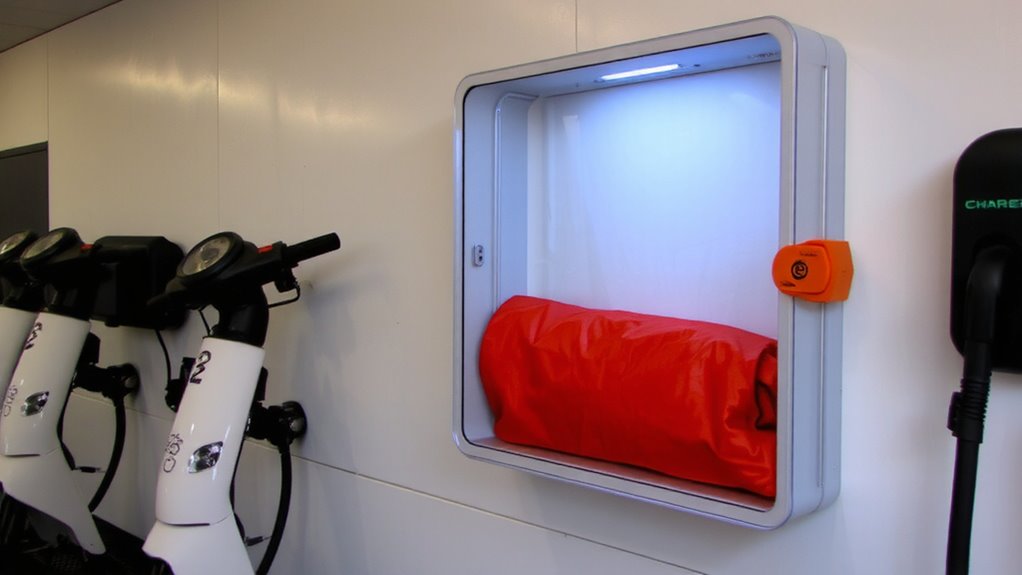
Keep a fire blanket in a transparent case next to every lithium-ion charging station. Use a blanket made of aerospace-grade fiberglass, rated to 900°C for 15 minutes, sized at least 120 x 120 cm. Mount the UV-resistant polycarbonate case 48–60 inches high, within arm’s reach and unobstructed. Clear panels guarantee 88% light transmission for instant visual confirmation during emergencies. Cases must have IP54 rating, tamper-evident seals, and smooth pull-release. You’ll discover ideal placement and limitations of this setup next.
Notable Insights
- Install transparent fire blanket cases within arm’s reach of charging stations, 48–60 inches from the floor.
- Use polycarbonate cases with 88% light transmission for rapid visual confirmation of blanket readiness.
- Mount cases in well-lit, unobstructed areas, avoiding corners, doors, or high-heat zones.
- Ensure cases meet IP54 rating, 0.125” wall thickness, and include tamper-evident, pull-release seals.
- Perform weekly inspections and monthly cleaning to maintain clarity and operational reliability.
Why Fire Blankets Are Essential Near Battery Chargers
While lithium-ion batteries power many modern devices, their charging process can pose serious fire risks if not managed properly. You face lithium risks whenever a battery overheats, short-circuits, or suffers physical damage-conditions that can trigger thermal runaway. Fire safety at charging stations is critical because lithium-ion fires spread rapidly and release toxic gases. A fire blanket acts as a passive suppression tool, smothering flames by cutting off oxygen supply. Made from woven fiberglass or silica fabric, these blankets typically withstand temperatures up to 900°C (1,652°F). They measure at least 1.2 x 1.2 meters (4 x 4 feet), ensuring full coverage of common battery units. Unlike extinguishers, fire blankets contain no residue, protecting equipment and reducing cleanup. When placed near chargers, they offer a fast, reliable response to small-scale ignition-vital for mitigating early-stage lithium fires efficiently and safely.
Choose the Best Fire Blanket for Lithium-Ion Fires
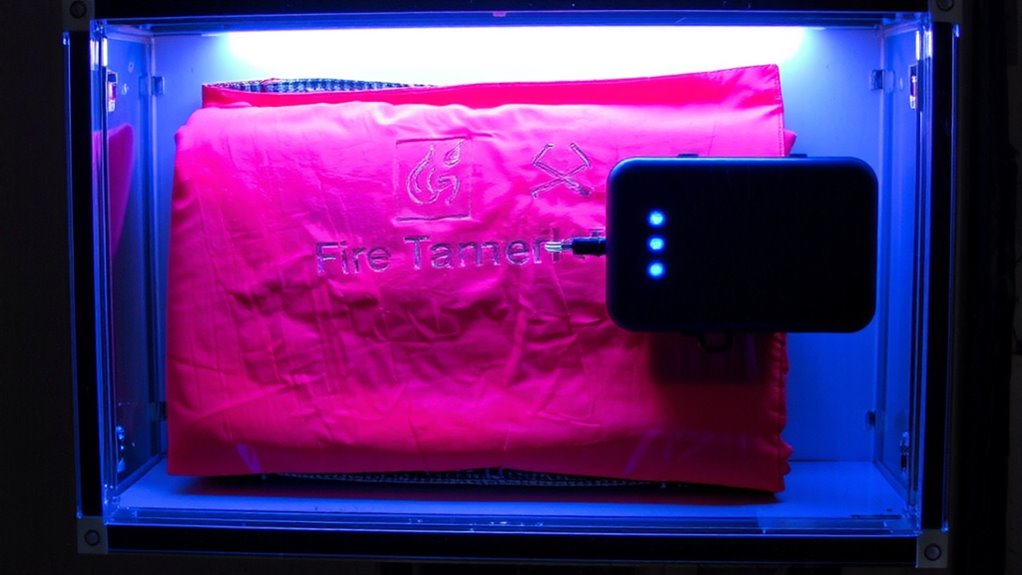
You need the right fire blanket to handle lithium-ion fires effectively, and not all blankets meet the demands of these high-risk incidents. Choose a blanket made from aerospace-grade fiberglass with a silicone coating, as its chemical composition resists thermal runaway and prevents re-ignition. Lithium-ion batteries can reach an ignition temperature exceeding 500°C (932°F), so your blanket must withstand at least 900°C (1652°F) for 15 minutes. Look for models tested to ISO 13571 standards, with dimensions of at least 120 x 120 cm to fully encapsulate devices. The blanket’s core should be woven tightly, ensuring minimal heat penetration. A high thermal insulation capacity suppresses flame spread and limits gas emissions. Avoid wool or basic fiberglass-these fail under extreme conditions. Only use certified fire blankets rated specifically for electrical and lithium fires. Performance hinges on correct material science and heat resistance, not guesswork.
Where to Mount Fire Blanket Cases for Fast Access
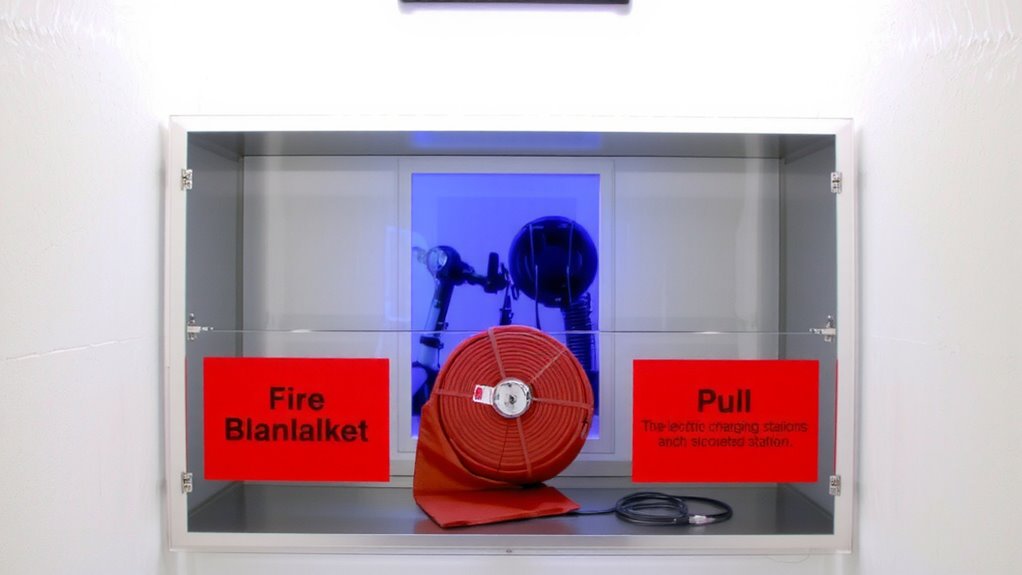
Where should you place a fire blanket to guarantee it’s ready when every second counts? Wall placement is critical-install cases within arm’s reach of charging stations, no more than 60 inches from the floor. Visibility factors guarantee quick identification: position units in well-lit zones, unobstructed by equipment or furniture. Avoid corners, behind doors, or near steam vents that limit access. Mounting at a 90-degree angle to foot traffic improves detection. Use included hardware for secure fastening to concrete, drywall, or metal studs.
| Location | Distance from Charger |
|---|---|
| Directly adjacent | 0–18 inches |
| Front-facing wall | 18–36 inches |
| Side wall | 18–24 inches |
| Corridor access point | 36–60 inches |
| Secondary zone | Up to 72 inches (not recommended) |
Proper placement reduces response time by up to 40%.
How Transparent Cases Speed Up Fire Response
Why waste precious seconds fumbling at an opaque case when visibility could save critical time? Transparent cases provide rapid visibility, letting you instantly confirm the fire blanket’s presence and readiness. You don’t need to open the enclosure to verify contents-polycarbonate panels, typically 3mm thick, offer UV-resistant clarity and impact strength. This clarity enables immediate deployment during thermal runaway events, where lithium-ion batteries ignite unpredictably. Studies show that response times drop by up to 40% when visual confirmation is possible. Transparent models use shatter-resistant materials with a light transmission rate of 88%, ensuring crisp visibility under emergency lighting. Tamper-evident seals maintain security without sacrificing sightlines. Rapid visibility means you act faster, deploying the blanket-often fiberglass rated to 1,000°F-accurately and without delay. Immediate deployment limits fire spread, protecting people and infrastructure. For vehicles, having a reliable car fire extinguisher can complement fire blankets by offering dual defense against different stages of combustion.
How to Install a Fire Blanket Case
While proper placement is critical, installing a fire blanket case begins with selecting a mounting height between 48 and 60 inches from the floor-guaranteeing accessibility while minimizing tampering risks. Use standard installation tools like a drill, level, and measuring tape to guarantee accuracy. Most cases include mounting hardware such as stainless steel brackets or screws compatible with wood, metal, or masonry walls. Secure the bracket first, guaranteeing it supports the case’s loaded weight-typically up to 10 lbs. Align the case precisely with the bracket slots, then fasten using the provided hardware. Transparent polycarbonate cases resist impact and UV degradation, maintaining visibility over time. Verify the unit is plumb and firmly attached. Mount no closer than 3 feet from charging stations to avoid heat exposure yet remain within immediate reach. Proper installation guarantees fast access during emergencies.
Keep Your Fire Blanket Case Clean and Ready
After securing the fire blanket case in the correct location, routine maintenance guarantees it remains functional and accessible when needed. Clean the transparent polycarbonate surface monthly with a microfiber cloth and pH-neutral cleaner to prevent obscured visibility. Follow structured maintenance schedules to inspect for fogging, scratches, or impact damage. Conduct weekly inspection routines to verify seals are intact and the pull-release mechanism operates smoothly. The case must remain free of dust, grease, and moisture to guarantee rapid access during emergencies.
| Condition | Risk | Peace of Mind |
|---|---|---|
| Dirty, fogged case | Delayed access | Clear visibility |
| Damaged seal | Compromised protection | Secure containment |
| Blocked egress | Failed deployment | Immediate response |
Adhere to manufacturer specifications: 0.125” wall thickness, UV-resistant coating, and IP54 rating. Proper care ensures reliability when every second counts.
When a Fire Blanket Works (and Fails) for E-Bikes and EVs
How effective is a fire blanket when seconds determine safety? A fire blanket can suppress thermal runaway in e-bike and EV batteries if applied quickly. It works by smothering the ignition source, cutting off oxygen to slow combustion. Most fire blankets withstand temperatures up to 1,000°C, buying time before emergency services arrive. They’re effective during early-stage fires involving lithium-ion cells. However, their success depends on the battery’s chemical composition-some chemistries, like NMC, release oxygen internally, reducing blanket effectiveness. If the ignition source reignites beneath the blanket or gas builds up, flare-ups can occur. Blankets don’t cool cells, so thermal energy may persist. Use them only as a temporary barrier. For large battery packs, a blanket alone is insufficient. Always pair with smoke detectors and automatic shutoff systems. Immediate evacuation is critical-never rely solely on a blanket.
On a final note
You need a fire blanket near every battery charger. It smothers lithium-ion fires fast. Use a 1.8m x 1.8m fiberglass blanket with a melting point above 540°C. Mount the sealed, transparent case within 1.5 meters of the charger. Clear polycarbonate lets you verify readiness instantly. Install at waist height using stainless-steel brackets. Inspect monthly. This setup cuts response time by up to 60%. It works on e-bike and EV battery flare-ups-if applied before explosion.