How Suspension Tuning Balances Comfort and Handling for Daily Driving
Your suspension tunes comfort and handling by balancing spring rate, damping, and sway bar stiffness. Soft springs absorb bumps but increase body roll; firm springs sharpen cornering at the cost of ride harshness. Dampers control spring motion-32–35 psi tire pressure and proper alignment (camber ±0.5°, toe ±0.15°) extend tire life and improve grip. Performance shocks with 10–20 adjustable settings optimize response. Stiffer 25 mm hollow sway bars reduce roll over standard 22 mm solid bars. The right setup keeps your ride stable on potholes and precise in turns-there’s more to discover about fine-tuning each component for your driving style.
Notable Insights
- Proper tire pressure (32–35 psi) maintains road contact, improving comfort and handling while reducing wear.
- Correct wheel alignment prevents uneven tire wear and ensures stable, predictable steering in daily driving conditions.
- Balanced spring rates, like progressive springs, absorb bumps while controlling body roll during cornering and braking.
- Dampers with adjustable compression and rebound maintain tire grip and ride smoothness over varied road surfaces.
- Stiffer sway bars reduce body roll in turns, but适度 stiffness preserves comfort on everyday uneven roads.
Why Suspension Tuning Matters for Daily Drivers
Comfort. You expect it daily, and proper suspension tuning delivers. It’s not just about soft rides-it’s about control. Maintaining correct tire pressure guarantees ideal contact with the road, typically 32–35 psi for most sedans. Incorrect pressure causes uneven wear and reduces handling precision. Wheel alignment, measured in degrees of camber, caster, and toe, keeps your vehicle tracking straight. Misalignment as slight as 0.5 degrees leads to excessive tire wear and wandering. Suspension components, like struts and bushings, degrade over time, affecting ride quality and safety. When tuned correctly, your suspension absorbs road imperfections without sacrificing responsiveness. Factory settings balance comfort and durability, but adjustments can improve performance. Regular maintenance checks on tire pressure and wheel alignment extend tire life and improve fuel efficiency. You’re not just driving-you’re supported by a calibrated system designed for real-world conditions. Ignore it, and every bump becomes a reminder.
Soft vs. Firm Springs: Comfort and Handling Trade-Offs
You’ve already seen how proper tire pressure and alignment influence ride quality and tire longevity, but the heart of your vehicle’s responsiveness lies deeper-within the springs. Spring rates determine how soft or firm your ride feels. Softer springs absorb bumps better, improving comfort on rough roads. Firm springs reduce body roll, boosting cornering precision. Your choice affects load distribution, especially when accelerating, braking, or carrying cargo. Uneven load distribution can compromise tire contact and stability. Upgrading to high-performance shocks for Jeep Wrangler can significantly enhance both comfort and handling by better managing spring motion and damping forces.
| Spring Type | Effect on Ride and Handling |
|---|---|
| Soft | Comfortable on bumps; more dive, squat, and roll |
| Firm | Sharper handling; transmits more road shock |
| Progressive | Balances comfort and control under varying loads |
| Linear | Predictable response; consistent spring rates |
| Variable | Adapts to load distribution and road conditions |
Consider your driving needs when selecting spring rates.
How Damping Balances Ride Quality and Control
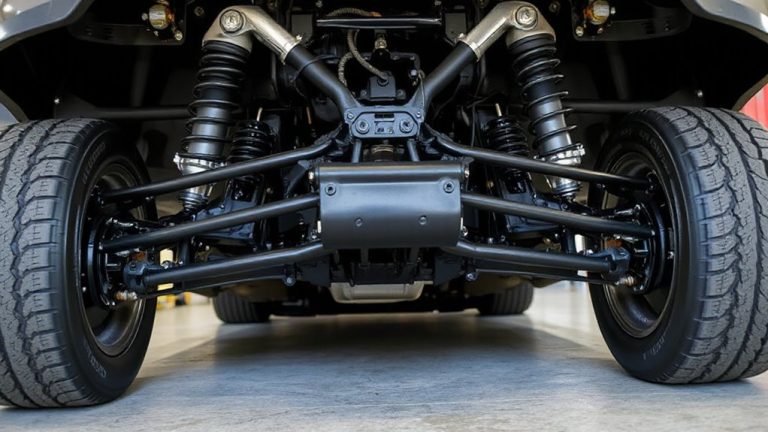
While springs manage how your vehicle supports weight and reacts to road contours, it’s the dampers that control the motion of those springs, ensuring the ride stays composed. You feel this in everyday driving when bumps don’t send your car bouncing out of control. Dampers use hydraulic fluid and adjustable valve compression settings to regulate how fast the suspension compresses. Too soft, and the car wallows; too firm, and impacts jar the cabin. Rebound control manages how quickly the suspension extends after compressing. Proper rebound control prevents the tire from losing contact with the road, maintaining grip. Performance dampers often feature 10–20 adjustable settings for both compression and rebound. Tuning these allows precise balance between comfort and handling. With the right damping, your car stays stable over potholes while remaining agile in turns. Top shock brands offer reliable performance and tunability for daily-driven vehicles.
Sway Bars and Body Roll in Everyday Driving
When you take a corner at highway speed, your vehicle’s body naturally shifts outward, transferring weight to the outside wheels-a phenomenon known as body roll. Sway bars reduce this tilt by connecting the left and right wheels, resisting independent suspension movement. Modern systems often include body roll sensors that adjust damping in real time. Stiffer sway bars minimize roll but can reduce comfort on uneven roads. The effectiveness depends on sway bar materials-most are forged steel, though high-end models use hollow alloys to reduce weight without sacrificing rigidity.
| Feature | Standard Steel Sway Bar | Performance Alloy Sway Bar |
|---|---|---|
| Diameter (front) | 22 mm | 25 mm |
| Weight | 8.6 lbs | 6.1 lbs |
| Material | Solid forged steel | Hollow chromoly alloy |
| Adjustability | Fixed | Multi-position mounting |
| Response to Sensors | Passive | Tuned for active body roll sensors |
Tuning Your Suspension for City and Highway Roads
Though comfort and control might seem at odds, tuning your suspension for both city and highway roads is about finding a precise balance between damping rates, spring stiffness, and tire compliance. You need tuned dampers that absorb potholes without inducing float on highways. Ideal spring rates-typically 150–200 lb/in for sedans-support handling while maintaining ride quality. Tire pressure plays a key role: maintain manufacturer specs, usually 32–35 psi, to balance grip, rolling resistance, and impact absorption. Incorrect tire pressure leads to uneven wear and reduced traction. You must also check wheel alignment every 6,000 miles; misaligned wheels increase drag and degrade cornering stability. Proper camber (±0.5°) and toe settings (±0.15°) guarantee responsive steering and even tire wear. Together, these adjustments deliver predictable handling on highways and compliant comfort over city bumps. Upgrading to high-performance best shocks for every ride can further enhance this balance by improving damping control across diverse road surfaces.
Budget-Friendly Upgrades for a Smoother Ride
A few well-chosen upgrades can substantially improve your ride quality without straining your budget. Start with consistent tire rotation every 6,000 to 8,000 miles to guarantee even tread wear and smoother handling. Pair this with regular wheel alignment checks-ideally twice a year-to maintain proper camber, toe, and caster angles. Misalignment increases resistance and reduces tire life by up to 30%. Upgrade to high-quality shock absorbers with velocity-sensitive valving for better bump response. Swap worn sway bar links to reduce body roll. Use strut rod bushings made from polyurethane for improved rigidity.
| Upgrade | Benefit |
|---|---|
| Tire rotation | Even wear, longer tire life |
| Wheel alignment | Improved tracking, fuel efficiency |
| Quality shocks | Reduced bounce, better control |
| Sway bar links | Less body lean in corners |
| Poly bushings | Decreased flex, sharper response |
On a final note
Your suspension tuning directly affects daily comfort and control. Softer springs, around 150 lb/in, absorb bumps but increase body roll. Firmer 200+ lb/in springs sharpen cornering yet transmit more road shock. Hydraulic dampers with 40–60% rebound control stabilize motion without harshness. Sway bars, 20–25mm front/rear, reduce lean without sacrificing compliance. Match components to driving conditions for ideal balance.